Why the Xbox Means So Little to Microsoft

Photo of Douglas A. McIntyre
By Douglas A. McIntyre Published
This post may contain links from our sponsors and affiliates, and Flywheel Publishing may receive compensation for actions taken through them.

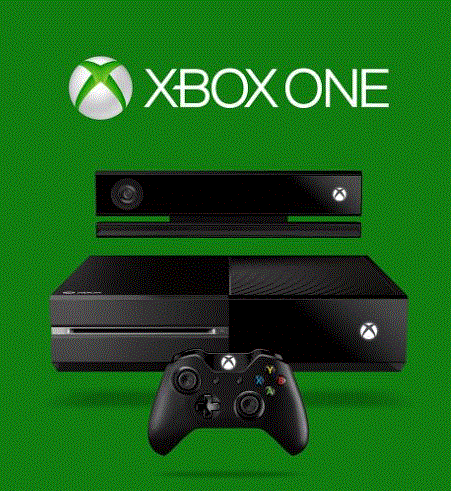
It is as if the Xbox One mattered to Microsoft Corp. (NASDAQ: MSFT) — at least financially. The world’s largest software company boasted it sold two million devices in 18 days. And in a negative note, the supply of Xbox One consoles has gotten low. So much for a huge surge in holiday sales. Whatever happens to the Xbox will have nothing to do with the success of Microsoft. The revenue it generates is so small compared to Microsoft’s big divisions that Xbox One sales are a rounding error.

In the quarter that ended on September 30, Microsoft had total revenue of $18.5 billion and operating income of $6.3 billion. Its Entertainment & Device segment, in which Xbox sales get counted, had revenue of $2.1 billion. Unfortunately, the segment posted a loss of $15 million. The segment also includes sales of other Microsoft hardware. Revenue from Skype, one of the company’s strangest acquisitions, is in there as well. Even if Xbox One is a huge success, the operating income contribution to Microsoft’s overall numbers will be modest, or less than that.

The theory behind why the Xbox One is important to Microsoft beyond revenue is a stretch. Xbox could be Microsoft’s portal into the American home. It could be used as an Internet-connected device that operates in the place of set-top boxes, PCs, Apple Inc.’s (NASDAQ: AAPL) Apple TV or the loads of other devices that sit atop American television sets.

The Xbox does have music and video services, as well as apps and a fitness program. The NFL has a programming deal with Xbox. And there are the games, which are at the heart of why most people buy consoles at all. However, none of these entertainment services is unique, and most have tremendous competition as Americans sort through whether they should have a half a dozen or a dozen devices or services to content with in whatever home entertainment centers they have.

Microsoft has had a dream that it might eventually matter in the hardware sector. That dream has been advanced by the launch of the Surface tablet and ongoing support of Windows-powered smartphones. None of these initiatives has worked very well. The Xbox is the most successful among them. At least Microsoft can boast enough Xbox unit sales to say the device is almost viable, financially.

Xbox One sales may give Microsoft some bragging rights. However, in the matter of Microsoft’s P&L, it means very little.


Photo of Douglas A. McIntyre
About the Author Douglas A. McIntyre →

Douglas A. McIntyre is the co-founder, chief executive officer and editor in chief of 24/7 Wall St. and 24/7 Tempo. He has held these jobs since 2006.

McIntyre has written thousands of articles for 24/7 Wall St. He is an expert on corporate finance, the automotive industry, media companies and international finance. He has edited articles on national demographics, sports, personal income and travel.

His work has been quoted or mentioned in The New York Times, The Wall Street Journal, Los Angeles Times, The Washington Post, NBC News, Time, The New Yorker, HuffPost USA Today, Business Insider, Yahoo, AOL, MarketWatch, The Atlantic, Bloomberg, New York Post, Chicago Tribune, Forbes, The Guardian and many other major publications. McIntyre has been a guest on CNBC, the BBC and television and radio stations across the country.

A magna cum laude graduate of Harvard College, McIntyre also was president of The Harvard Advocate. Founded in 1866, the Advocate is the oldest college publication in the United States.

TheStreet.com, Comps.com and Edgar Online are some of the public companies for which McIntyre served on the board of directors. He was a Vicinity Corporation board member when the company was sold to Microsoft in 2002. He served on the audit committees of some of these companies.

McIntyre has been the CEO of FutureSource, a provider of trading terminals and news to commodities and futures traders. He was president of Switchboard, the online phone directory company. He served as chairman and CEO of On2 Technologies, the video compression company that provided video compression software for Adobe’s Flash. Google bought On2 in 2009.

Continue Reading

Top Gaining Stocks

WAT Vol: 2,131,048
INTC Vol: 198,362,091
AKAM Vol: 8,677,900
MU Vol: 64,268,462
QCOM Vol: 34,272,223

Top Losing Stocks

HII Vol: 1,746,810
POOL Vol: 2,311,870
APTV Vol: 10,166,405
LDOS Vol: 2,252,442
PYPL Vol: 39,099,369