


For most investors especially those with a longer investing history, Intel Corporation (NASDAQ: INTC | INTC Price Prediction) presents a vision of a legacy technology giant that truly changed everything. The third largest semiconductor company in the world, Intel was started in 1968 by Silicon Valley tech legends Robert Noyce, Gordon Moore, and Andy Grove. The company created technology innovations and semiconductors that literally changed the way we live forever.
The three founders were already leaders in the Silicon Valley tech world for their work on integrated circuits, and by the 1970s, the company was producing dynamic random-access memory (DRAM), making semiconductors the standard for memory replacing magnetic core memories.
For decades the company’s semiconductors grew faster in speed and capability and Intel literally owned the space as every growth fund portfolio manager owned the shares. However, hard-charging rivals like Advanced Micro Devices and Nvidia, and some manufacturing disasters have turned the tables for the stock.
While new foundry efforts have been cited for the stock rising this year, although it’s down 15% from the 52-week high, these are 8 big reasons to avoid the shares.
The competition is stiff
Huge companies have sprinted ahead of Intel, especially in the Artificial Intelligence space. Advanced Micro Devices (NASDAQ: AMD) and Nvidia (NASDAQ: NVDA) are likely the biggest threats, with AMD competing on motherboards, servers, and other computer-related hardware. Nvidia is reportedly developing central processing units (CPUs). These rare chips power PCs. Microsoft has been nudging chipmakers not named Intel to create advanced ARM-chips.
Wall street is not a fan

For years there was not a growth mutual fund that did not have a position in Intel, as the company consistently churned out faster chips and dominated desktop and laptop applications. Not now, and Wall Street is well aware. Of the 33 banks and brokerage firms that cover the company, there are no Strong Buy ratings, 6 Buy ratings, 22 Hold or Neutral ratings, and 5 Sell ratings.
The best and brightest say hard pass

For years Intel was the employment destination of choice for the top talent in the industry. However, when much of the compensation is stock-based, who can blame talented engineers for avoiding a slow-growth company whose stock price seems trapped? Shares in AMD and Nvidia have skyrocketed over the last few years, and look to continue to trend higher, and those getting stock have profited wildly.
Capital expenditures are high

Semiconductor manufacturing comes with huge costs and big capital expenditures. The problem is those huge cap-ex costs put big pressure on margins, and is a negative, many Wall Street firms have stressed.
Altera purchase blows up
Intel spent $17 billion in 2015 to buy Altera, which was a major supplier of chips known as field programmable gate arrays, or FPGAs. The company has seen virtually no return on the investment, and according to reports, Intel doesn’t even break out their FPGA business in current earnings presentations.
Gross margins pale to competition
With gross margins considered acceptable compared to some of the competition, Intel drastically trails the competition. The 35.8% print for the second quarter trailed Nvidia’s 65%, AMD’s 46% and Broadcom’s 69.45%.
New fabs will take years to generate cash flow

Intel has announced two huge microchip fabrication plants or fabs, with one costing $30 billion in Arizona and another $20 billion facility in Ohio. This is in addition to an expected $88 billion for fabs in Europe. The sheer size and cost are staggering, and while there may be some concessions from credits and cash subsidies, with an estimated 3 years to complete construction and another year or two to generate cash flow, the task is massive.
Lastly
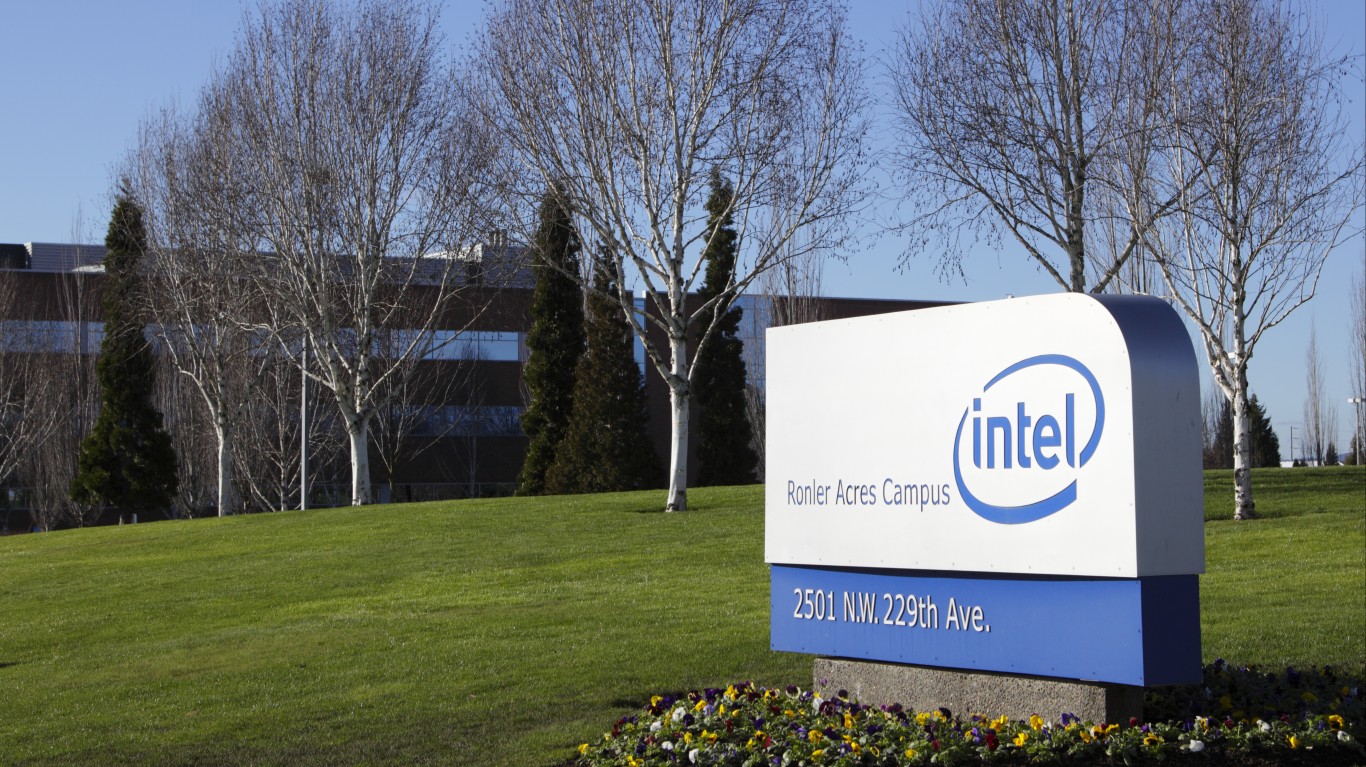
BofA Securities semiconductor analyst Vivek Arya has an Underperform rating on the shares, and has this criterion for his call.
- Our $32 price objective is based on 20x our 2024E pf-EPS ex-stock comp expense, at the low end of compute peers (15x-40x), which we view as appropriate given manufacturing uncertainties and risks of new foundry strategy.
- Upside risks to our price objective are 1) clarity or breakthrough on yields for 7nm process technology, 2) new products allowing Intel to limit share loss, 3) improving product mix which can drive upside to gross margins, 4) manufacturing slip up at key foundry competitors.
- Downside risks to our price objective are 1) weaker-than-expected trends in a mature PC market, which is the largest revenue generator for Intel, 2) further delays in 7 nanometer process technology and roadmap, 3) accelerated share loss to AMD, 4) more competition in the profitable data center market.










 Top Gaining Stocks
 Top Losing Stocks