


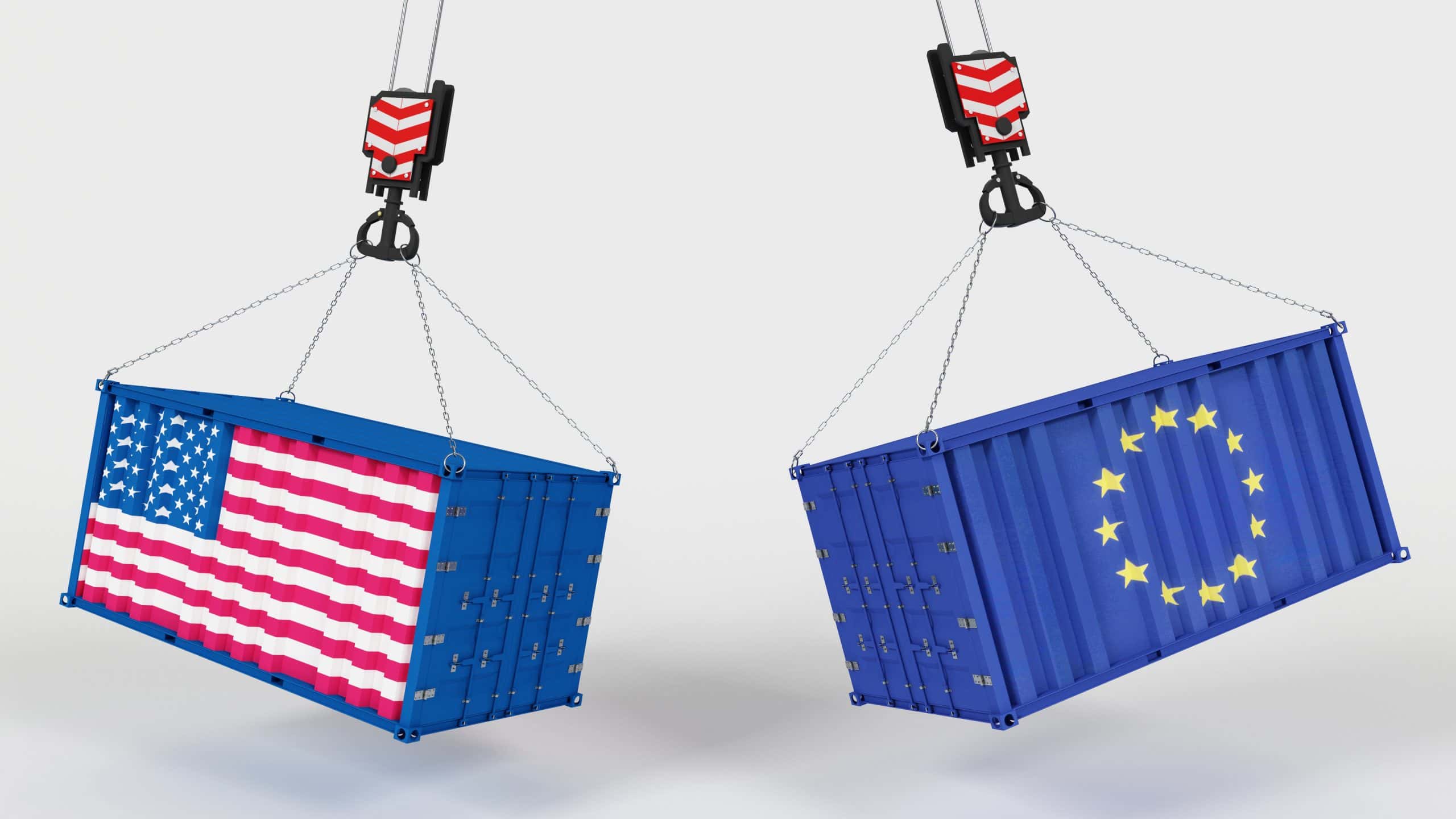
Holding All the Cards
The U.S. and EU forged a transformative $1.7 trillion trade deal this morning that zeroes in on energy, autos, and technology, particularly advanced artificial intelligence (AI) semiconductors, to the benefit of American and select multinational companies.
The Framework Agreement on Reciprocal, Fair, and Balanced Trade was announced in a joint statement that impacts a massive amount of annual transatlantic trade, with the EU bearing the bulk of the costs.
Under the terms of the framework agreement, the deal imposes a 15% tariff on most EU exports to the U.S., with exemptions for critical sectors like semiconductors, and commits the EU to $750 billion in U.S. energy purchases and $600 billion in investments by 2028.
A standout feature is the EU’s $40 billion pledge to procure U.S. AI chips for advanced computing centers, fueling demand for AI infrastructure. With the global AI chip market projected to reach $341 billion by 2032, this agreement stabilizes supply chains, encourages onshoring, and drives innovation.
While many AI chip stocks will ride this wavehigher, two companies are uniquely positioned to emerge as major winners, capitalizing on the deal’s focus on AI and semiconductors.
ASML Holding (ASML)
Dutch semiconductor equipment giant ASML Holding (NASDAQ:ASML) is exceptionally positioned to capitalize on the U.S.-EU trade deal, much as it was from the barebones agreement reached last month.
As the sole manufacturer of extreme ultraviolet (EUV) lithography machines — critical for producing advanced AI chips at 3 nanometers (nm) and below — ASML holds a technological monopoly.
The deal’s tariff exemptions for semiconductor equipment ensure cost-effective exports to U.S. foundries, such as Taiwan Semiconductor Manufacturing‘s (NYSE:TSM | TSM Price Prediction) $165 billion U.S. expansion, partly funded by the CHIPS Act. The EU’s $40 billion commitment to U.S. AI chips amplify demand for ASML’s $300 million EUV systems, as U.S. manufacturers rely on its technology to fulfill these orders.
Trading at $739 per share, ASML’s stock carries a “buy” rating or better from 25 of the 37 analysts covering the stock with a $835 per share price target, reflecting its pivotal role in the AI ecosystem.
Recent order bookings, up 30% year-over-year, signal robust demand, particularly from AI-driven foundries. Even though it is a Dutch company, the deal’s focus on supply chain resilience shields ASML from trade disruptions, while its innovation pipeline, including next-generation EUV systems, ensures long-term dominance.
As AI applications like generative models proliferate, ASML’s machines remain indispensable, driving outsized gains.
Intel (INTC)
Intel (NASDAQ:INTC) is a cornerstone of U.S. semiconductor manufacturing and is primed to thrive under the trade deal’s AI-focused framework. The EU’s $40 billion pledge to purchase U.S. AI chips directly supports Intel’s Gaudi processors and expanding foundry services, backed by $100 billion in U.S. fab investments, including an $8.5 billion CHIPS Act grant and $11 billion in loans.
The U.S. government’s recently announced plan to take a 10% stake in Intel enhances its strategic clout, potentially steering chip-purchasing decisions for government-led AI and national security projects. This stake could prioritize Intel’s chips in federal contracts, boosting its market share in high-stakes applications.
Despite a forward P/E ratio of 33, Intel’s first-quarter sales rose 9% to $12.7 billion, reflecting a recovery from prior challenges. The deal’s tariff relief and EU investments strengthen Intel’s global competitiveness, enabling it to capture a larger slice of the AI chip market.
Also, Intel’s push into AI-specific chips and its foundry partnerships with tech giants like Microsoft (NASDAQ:MSFT) further solidify its position. With onshoring incentives and government backing, Intel is set to lead the AI chip surge.
Key Takeaway
The U.S.-EU trade deal not only mitigates tariff uncertainties but also fosters a collaborative environment for AI innovation. For ASML, tariff exemptions and rising AI chip demand amplify its growth trajectory, while Intel benefits from direct EU purchases, government support, and domestic manufacturing strength.
As the AI chip market accelerates toward a $341 billion opportunity in less than a decade, these two companies are poised to gain substantially, leveraging their unique strengths to capitalize on this historic agreement.









 Top Gaining Stocks
 Top Losing Stocks