


One of the major warning signs that the US economy was in a recession was the 2022-2024 inverse yield curve for US Treasuries. In normal, healthy economic conditions, shorter maturities usually correlate with lower yields. This is due to the perception of lower near term interest rate fluctuations, since holding debt over a longer period is riskier due to unforeseen events that may occur in the future. During this inverse yield curve period, the longest in US history, confidence in the future term US economic health prospects were in doubt as a result of Bidenomics and hyper-inflation. As a result, cash was deemed more dear, since credit and payment defaults were on the rise. Translation: “Pay me now – I don’t trust the money will be there later.”
Backwardation and Contango
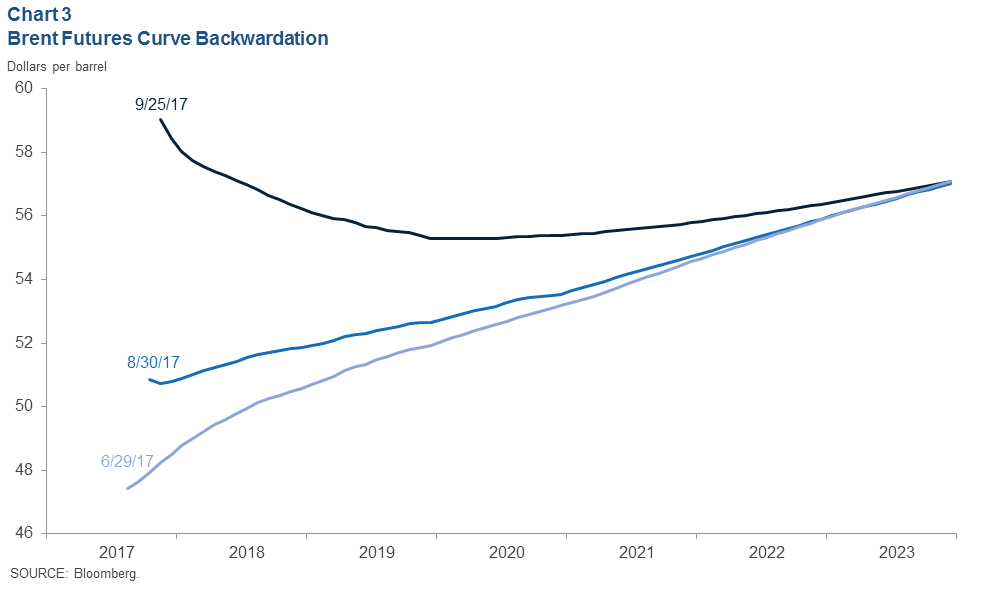
When commodities like oil or gold enter backwardation, near term prices exceed long term ones, indicating potential market instability and other threats.
In commodities, an inverse curve between spot prices and futures prices is referred to as backwardation. This is the opposite of the normal state of the markets, similar to a normal yield curve, which is referred to as contango. Higher future costs are usually associated with carrying and storage costs, among other factors. When commodity markets are in backwardation, it can indicate several concerns, which may have geopolitical reasons. Among the possibilities are:
- Global market concerns that successful deliveries on contracts may be impaired, fostering distrust in futures’
- Policy changes on the national level of various nations and their central banks are triggering large scale accumulation;
- Supply issues from producers.
- Currency debasement concerns and trends away towards reserve currency.
- Market manipulation by governments or large institutions.
Earlier this October saw the gold and silver precious metals markets enter temporarily into backwardation. Although silver entered backwardation during the 1980 Hunt Brothers’ cornering of the physical silver market and during the Covid-19 pandemic, it entered in a steeper backwardation in October – a more detailed analysis to be featured in a separate forthcoming 24/7 Wall Street.com article.
However, when gold also went into backwardation, it sent some shockwaves into the markets. Since 1972, there had been only eight (8) total days prior in which gold futures had entered into backwardation. For some, it was a chilling reality that there could be global problems with the reliability of the futures markets and that another full scale economic meltdown might be burgeoning. For others, it validated long held prognostications on the consequences from debasement of the US dollar by the Federal Reserve and other central banks steeped in fiat currency.
“Gold is Money. Everything Else is Credit” – J.P. Morgan, 1912

J.P. Morgan knew from the start that currency itself was a derivative of physical gold, which was a genuine store of value.
The history of currency devaluation is universal. Some of the most prominent historical examples include:
- The practice of Roman emperors to shave silver from their denarius coins until, over the course of 250 years, its currency contained zero silver content.
- Han Dynasty China licensed private mints led to an oversupply of lighter coins with less metal content that still bore imperial seals. These Ban Liang “elm seed” coins soon became worthless as the populace realized how the shortchanging was being put into effect.
- The French assignat was its first paper currency, created to cover the debts incurred by the Louis XVI monarchy and its profligate spending. While the rest of France was still recovering from war and faced mass deprivation, the blatant excesses displayed by Louis XVI and Marie Antoinette, combined with the worthless assignat, led to the French Revolution, ending the monarchy in 1792 with Louis XVI’s guillotine execution the following year.
- Although rarely mentioned, currency debasement played a significant role in the confederate South’s losing the U.S. Civil War. Historic letters from General Robert E. Lee to General James Longstreet during the final months of the war focused on the need for gold more than on weapons. Confederate president Jefferson Davis had debased the confederate states’ currency to such an extent that soldier salaries could not keep up with inflation.
- Since President Richard Nixon removed the US dollar from the gold standard to create the petrodollar with OPEC in 1971, the US dollar has lost over 90% of its buying power.
Backwardation – A Signal For Revaluation?

The BRICS coalition has led a major de-dollarization campaign that has escalated international transactions away from the US dollar and towards their own members’ currencies.
In 1933, President Franklin D. Roosevelt confiscated gold at $20 per oz. and revalued it overnight at $35 per oz., thus devaluing the US dollar by 69% to help reduce the mathematical debt burden created by the Great Depression.
The strong bull run surge in gold showed early signs in 2018 but exploded in 2022 and has been on a steep trajectory ever since. It’s no secret that many countries’ central banks have been on a physical gold buying binge. A confluence of geopolitical and policy factors have all been contributing drivers to boosting gold and further devaluing the US dollar. As such, a number of analysts believe that the rest of the world anticipates a US dollar revaluation.
- Foreign central banks have been net sellers of US Treasuries since 2014, and have been hoarding gold at a steady clip ever since.
- Since 2022, central bank stacking of gold has exceeded 1,000 MT per annum.
- Central banks now hold more gold than US Treasuries for the first time since 1996.
- The rise of the BRICS coalition (Brazil, Russia, India, China, South Africa) has openly fostered de-dollarization of cross-border transactions and settlement in BRICS member currencies.
- The Bank for International Settlements instituted Basel III rules in 2019 designating gold as a Tier-1 HQLA (High-Quality Liquid Asset) as of 2025.
- Forbes published an article in September by Steve Forbes exploring the possibility of Treasury Secretary Scott Bessent authorizing US Treasury bond issues that would allow the holder the option to redeem in US dollars, or in physical gold.
Potential Winners and Losers

In times of uncertainty about the future of gold and the US dollar, odds favor those holding physical gold after the dust settles.
Although the signs are present, no official announcement has been made to date, and both bond and equity markets are continuing as if no policy or economic change on the level of a US dollar revaluation is on the horizon.
That said, given that the occurrence of backwardation in the gold market is already speaking in loud volumes, investors have some choices available if they want exposure to a gold play. The smarter money is on a bullish spot market and away from futures, at least in the near term of uncertainty. Therefore, stocks and ETFs that hold or mine physical gold are clearly the safer choices for investors seeking to speculate on the future of gold and the US dollar. Among the more established securities that hold physical gold are:
- Newmont Corporation (NYSE: NEM | NEM Price Prediction)
- Barrick Mining Corp. (NYSE: B)
- SPDR Gold Trust (NYSEARCA: GLD)
- Goldman Sachs Physical Gold ETF (BATS: AAAU)
- Abrdn Physical Gold Shares ETF (NYSEARCA: SGOL)
ETFs that attempt to trade the future contracts market or attempt to create synthetic securities by using a covered call strategy against a stock or ETF it may hold faces a number of variables. For example, a covered call ETF security inevitably has its upside capped in favor of the option premium obtained for generating dividends. A sudden upward revaluation can cause the ETF to lose a major chunk of that move. Conversely, a commodity’s revaluation upward increases its futures contract commensurately. However, if the seller of the futures contract is caught in between with insufficient funds to cover the difference, delivery default risks will elevate unless those contracts are closed out before expiration. As such, these ETFs and stocks carry a higher risk factor, and investors considering them may wish to exercise greater caution.
Stocks and ETFs that deal primarily with gold futures or with synthetic dividend securities include:
- ProShares Ultra Gold (NYSEARCA: ULG)
- DB Gold Double Long ETN exp 15 Feb 2038 (NYSEARCA: DGP)
When Marco Polo brought back treasures from his Chinese explorations to Italy, the notion of Chinese paper money triggered some of the greatest skepticism and disbelief. The inherent fraud and debasement was apparent even back then. The only reason China could count on paper money at that time was because Kublai Khan enforced it under penalty of death. Venetian commerce was based on sound coinage. Since penalty of death is no longer an option in the modern world, maybe the Venetians had the right idea – Scott Bessent certainly seems to be leaning in that direction.










 Top Gaining Stocks
 Top Losing Stocks