


When Ford (NYSE:F | F Price Prediction) announced a $19.5 billion write-off on its electric vehicle business, shareholders didn’t panic. They exhaled. The stock barely flinched, trading near 52-week highs at $13.67, because investors were relieved Ford finally stopped burning cash on a battle it was never equipped to win.
The write-off represents 36% of Ford’s entire $54.5 billion market cap. That’s not a rounding error. That’s an admission that everything Ford bet on EVs was fundamentally mispriced from day one. The company has lost $13 billion on EVs since 2023 alone, with its Model e division bleeding $1.4 billion in Q3 2025. CFO Sherry House acknowledged in October that “the only practical way to improve the profitability of our Gen 1 vehicles is through one or more of the following: pricing, new cost reductions, and improved fixed cost leverage.” Two months later, Ford gave up entirely.
The Manufacturing Gap Nobody Talks About
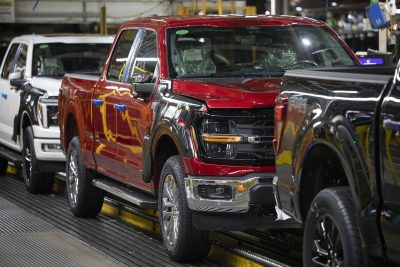
This isn’t a story about whether EVs are the future. It’s about Ford’s inability to manufacture them profitably while Tesla (NASDAQ:TSLA) treats the factory itself as a product. Tesla’s Shanghai Gigafactory just produced its 4 millionth vehicle with industry-leading efficiency, while Berlin has become Tesla’s most efficient plant globally. Ford, meanwhile, is renaming its Tennessee Electric Vehicle Center back to “Tennessee Truck Plant” to build gas-powered trucks instead.
Tesla’s market cap hit $1.63 trillion last week, 30 times Ford’s valuation, on the same day Ford announced its EV retreat. Gene Munster of Deepwater Asset Management captured it perfectly: “Ford’s retreat from EVs will benefit Tesla, making it harder for Ford to build autonomous vehicles.” Gary Black of Future Fund was more blunt: “Ford can’t make money… Ford’s pivot to hybrids is an admission that it cannot profit from launching EV brand extensions.”
Reading the Market Wrong
Just six weeks before the write-off, CEO Jim Farley sounded confident on Ford’s Q3 earnings call. He touted the company’s universal EV platform that would “start at around $30,000” and claimed “sourcing is at 95% complete now.” He promised to unveil new products in Q1. That optimism aged like milk.
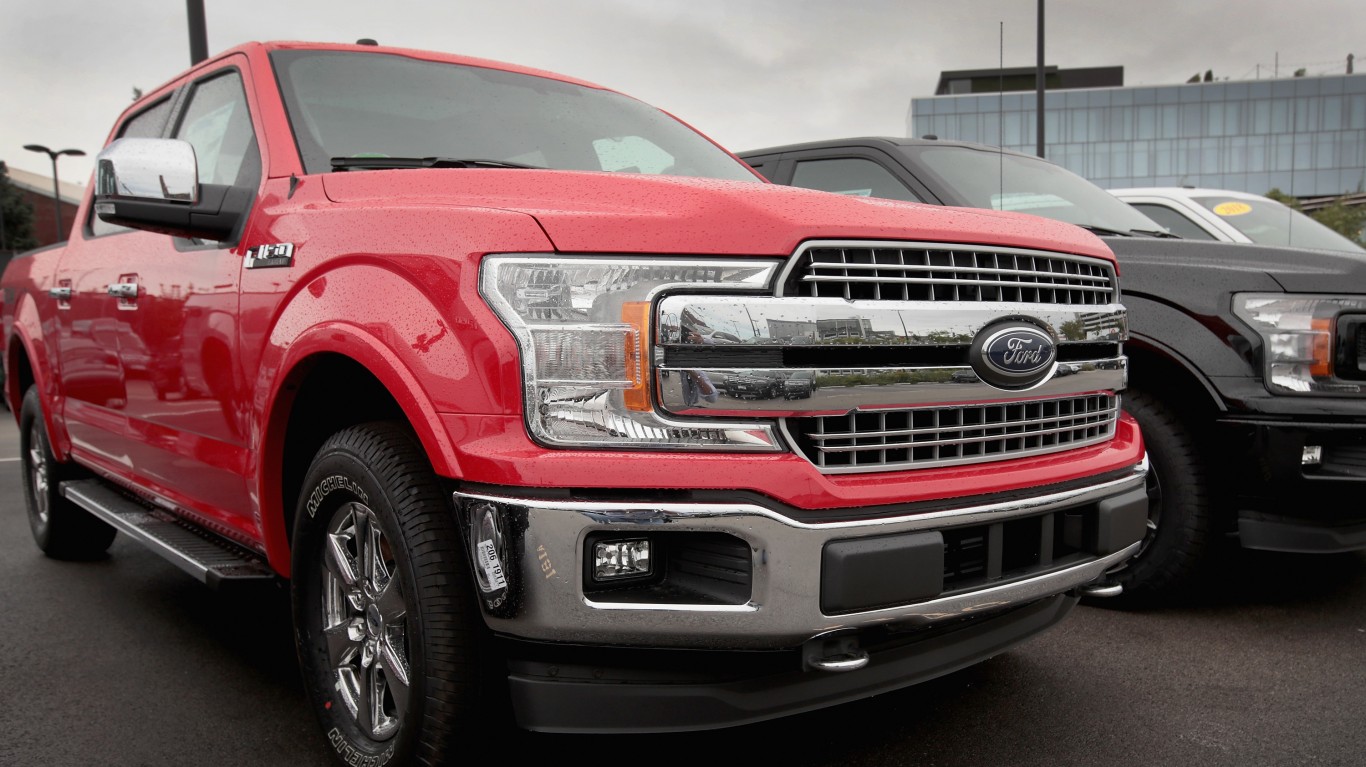
The problem wasn’t consumer demand shifting. The problem was Ford never understood what building EVs actually required. They took existing gas-powered trucks, swapped in electric drivetrains, and expected customers to pay premium prices for vehicles that cost more to make than they could sell them for. The F-150 Lightning, once the best-selling EV pickup in America, is now discontinued. Ford couldn’t fill the plant’s capacity because the economics never worked.
Everyone Else Is Struggling Too
Ford isn’t alone in its EV stumbles. General Motors (NYSE:GM) saw revenue decline 0.3% year-over-year in Q3, though it’s managing the transition better with a more credible EV commitment. Stellantis (NYSE:STLA) faces similar profitability challenges. Even Toyota (NYSE:TM) and Honda (NYSE:HMC) have been cautious about full EV commitments, hedging with hybrids.
But here’s what should terrify Detroit: the Chinese are coming. BYD, Geely, and NIO are vertically integrated manufacturers launching new EV models at a pace that makes traditional automakers look arthritic. BYD got approval for 38 new car models in China this year. Tesla got three. Ford got zero that mattered. These Chinese manufacturers are the White Walkers from Game of Thrones, and winter is coming whether Detroit is ready or not.
The Real Cost of Failure
Ford’s pivot to hybrids and “affordable EVs” sounds pragmatic, but it’s a retreat to defend shrinking territory. The company now expects 50% of its global volume to be hybrids, extended-range EVs, or full EVs by 2030. That’s not a strategy. That’s hedging every bet because you don’t know which one will pay off.
The market’s muted reaction to the write-off suggests investors see Ford as a dividend stock with 4.4% yield, not a growth company. With 2.48% profit margins and a price-to-sales ratio of 0.29x, Ford is priced like a company in managed decline. The $19.5 billion write-off just makes it official.
Farley said this is a “customer-driven shift to create a stronger, more resilient and more profitable Ford.” Translation: we’re retreating to what we know because we can’t compete in what’s next. Whether Ford took this write-off or not, they were never on the right track. The numbers prove it. The competition proves it. And now, finally, Ford admits it.








 Top Gaining Stocks
 Top Losing Stocks