



Most retail portfolios have quietly become single-country bets, a byproduct of years of U.S. equity dominance that left international allocations as an afterthought. Vanguard Total International Stock Index Fund ETF Shares (NASDAQ:VXUS | VXUS Price Prediction) exists to fix that. It is one of the broadest, cheapest ways to own the rest of the world, and 2026 is giving investors a concrete reason to pay attention.

What This Fund Is Actually Built to Do
VXUS tracks the FTSE Global All Cap ex US Index, a benchmark that spans developed and emerging markets across Europe, Asia, Canada, Latin America, and beyond. The fund’s objective is straightforward: measure the investment return of stocks issued by companies located in developed and emerging markets, excluding the United States. That breadth means thousands of individual holdings, so no single company or sector dominates the outcome.
The return engine is ownership in foreign businesses. Investors collect earnings growth and valuation expansion from non-U.S. companies, plus dividends those businesses pay out. The cost of accessing all of that is nearly nothing: an expense ratio of 0.05%, or 5 basis points annually. Over a long holding period, that near-zero fee structure means almost none of the fund’s return gets absorbed by costs.
In practice, retail investors have used VXUS as a core international sleeve alongside a domestic fund like Vanguard Total Stock Market ETF (NYSEARCA:VTI). Reddit’s r/investing community has discussed the fund extensively under threads like “Why I’ve been increasing my international allocation in 2026,” with the dominant themes being USD devaluation concerns and U.S. market concentration risk. One thread titled “Possibility of long term damage to US market” drew sustained engagement through late March and early April, correlating directly with bullish VXUS sentiment scores.
Does the Recent Performance Hold Up to Scrutiny?
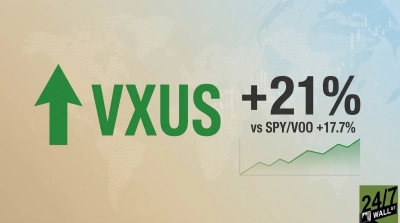
The numbers have been striking. VXUS is up 11% year to date while the domestic benchmark VTI has gained about 5% over the same period. The one-year gap is even wider: VXUS has returned roughly 41% versus about 35% for VTI. That outperformance reflects a combination of dollar weakness, cheaper international valuations, and a rotation away from U.S. mega-cap technology names.
The five-year record tells a different story. VXUS has gained about 51% over five years, while VTI has returned roughly 61%. The long-run underperformance of international equities relative to U.S. stocks is real, structural, and worth sitting with honestly before assuming recent trends define the next decade.
Three Tradeoffs That Come With the Territory
- Unhedged currency exposure: VXUS does not hedge its foreign currency positions. When the dollar strengthens against the euro, yen, or pound, foreign stock gains get translated back into fewer dollars. The U.S. trade balance has been volatile, ranging from a deficit of about $31 billion in October 2025 to nearly $74 billion in July 2025, and currency movements will continue to affect unhedged international returns.
- Correlation during stress events: International diversification offers the most theoretical benefit when U.S. and foreign markets diverge. During sharp selloffs, they often fall together. The VIX spiked to nearly 34 in April 2025 and climbed back above 31 in late March 2026, both episodes where international and domestic equities declined simultaneously. The short-term diversification benefit shrinks precisely when investors most want it.
- Lumpy dividend income: VXUS pays dividends, but the schedule is irregular. Investors relying on consistent quarterly income will find the payments inconsistent, which limits its usefulness as a pure income vehicle.
VXUS works as a long-term geographic diversifier for investors who accept that the U.S. will not always lead global returns. Anyone expecting it to consistently outpace domestic equities or deliver smooth income should weigh the five-year underperformance and irregular dividend schedule against the current tailwinds of dollar weakness and cheaper international valuations.













 Top Gaining Stocks
 Top Losing Stocks