



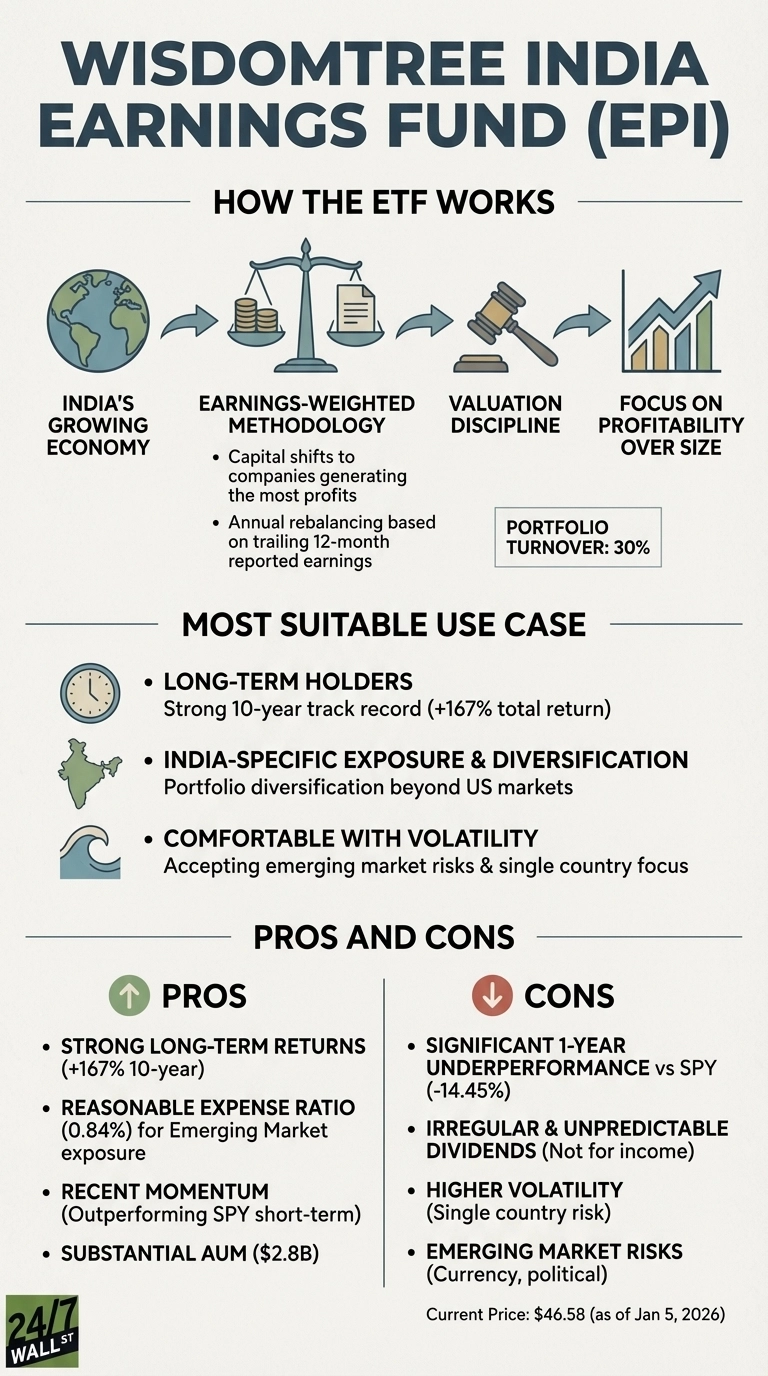
The WisdomTree India Earnings Fund (NYSEARCA:EPI) solves a key problem for investors seeking India exposure: accessing one of the world’s fastest-growing major economies without overpaying for growth stocks that may never deliver earnings. Unlike market cap weighted funds that tilt toward the largest companies regardless of profitability, EPI weights holdings by actual reported earnings.
With $2.8 billion in assets and an 18-year track record since its 2008 launch, EPI has delivered a 167% return over the past decade. But the fund gained just 3% over the past year while the S&P 500 climbed 17%. That underperformance reflects a broader challenge: foreign investors pulled a record $18 billion from Indian equities in 2025, the largest annual outflow ever recorded. The selling continued into 2026, with another $846 million leaving in just the first two trading days of January.
The Foreign Flow Problem
The biggest factor determining EPI’s 2026 performance is whether foreign portfolio investment flows reverse course. These flows directly drive demand for the stocks EPI holds, including top positions like Reliance Industries (NSE:RELIANCE) (7.7% of the fund), HDFC Bank (NYSE:HDB | HDB Price Prediction) (6%), and ICICI Bank (NYSE:IBN) (5%).
Foreign investors fled India in 2025 due to stretched valuations, a weakening rupee that fell 5% against the dollar, and concerns about potential U.S. tariffs on Indian exports. The rupee has continued weakening into 2026, trading around 90 per dollar. When foreign investors sell Indian stocks and convert rupees back to dollars, it creates a double headwind for U.S. investors in EPI.
Watch monthly foreign portfolio investment data published by India’s National Securities Depository Limited. If net foreign buying returns, particularly in the March quarter, it would signal renewed confidence and likely support EPI’s price. Catalysts that could trigger a reversal include progress on a U.S.-India trade deal, rupee stabilization, and evidence that India’s GDP growth (expected above 7% for fiscal 2026) is translating into stronger corporate earnings.
The Earnings Weighting Advantage
EPI’s earnings-weighted methodology automatically shifts capital toward companies generating the most profits. This approach has historically provided valuation discipline compared to market cap weighting, which can overweight expensive stocks simply because they’re large.
The fund rebalances annually based on trailing 12-month reported earnings, with 30% portfolio turnover. For 2026, the key factor to monitor is whether Indian corporate earnings accelerate after a disappointing 2025. Analysts expect earnings growth to improve as inflation moderates and public infrastructure spending increases.
Check WisdomTree’s quarterly fund fact sheets to track which sectors are gaining weight as earnings patterns shift. The fund’s 0.84% expense ratio is higher than broader market ETFs but reasonable for single-country emerging market exposure.
Consider the Bigger Alternative
The iShares MSCI India ETF (NYSEARCA:INDA) offers a compelling alternative with $9.6 billion in assets and a lower 0.62% expense ratio. INDA tracks a market cap weighted index rather than earnings weighting, providing broader diversification across 150+ holdings compared to EPI’s more concentrated approach. The larger asset base also means tighter bid-ask spreads and better liquidity.
The Bottom Line
EPI’s 2026 performance hinges on whether foreign investment flows return to India and whether the fund’s earnings-weighted holdings can capitalize on an expected acceleration in corporate profitability.












 Top Gaining Stocks
 Top Losing Stocks