


A lot of people look forward to retiring so they don’t have to grind away at a job. But retirement can be a surprisingly stressful period of life from a financial standpoint.
Many seniors end up struggling to cover their expenses in retirement because they rely too heavily on Social Security. But if you ask financial expert Dave Ramsey, he’ll tell you that Social Security should not be your primary source of retirement income — not even close.
The problem with relying too heavily on Social Security
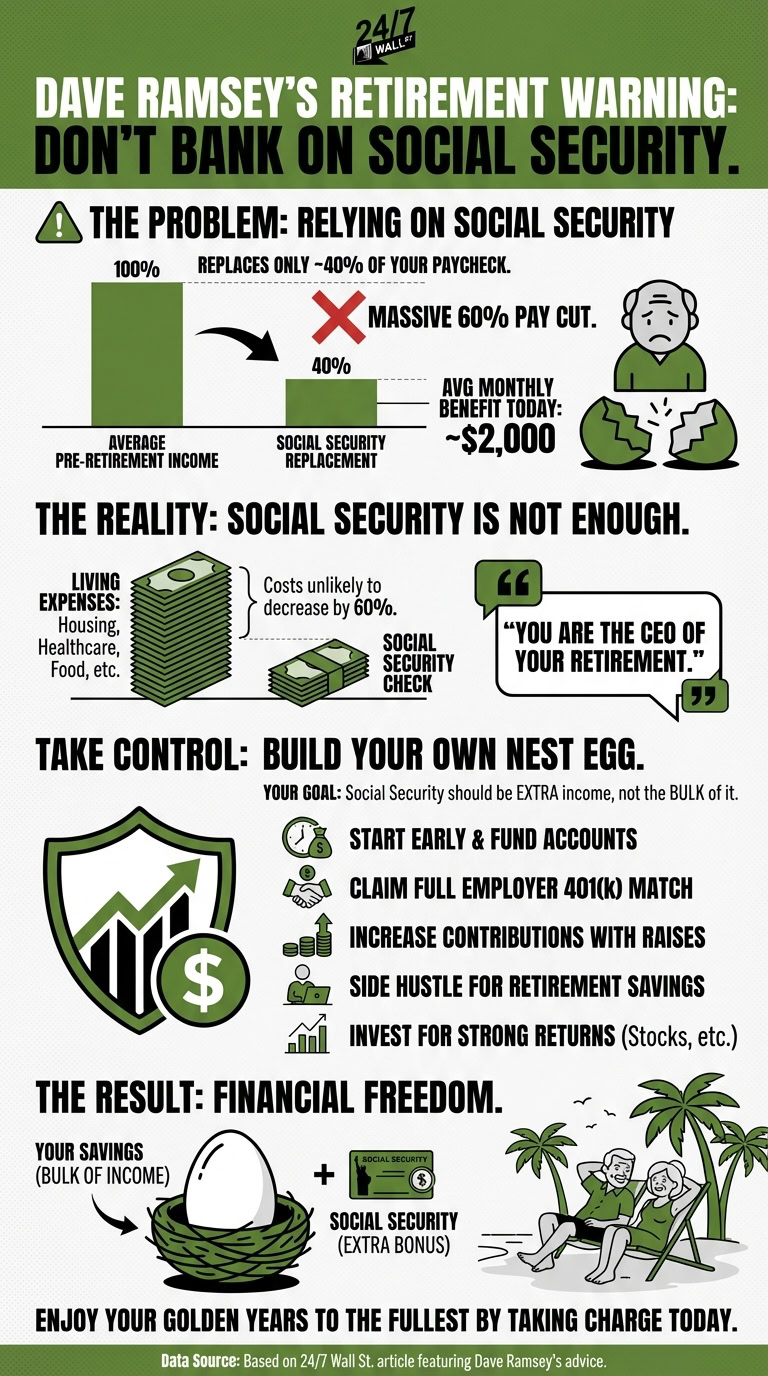
The average retired senior on Social Security today collects about $2,000 a month. But you should know that if you earn an average salary, you can expect Social Security to take the place of about 40% of your paycheck.
What this means is that if you retire on just Social Security, you’ll be looking at a 60% pay cut. And while some of your costs might go down in retirement, the likelihood of them decreasing by 60% is pretty low.
Of course, a big problem is that many people expect to get more from Social Security in retirement than what they’re actually entitled to, according to Ramsey. If you think your monthly benefits will replace almost 100% of your paycheck when, in reality, that’s not the case, you could end up in a pretty dire situation. Fortunately, though, there’s a way out of that.
Take control of your retirement
Although it’s okay to expect a monthly benefit from Social Security in retirement, Ramsey insists that you should not depend on that income too heavily. As he says, “You are the CEO of your retirement.”
What Ramsey means by this is that your ability to cover your expenses in retirement should not hinge on a monthly Social Security check. Rather, those benefits should just be considered extra. The bulk of your income in retirement should, ideally, come from money you’ve saved yourself.
To this end, your best bet is to start funding a retirement account from an early age so you can give your money time to grow. Some other ways to end up with a sizable retirement nest egg include:
- Claiming your full employer 401(k) match each year
- Increasing your 401(k) or IRA contributions every time your wages increase
- Working a side job and putting the extra money into retirement savings
- Investing in stocks and other assets that can generate strong returns
All told, the money Social Security pays you in retirement probably won’t be enough to live on. Ramsey wants people to recognize that early on so they can take control of their retirement finances and set themselves up for success.
This doesn’t mean you can’t or shouldn’t factor Social Security into your retirement income. It’s just that you should not rely too heavily on those benefits. If you set yourself up so that the bulk of your retirement income comes from your nest egg and look at Social Security as extra money, you might really manage to enjoy your golden years to the fullest.













 Top Gaining Stocks
 Top Losing Stocks