


The iShares iBonds Dec 2026 Term Corporate ETF (NYSEARCA:IBDR) offers retirees a 4.12% yield with an unusual feature: it’s designed to liquidate in December 2026, returning investors’ principal at maturity. This target-maturity structure distinguishes IBDR from traditional bond ETFs that run indefinitely.
How IBDR Generates Income
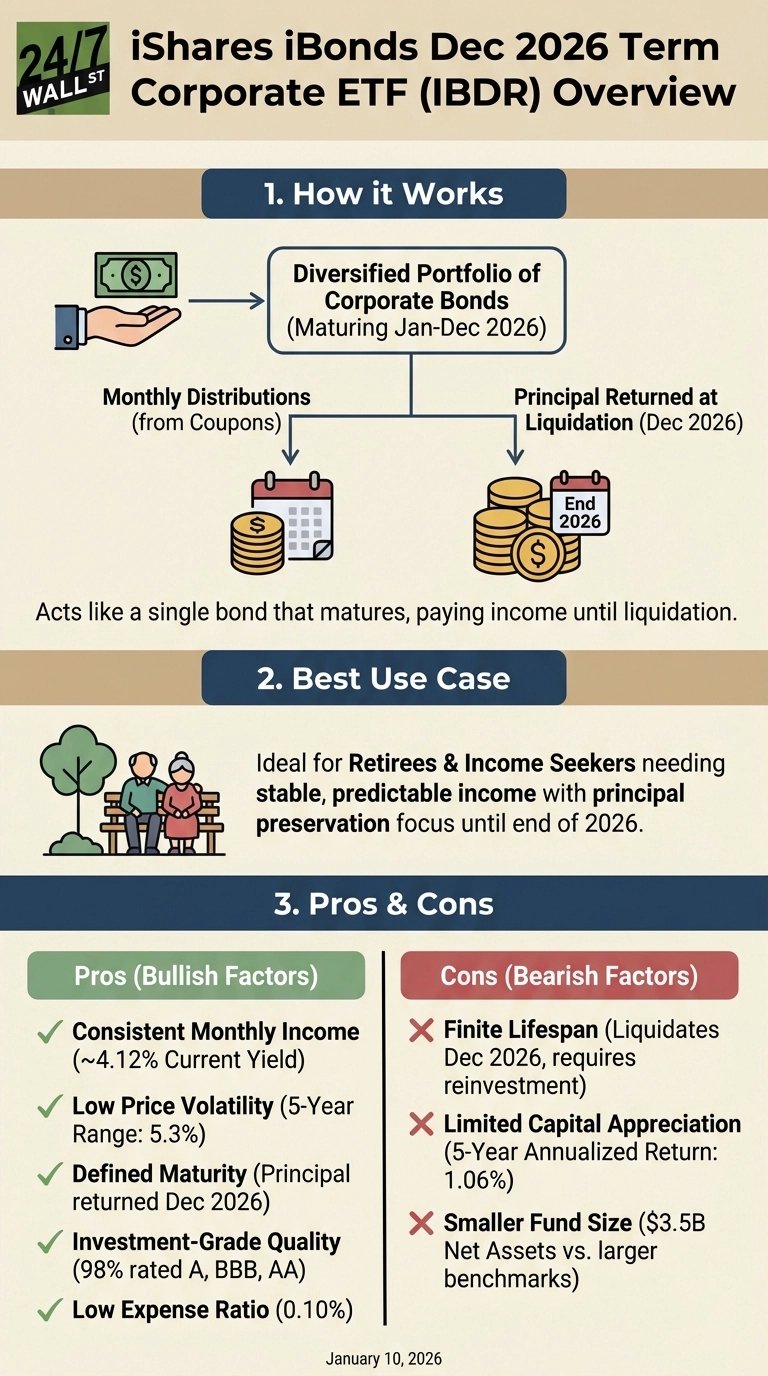
IBDR produces monthly distributions from coupon payments on its portfolio of investment-grade corporate bonds, all scheduled to mature between January and December 2026. Unlike perpetual bond funds that constantly replace maturing bonds, IBDR holds its bonds until maturity and will distribute the principal to shareholders when the fund liquidates later this year. This structure mimics owning individual bonds while providing diversification across hundreds of corporate issuers through a single ticker.
Distribution Safety and Sustainability
With less than one year until maturity, IBDR’s income stream carries minimal interest rate risk. The fund’s credit quality breakdown reveals 45% A-rated bonds, 41% BBB-rated bonds, and 12% AA-rated bonds—all investment-grade securities.
This conservative profile has supported consistent monthly payments averaging $0.084 per share throughout 2025, translating to roughly $1.01 annually.
As bonds approach maturity, credit quality typically improves since companies prioritize debt repayment, reducing default risk. The fund’s investment-grade focus provides retirees with a conservative income stream backed by established corporate issuers.
The fund’s 5-year price volatility has been remarkably low, with shares trading in a tight $23.01 to $24.23 range—just 5.3% total variation. This stability matters for retirees who cannot afford significant principal erosion. IBDR’s 1-year total return of 4.99% demonstrates that investors captured the full yield without meaningful capital loss.
However, retirees must understand this ETF’s finite lifespan. When IBDR liquidates in December 2026, investors will receive their principal back but must find a new investment vehicle. The 0.10% expense ratio is competitive, costing just $10 annually per $10,000 invested, and the 9% portfolio turnover minimizes taxable events.
Alternative: Consider IBDS for 2027 Maturity
Investors seeking a similar strategy with a longer runway should explore the iShares iBonds Dec 2027 Term Corporate ETF (NYSEARCA:IBDS). This fund mirrors IBDR’s structure but targets bonds maturing in December 2027, offering a 4.01% yield with one additional year of income generation.
IBDS maintains the same investment-grade focus and monthly distribution schedule, providing retirees an option to extend their bond ladder strategy. Like IBDR, IBDS will liquidate at maturity, returning principal to shareholders. The nearly identical yields between IBDR and IBDS reflect the current flat yield curve environment, making IBDS an efficient way to maintain income exposure beyond 2026.











 Top Gaining Stocks
 Top Losing Stocks