What Should Retirees Do With Pimco’s 7% Yield Bond ETF?

Photo of Michael Williams
By Michael Williams Published

Quick Read

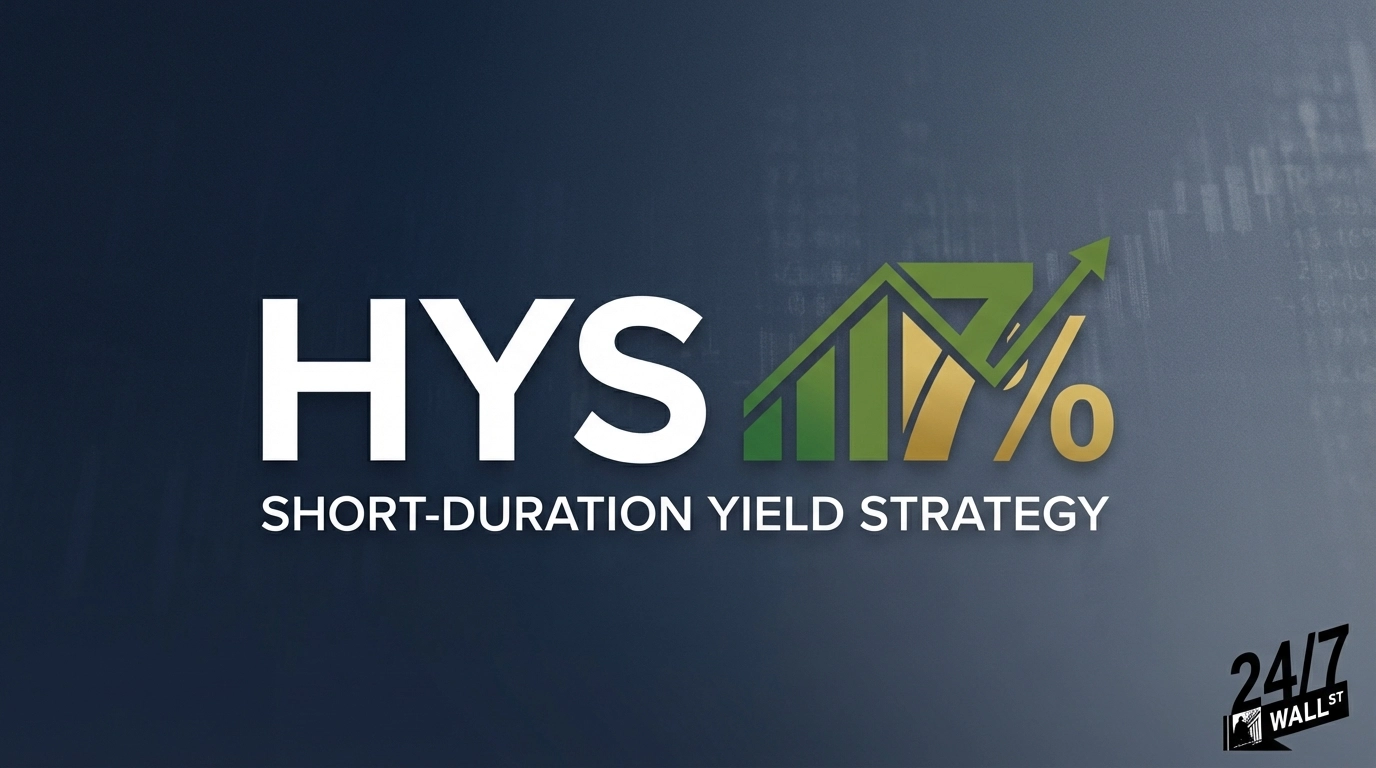
  • HYS delivers a 7.1% yield from short-term high-yield bonds while limiting interest rate risk through 0-5 year maturities.

  • The fund outperformed investment-grade bonds by 33% over five years but carries credit risk and variable monthly distributions.

  • JAAA offers a lower-cost alternative with 5.3% yield and AAA-rated CLOs at 0.20% expense ratio versus HYS at 0.56%.

This post may contain links from our sponsors and affiliates, and Flywheel Publishing may receive compensation for actions taken through them.
What Should Retirees Do With Pimco’s 7% Yield Bond ETF?

© 24/7 Wall St.

When bond yields were near zero a few years ago, retirees hunting for income had to venture into riskier territory. Now that high-yield bonds are delivering around 7% while rates remain elevated, the question shifts: is this the right kind of risk for someone living off their portfolio?

Built for Income With a Safety Net

PIMCO 0-5 Year High Yield Corporate Bond Index Exchange-Traded Fund (NYSEARCA:HYS) targets high-yield corporate bonds maturing within five years. The short duration limits sensitivity to interest rate swings. While these bonds carry credit risk (rated below investment grade), their brief maturity means more predictable pricing even when the Fed shifts policy.

The fund generates income from bond coupon payments, currently distributing around $6.80 annually per share. Based on the recent price near $95, that translates to roughly 7.1% yield.

Does It Deliver on the Promise?

With $1.5 billion in assets and a 14-year track record, HYS has proven resilient through multiple credit cycles. Over five years, HYS returned 31% while investment-grade bonds (AGG) lost 1.6%. That outperformance reflects the yield advantage of high-yield debt during a period when rate volatility punished longer-duration bonds.

The fund fulfills its mandate of delivering steady income with controlled rate risk, but retirees expecting equity-like growth will be disappointed.


The Tradeoffs You’re Accepting

Credit risk is the primary concern. High-yield bonds earn their nickname (junk bonds) because issuers have weaker balance sheets. During recessions or credit crunches, defaults rise and prices fall. The short maturity helps but doesn’t eliminate this risk.

The 0.56% expense ratio is reasonable for active management but higher than broad bond index funds. That cost compounds over time, eating into net yield. Monthly distributions vary from $0.49 to $0.62, which can complicate budgeting for those relying on consistent income.
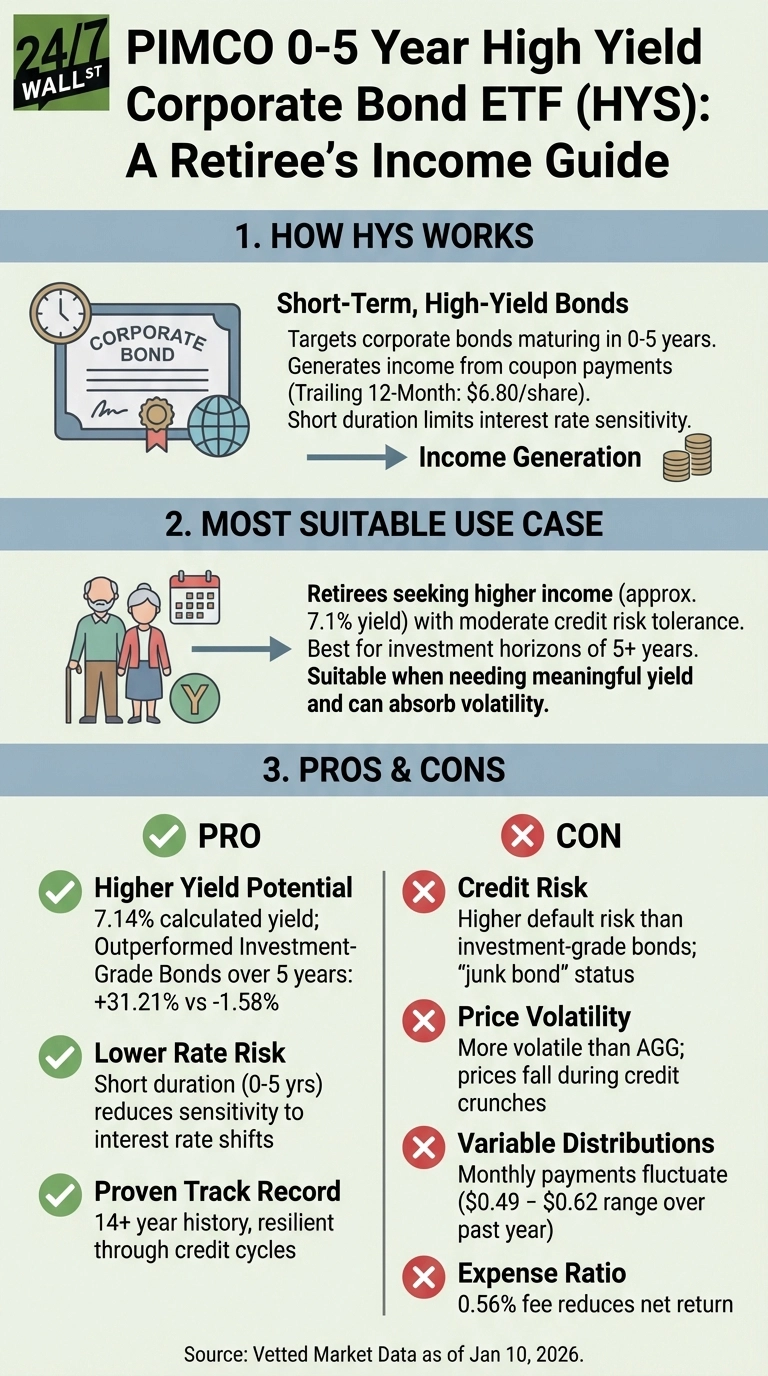
An infographic titled 'PIMCO 0-5 Year High Yield Corporate Bond ETF (HYS): A Retiree's Income Guide'. The graphic is divided into three main sections. Section 1, 'How HYS Works', explains it targets short-term, high-yield corporate bonds maturing in 0-5 years, generating income from coupon payments ($6.80/share trailing 12-month) and limiting interest rate sensitivity. It features an icon of a corporate bond certificate, a clock, a globe, and coins representing income generation. Section 2, 'Most Suitable Use Case', indicates it's for retirees seeking higher income (approx. 7.1% yield) with moderate credit risk tolerance, for investment horizons of 5+ years, and who can absorb volatility. It includes icons of an elderly couple, a calendar, and a 'Y' symbol. Section 3, 'Pros & Cons', lists three pros with green checkmarks: 'Higher Yield Potential' (7.14% calculated yield, outperformed Investment-Grade Bonds over 5 years by +31.21% vs -1.58%), 'Lower Rate Risk' (short duration 0-5 years), and 'Proven Track Record' (14+ year history). It lists four cons with red 'X' marks: 'Credit Risk' (higher default risk, 'junk bond' status), 'Price Volatility' (more volatile than AGG, prices fall during credit crunches), 'Variable Distributions' (monthly payments fluctuate $0.49-$0.62 over past year), and 'Expense Ratio' (0.56% fee). Source: Vetted Market Data as of Jan 10, 2026.
24/7 Wall St.
This infographic from 24/7 Wall St. details how the PIMCO 0-5 Year High Yield Corporate Bond ETF (HYS) works, its suitable use cases for retirees, and a comprehensive list of its pros and cons, including its 7.14% yield.

Who Should Avoid HYS

Conservative retirees who prioritize capital preservation over yield should skip this fund. The credit risk and price volatility, while muted compared to longer-duration high-yield funds, still exceed what investment-grade bonds offer.

Retirees with shorter time horizons (under five years) should also think twice. If you need to liquidate during a credit market downturn, you could face losses that erode your principal at the wrong time.

A Lower-Cost Alternative Worth Considering

The Janus Henderson AAA CLO ETF (NYSEARCA:JAAA | JAAA Price Prediction) offers a different approach to income generation. With a 5.3% yield and a 0.20% expense ratio, JAAA invests in AAA-rated collateralized loan obligations rather than junk bonds. The lower yield reflects higher credit quality, and the dramatically lower fee structure means retirees keep more of what they earn. For those willing to trade some yield for better credit ratings and lower costs, JAAA presents a compelling alternative.

HYS works best for retirees who need meaningful income, understand credit risk, and have other assets to cushion potential downturns, but the premium yield comes with volatility that not every retirement portfolio can absorb.


Photo of Michael Williams
About the Author Michael Williams →

I am a long time investor and student of business, and believe finding good companies that can become great investments is the best game on earth. After 20 years of writing and researching the public markets it is clear that individuals have never had more tools and information to take control of their financial lives. From ETFs and $0 commissions to cryptos and prediction markets there has never been a greater democratization of access to investing. 

I write to help people understand the investments available to them so they can make the best choice for their portfolio, whether they're starting out or looking for income in retirement. 

Featured Reads

Our top personal finance-related articles today. Your wallet will thank you later.

Continue Reading

Top Gaining Stocks

CBOE Vol: 1,568,143
PSKY Vol: 12,285,993
STX Vol: 7,378,346
ORCL Vol: 26,317,675
DDOG Vol: 6,247,779

Top Losing Stocks

LKQ
LKQ Vol: 4,367,433
CLX Vol: 13,260,523
SYK Vol: 4,519,455
MHK Vol: 1,859,865
AMGN Vol: 3,818,618