



SPDR Bloomberg High Yield Bond ETF (NYSEARCA:JNK | JNK Price Prediction) isn’t actually invested in junk. Despite its nickname referencing below-investment-grade corporate bonds, this State Street ETF has delivered consistent monthly income to investors for over 18 years. With a current yield around 6.5% and $7.7 billion in assets, JNK appeals to retirees seeking reliable income without picking individual bonds.
How JNK Generates Its 6.5% Yield
JNK produces income by tracking the Bloomberg High Yield Very Liquid Index, which holds hundreds of below-investment-grade corporate bonds. These bonds pay contractual interest that flows through to shareholders as monthly distributions. Unlike stock dividends that depend on management decisions, bond interest is legally obligated, giving retirees predictable income streams.
The ETF’s monthly payments have remained remarkably consistent, demonstrating the stability that comes from diversified bond portfolios. This consistency matters for retirees budgeting around fixed income streams.
Evaluating Distribution Safety
The creditworthiness of JNK’s underlying borrowers has improved dramatically over the past year. Credit spreads measure the extra yield investors demand for taking on default risk, and these spreads have compressed to just 2.74% as of January 2026. This represents near two-decade lows, signaling that bond market participants see minimal default risk ahead despite economic uncertainties. The tight spread environment reflects strong corporate balance sheets and supports the sustainability of JNK’s distributions.
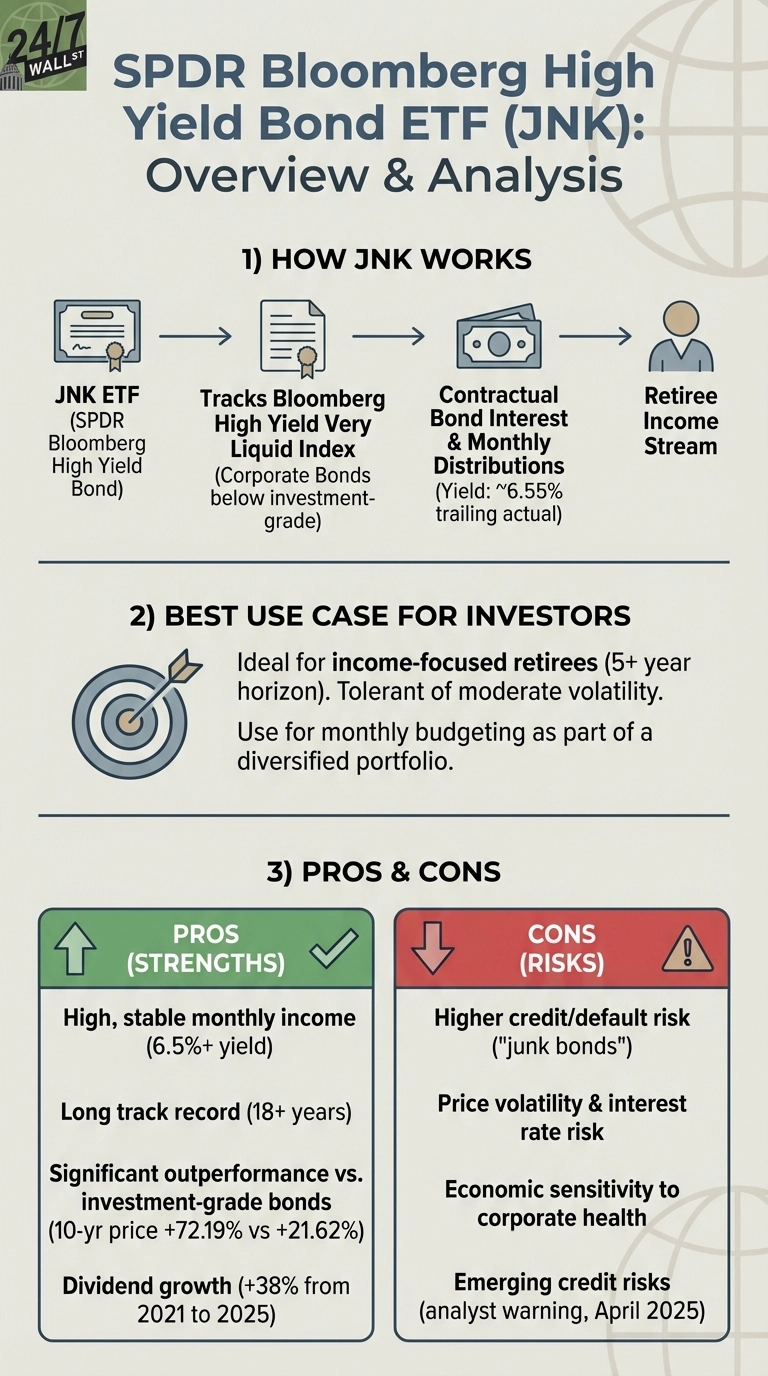
JNK’s distribution has climbed significantly as interest rates rose. Higher rates mean newer bonds in the portfolio carry bigger coupons, which flow through as larger payments to shareholders. However, some analysts warn that economic headwinds like tariff pressures could eventually stress corporate borrowers.
The total return picture strengthens the safety case for income-focused investors. Over the past decade, JNK has combined steady income payments with meaningful price appreciation, delivering annualized returns of 8.8%. This performance reflects both the contractual interest payments from high-yield bonds and capital appreciation as credit conditions improved. The dual benefit demonstrates that high-yield bonds can provide both income and growth, addressing retirees’ dual needs for cash flow and portfolio preservation while compensating for the additional credit risk inherent in below-investment-grade securities.
The Bottom Line on Distribution Safety
JNK’s distributions appear sustainable given tight credit spreads and the fund’s 18-year track record through multiple crises. Retirees comfortable with modest bond price volatility will find the monthly 6.5% yield attractive. The combination of contractual bond interest, diversified holdings across hundreds of corporate borrowers, and current low default risk indicators suggests the fund can maintain its income stream even if economic conditions soften moderately.








 Top Gaining Stocks
 Top Losing Stocks