


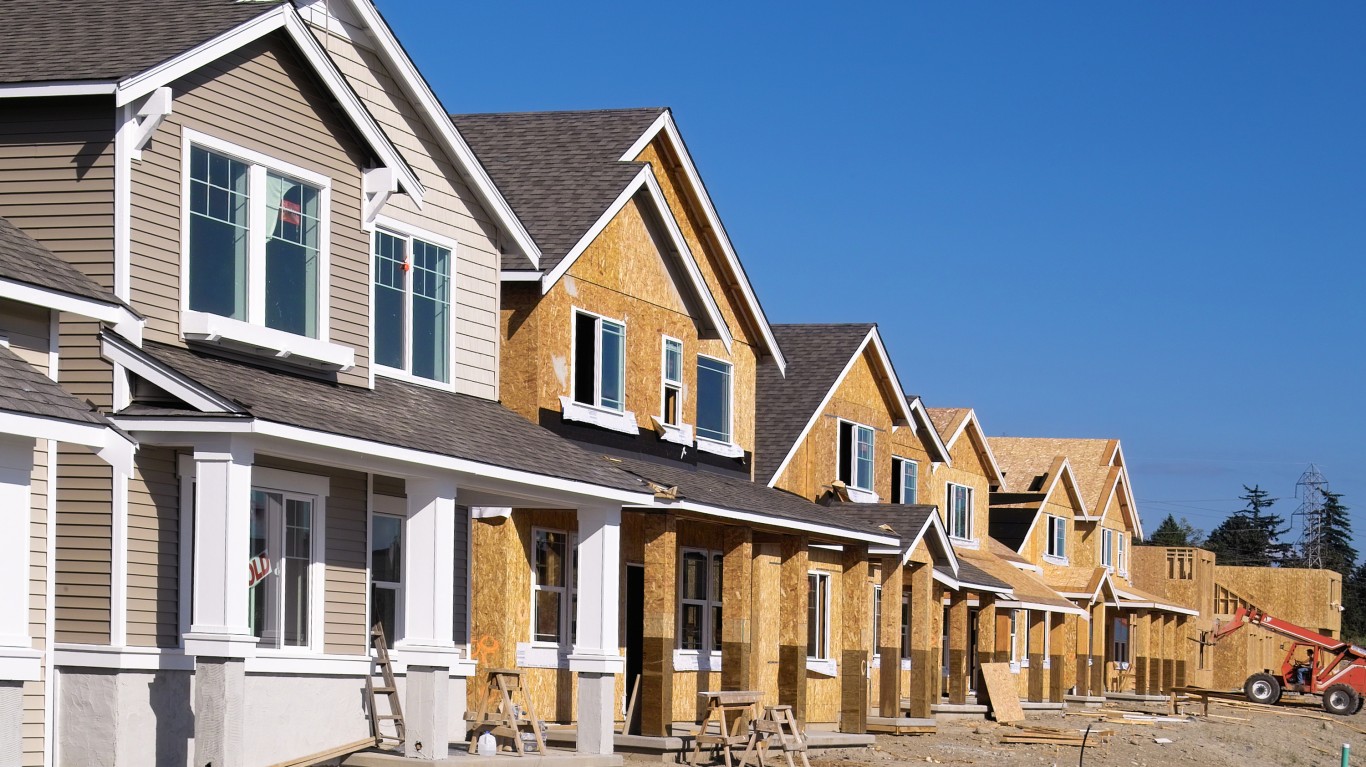
Simpson Manufacturing (SSD) trades at $187.78 after a 16.5% surge to start 2026, putting it within striking distance of its 52-week high of $197.12. The company spent $100 million buying back shares in 2024 while earnings fell 13%. That’s the tension: Is management buying low on a housing recovery, or throwing good money after bad?
The bull case starts with the business itself. Simpson makes the unglamorous connectors and fasteners that hold buildings together, structural products with sticky relationships to contractors and builders. When housing construction picks up, Simpson’s revenue follows. The company posted $623.5 million in Q3 2025 revenue, up 6.2% year-over-year, with operating margins holding at a robust 20.4%.
Polymarket prediction markets show 58% probability that U.S. median home values will exceed $418,000 by February 2026, up from current levels. That’s real money betting on housing strength. KB Home beat earnings estimates in Q4 2025, posting $1.92 per share against $1.81 expected. The housing data suggests demand is stabilizing after the mortgage rate shock of 2023-2024.
Here’s where it gets interesting: Simpson generated $338 million in operating cash flow in 2024 and spent $180 million on capital expenditures, leaving $158 million in free cash flow. The $100 million buyback was fully funded from operations, no debt required. In fact, the company reduced debt by $261 million in 2024 while simultaneously returning $146.5 million to shareholders through buybacks and dividends. That’s financial discipline, not desperation.
But the bear case has teeth. Annual earnings per share peaked at $8.80 in 2023 and have fallen for two consecutive years, landing at $6.66 in 2025. That’s a 24% decline from peak. The company is buying back shares while earnings contract, which raises the obvious question: Are they buying at inflated valuations?
The valuation math matters here. Simpson trades at 22.87 times trailing earnings, a slight discount to peer Illinois Tool Works at 25.38 times. But ITW’s earnings fell 28% year-over-year in its most recent quarter, suggesting the industrial/construction sector faces headwinds. Simpson’s Q3 2025 earnings of $2.33 per share missed analyst estimates of $2.34, the first miss in fiscal 2025 after strong beats in Q1 and Q2.
The housing recovery thesis depends on whether 2023 was peak cycle or temporary plateau. If housing stabilizes at current elevated prices and construction activity picks up as mortgage rates moderate, Simpson’s 16% historical EPS growth rate could reassert itself. The buyback would look smart in hindsight.
If housing rolls over or stays flat, Simpson is repurchasing shares at 23 times earnings while profits decline. That’s value destruction, not creation. The next catalyst is D.R. Horton’s earnings on January 20, which will provide fresh housing market signals. Until then, Simpson sits in the tension between capital allocation confidence and fundamental deterioration.













 Top Gaining Stocks
 Top Losing Stocks