
Social Security Faces 24% Benefit Cut in 2032 Without Congressional Action

Photo of Austin Smith
By Austin Smith Published

Quick Read

  • Johnson & Johnson (JNJ) and Procter & Gamble dividend growth averaged 5% annually. Social Security’s 2026 COLA rose just 2.8%.

  • A $350,000 Procter & Gamble position generates roughly $10,000 in annual dividends with six decades of consistent growth.

  • Charles Schwab platforms provide retirees control over timing and allocation unavailable in Social Security’s fixed benefit structure.

This post may contain links from our sponsors and affiliates, and Flywheel Publishing may receive compensation for actions taken through them.
Social Security Faces 24% Benefit Cut in 2032 Without Congressional Action

© 24/7 Wall St.

Social Security faces a fundamental problem that millions of Americans will soon confront directly. The program’s retirement trust fund is projected to deplete by late 2032, just seven years away, according to estimates from the Social Security Chief Actuary. When that happens, the law requires an automatic 24% benefit cut across the board unless Congress acts first.

The average retiree’s monthly check of approximately $2,071 represents their primary income source in 2026. When the trust fund depletes in 2032, that dependence becomes dangerous—the automatic 24% benefit cut would slash annual income by nearly $6,000, forcing difficult choices about healthcare, housing, and basic expenses. This vulnerability stems from Social Security’s structure as a defined benefit plan that depends entirely on political decisions rather than individual control.
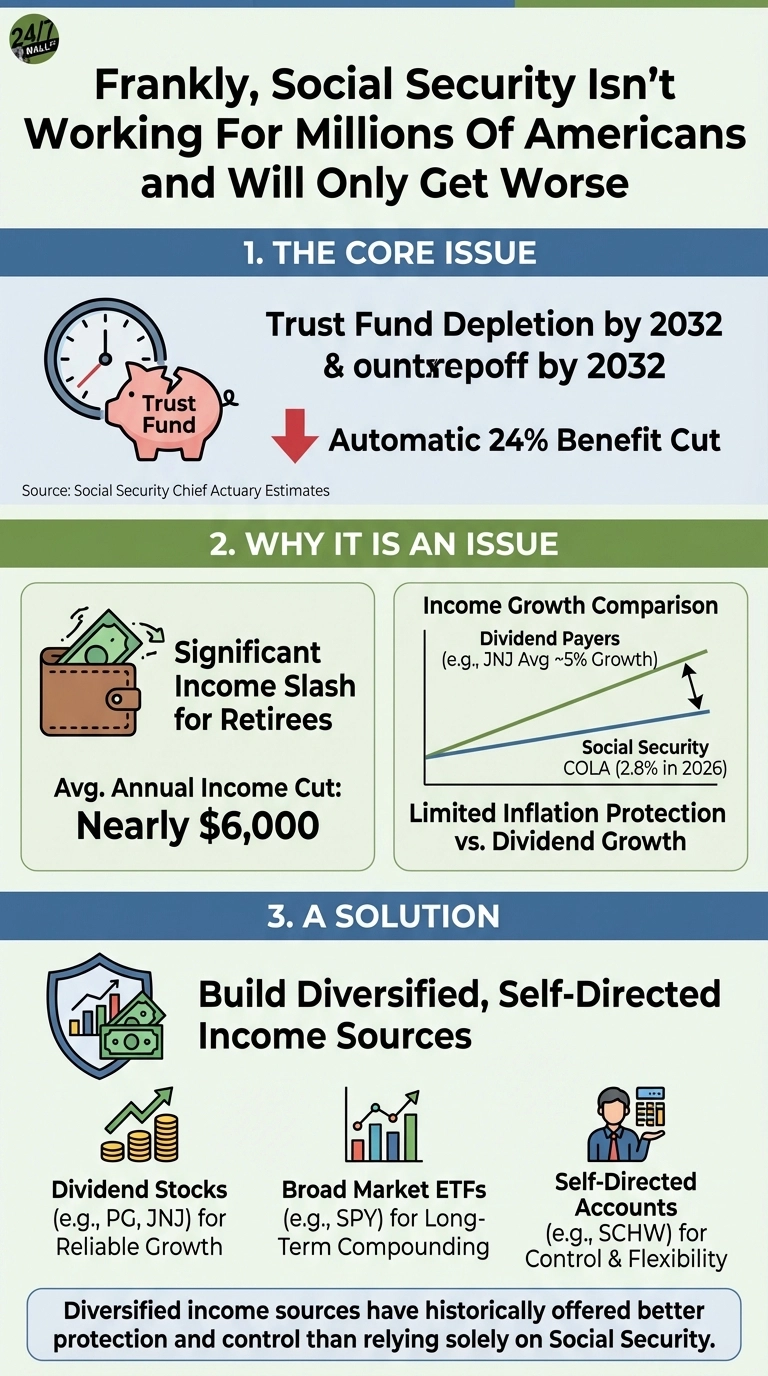
An infographic titled 'Frankly, Social Security Isn't Working For Millions Of Americans and Will Only Get Worse' is presented with a blue header and light green content sections. Section 1, 'THE CORE ISSUE,' displays a clock next to a broken piggy bank labeled 'Trust Fund,' with text indicating 'Trust Fund Depletion by 2032' and an 'Automatic 24% Benefit Cut.' The source is 'Social Security Chief Actuary Estimates.' Section 2, 'WHY IT IS AN ISSUE,' has two content boxes. The first shows a wallet with money flying out and text 'Significant Income Slash for Retirees' and 'Avg. Annual Income Cut: Nearly $6,000.' The second box contains an 'Income Growth Comparison' line graph, showing 'Dividend Payers (e.g., JNJ Avg ~5% Growth)' with a green line above 'Social Security COLA (2.8% in 2026)' with a blue line, along with text 'Limited Inflation Protection vs. Dividend Growth.' Section 3, 'A SOLUTION,' is titled 'Build Diversified, Self-Directed Income Sources.' It presents three icons: a shield with graphs and money for 'Dividend Stocks (e.g., PG, JNJ) for Reliable Growth,' a bar chart with an upward arrow for 'Broad Market ETFs (e.g., SPY) for Long-Term Compounding,' and a person at a desk with a calculator for 'Self-Directed Accounts (e.g., SCHW) for Control & Flexibility.' A concluding statement at the bottom reads, 'Diversified income sources have historically offered better protection and control than relying solely on Social Security.'
24/7 Wall St.
With the Social Security Trust Fund projected to deplete by 2032 and benefit cuts looming, this infographic highlights the importance of diversified income sources like dividend stocks and ETFs for retirement security.
 

Why the Current Structure Creates Risk

The 2026 cost-of-living adjustment illustrates a deeper issue. Benefits increased just 2.8% this year, barely keeping pace with essential expenses. Meanwhile, established dividend payers like Johnson & Johnson and Procter & Gamble have grown their payouts at rates averaging around 5% annually, demonstrating how different income sources have performed historically in protecting purchasing power over time.


The difference matters because defined benefit plans like Social Security lack flexibility. Recipients cannot control when benefits start without permanent reductions, cannot adjust for individual circumstances, and face political risk with every budget cycle. Financial advisors note that retirees with self-directed retirement accounts have adaptability that a government program cannot match.

How Different Income Sources Compare

Dividend income provides a different kind of security than government benefits. A retiree who built a $350,000 position in Procter & Gamble receives roughly $10,000 annually in dividends that have grown consistently for over six decades, demonstrating how private income streams have historically provided inflation protection that government adjustments have not matched.

Broad market exposure offers a different wealth-building approach than fixed income. The S&P 500 ETF has delivered substantial long-term returns, demonstrating how equity ownership compounds wealth over decades. While the current yield appears modest at around 1%, the total return over time has historically provided accumulation that fixed benefits cannot match.

The fundamental issue is that Social Security was designed for a different demographic reality. Longer lifespans and fewer workers per retiree create mathematical challenges no COLA adjustment can solve. Self-directed accounts through platforms like Charles Schwab give retirees control over asset allocation, withdrawal timing, and investment selection—flexibility that becomes critical when government benefits face uncertain futures.

Social Security will likely continue in some form, but relying on it exclusively means accepting whatever benefits politicians decide to provide. The data shows that retirees with diversified income sources have historically experienced different outcomes than those relying solely on Social Security’s fixed payments.


Photo of Austin Smith
About the Author Austin Smith →

Austin Smith is a financial publisher with over two decades of experience in the markets. He spent over a decade at The Motley Fool as a senior editor for Fool.com, portfolio advisor for Millionacres, and launched new brands in the personal finance and real estate investing space.

His work has been featured on Fool.com, NPR, CNBC, USA Today, Yahoo Finance, MSN, AOL, Marketwatch, and many other publications. Today he writes for 24/7 Wall St and covers equities, REITs, and ETFs for readers. He is as an advisor to private companies, and co-hosts The AI Investor Podcast.

When not looking for investment opportunities, he can be found skiing, running, or playing soccer with his children. Learn more about me here.

Featured Reads

Our top personal finance-related articles today. Your wallet will thank you later.

Continue Reading

Top Gaining Stocks

CBOE Vol: 1,568,143
PSKY Vol: 12,285,993
STX Vol: 7,378,346
ORCL Vol: 26,317,675
DDOG Vol: 6,247,779

Top Losing Stocks

LKQ
LKQ Vol: 4,367,433
CLX Vol: 13,260,523
SYK Vol: 4,519,455
MHK Vol: 1,859,865
AMGN Vol: 3,818,618