Credit Card Debt Hits $7,886 per American as 23% Rates Keep Balances Growing

Photo of Austin Smith
By Austin Smith Published

Quick Read

  • Average American cardholder owes $7,886 with credit card interest rates near 23%.

  • Issuer margins prevent Fed rate cuts from lowering credit card APRs for consumers.

  • Minimum payments of 1-3% go mostly to interest, requiring decades to eliminate balances.

This post may contain links from our sponsors and affiliates, and Flywheel Publishing may receive compensation for actions taken through them.
Credit Card Debt Hits $7,886 per American as 23% Rates Keep Balances Growing

© 24/7 Wall St.

Credit card debt has reached crisis levels, with the average American cardholder now owing $7,886. When combined with interest rates near 23%, this creates a situation where monthly interest charges consume most payments, making it nearly impossible to reduce the actual balance owed.

Why Credit Card Rates Stay High When the Fed Cuts

The Federal Reserve cut rates multiple times throughout 2025, yet credit card holders haven’t seen meaningful relief. The reason is simple: while the prime rate dropped to 6.75%, card issuers maintain substantial margins that keep total APRs near 23%. These issuer margins act as a buffer that prevents Fed rate cuts from translating into lower costs for consumers.


Credit cards use daily compounding, which means interest builds on itself every 24 hours rather than monthly. This mathematical reality transforms what looks like a manageable annual rate into a powerful wealth drain. A cardholder with $5,000 in debt faces roughly $95 in monthly interest charges before touching the principal balance.

The Minimum Payment Trap

Card issuers design minimum payments to feel manageable, typically requiring just 1-3% of your balance each month. But this creates a dangerous trap: on a $5,000 balance, a $100 minimum payment might seem responsible, yet nearly all of it goes to interest rather than reducing what you owe. Without aggressive payments well above the minimum, balances can take years or decades to eliminate.


What This Means for Your Finances

The most important factor is whether you’re making progress on your balance or just covering interest. Calculate your monthly interest charge by multiplying your balance by your APR, then dividing by 12. If your payment is close to or below this number, you’re not making meaningful headway. The costly mistake is assuming minimum payments represent a sustainable path forward. They don’t. At current rates, carrying a balance month-to-month can easily cost thousands in interest annually, money that could otherwise build savings or reduce other debt.
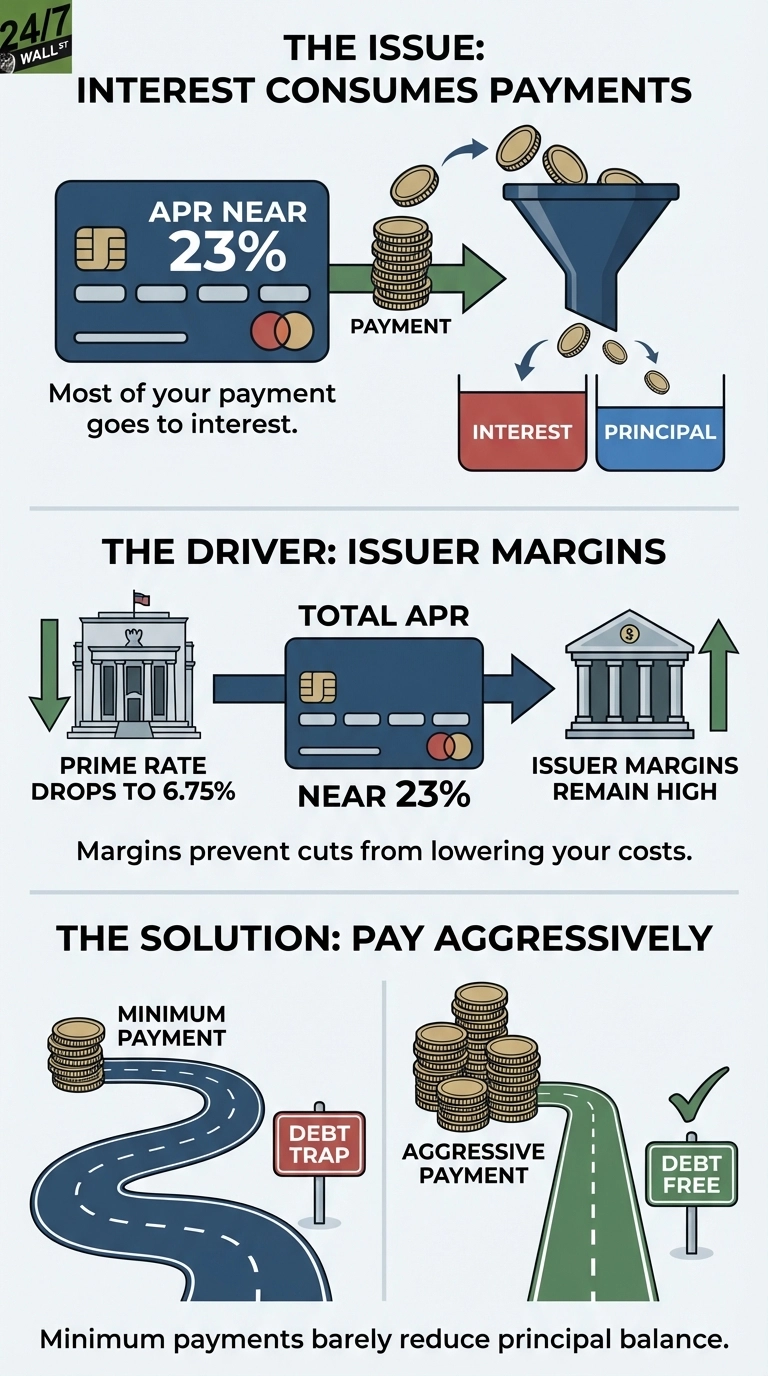
An infographic with three main sections. The first, 'The Issue: Interest Consumes Payments,' shows a credit card with 'APR NEAR 23%'. A stack of coins labeled 'PAYMENT' goes into a funnel, then divides into two containers: a large red one labeled 'INTEREST' and a small blue one labeled 'PRINCIPAL', illustrating that most of the payment goes to interest. The second section, 'The Driver: Issuer Margins,' shows a bank with a downward arrow and text 'PRIME RATE DROPS TO 6.75%', an arrow points to a credit card with 'TOTAL APR NEAR 23%', which then points to another bank with an upward arrow and text 'ISSUER MARGINS REMAIN HIGH'. This section explains that margins prevent cuts from lowering costs. The third section, 'The Solution: Pay Aggressively,' shows two paths. The left path, with a small stack of coins labeled 'MINIMUM PAYMENT', is a winding road leading to a 'DEBT TRAP' sign. The right path, with a large stack of coins labeled 'AGGRESSIVE PAYMENT', is a straight road leading to a 'DEBT FREE' sign with a checkmark. This section states that minimum payments barely reduce the principal balance.
24/7 Wall St.
This infographic illustrates why credit card interest consumes most payments, how issuer margins keep APRs high despite prime rate drops, and how aggressive payments can lead to becoming debt-free.

This article is for educational purposes and does not constitute personalized financial advice.


Photo of Austin Smith
About the Author Austin Smith →

Austin Smith is a financial publisher with over two decades of experience in the markets. He spent over a decade at The Motley Fool as a senior editor for Fool.com, portfolio advisor for Millionacres, and launched new brands in the personal finance and real estate investing space.

His work has been featured on Fool.com, NPR, CNBC, USA Today, Yahoo Finance, MSN, AOL, Marketwatch, and many other publications. Today he writes for 24/7 Wall St and covers equities, REITs, and ETFs for readers. He is as an advisor to private companies, and co-hosts The AI Investor Podcast.

When not looking for investment opportunities, he can be found skiing, running, or playing soccer with his children. Learn more about me here.

Featured Reads

Our top personal finance-related articles today. Your wallet will thank you later.

Continue Reading

Top Gaining Stocks

CBOE Vol: 1,568,143
PSKY Vol: 12,285,993
STX Vol: 7,378,346
ORCL Vol: 26,317,675
DDOG Vol: 6,247,779

Top Losing Stocks

LKQ
LKQ Vol: 4,367,433
CLX Vol: 13,260,523
SYK Vol: 4,519,455
MHK Vol: 1,859,865
AMGN Vol: 3,818,618