



Strategy (NASDAQ: MSTR | MSTR Price Prediction) now owns 713,502 Bitcoin (CRYPTO: BTC) —roughly 3.4% of all Bitcoin that will ever exist. That’s one out of every 29 coins, and the share keeps growing. The company just completed its largest single purchase ever, adding 22,305 BTC in one week. With an $84 billion buying plan running through 2027, Strategy is on track to control an even larger slice of Bitcoin’s fixed 21 million supply.
Whether Strategy keeps accumulating isn’t really in question—the $84 billion plan makes that clear. The real question is what happens to the Bitcoin price and market dynamics when a single corporate buyer controls this much of a scarce asset.
How Strategy Built the Largest Corporate Bitcoin Treasury

Strategy’s path to 713,502 BTC started in 2020 when Bitcoin traded at a fraction of today’s prices. Holdings grew steadily to 124,000 BTC by the end of 2021 and 132,500 BTC by late 2022. The real acceleration came during the 2024-2025 bull market, when holdings jumped from roughly 280,000 BTC in late 2024 to over 700,000 BTC a year later.
The January 2026 purchase pushed the total past 700,000 for the first time. Between January 12-19, Strategy added 22,305 BTC at an average price of $95,284 per coin—the largest single-week acquisition since the company began its Bitcoin strategy. The purchase was funded by selling 10.4 million common shares for $1.83 billion and issuing 2.95 million preferred shares for another $294 million. Within days, $2.1 billion in fresh capital converted into Bitcoin.
That 713,502 BTC stack is now larger than any Bitcoin ETF holds. Only Satoshi Nakamoto’s estimated 1.1 million dormant coins represent a bigger single holding. At current prices, Strategy’s position is worth roughly $54 billion against a cost basis of $54.26 billion—essentially breakeven with an average purchase price of $76,052 per coin.
Vanguard’s U.S. mid-cap index fund recently bought $505 million worth of Strategy shares, marking its first position in the company. When index funds start adding exposure, it signals that Strategy’s Bitcoin-heavy balance sheet has crossed into mainstream acceptance.
The 42/42 Plan: Funding $84 Billion in Bitcoin Buys

Strategy’s buying power comes from the “42/42 Plan,” an aggressive financing strategy announced in 2025. The plan targets $84 billion in fresh capital by 2027, split evenly between $42 billion in stock sales and $42 billion in debt issuance. The name doubled a prior “21/21” initiative after Bitcoin’s price and institutional interest grew faster than expected.
The model works like a flywheel. Strategy issues new shares through at-the-market offerings, converts the cash into Bitcoin, then uses the larger Bitcoin treasury to justify a higher market cap. The higher market cap supports further share issuance, and the cycle repeats. The company also plans bonds and convertible notes to satisfy the debt component without over-leveraging the balance sheet.
In 2025 alone, Strategy raised more than $25 billion through stock and preferred share sales. The company has turned its equity into a Bitcoin acquisition vehicle—each share issued becomes a claim on a growing pile of coins. As long as investors keep buying MSTR stock, the Bitcoin purchases continue.
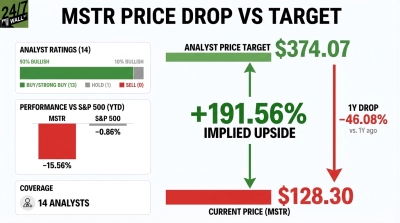
But the strategy carries dilution risk. Each new share spreads the Bitcoin holdings across more owners, potentially reducing “Bitcoin per share” over time. Strategy currently trades at a discount to its net asset value, with a market cap below the value of its Bitcoin holdings. Earlier in the bull market, the stock traded at a premium, making share issuance more accretive. With the premium gone and shares down over 66% from highs, raising capital gets harder.
What Strategy’s 3.4% Ownership Means for Bitcoin

Controlling 3.4% of a decentralized currency creates both opportunity and risk.
The Bull Case: Scarcity Amplified
Bitcoin’s value comes partly from fixed supply meeting rising demand. Every coin Strategy buys is one less available to other buyers. The company has stated it won’t sell, effectively removing 713,502 BTC from circulation permanently. As more institutions, ETFs, and even nation-states seek Bitcoin exposure, they’re competing for a shrinking pool of available coins.
The past year illustrated this dynamic. Spot Bitcoin ETFs launched and needed to accumulate large positions. BlackRock’s iShares Bitcoin Trust built holdings that rival Strategy’s. Other corporations followed Strategy’s treasury model—over 180 public companies now hold Bitcoin on their balance sheets. When multiple deep-pocketed buyers chase limited supply, prices tend to rise.
The Bear Case: Concentration Risk
Strategy’s fate is now tied almost entirely to Bitcoin’s performance. The stock trades in lockstep with Bitcoin but with amplified volatility—swinging roughly 2x Bitcoin’s moves in both directions during 2025. A prolonged Bitcoin downturn would pressure Strategy’s financial position and stock price simultaneously.
There’s also execution risk in the 42/42 Plan. Raising $84 billion requires sustained investor appetite for MSTR shares. If Bitcoin sentiment sours or the stock’s discount to net asset value widens, funding future purchases becomes harder. The flywheel that powered accumulation could slow or stall.
The Market Impact: Supply Squeeze Dynamics
Strategy’s buying pattern has arguably contributed to supply squeezes during Bitcoin rallies. The company buys consistently regardless of price—accumulating during dips but also during rallies. The January 2026 purchase at $95,284 per coin came right before Bitcoin briefly dropped below $90,000. Short-term timing looks questionable, but the logic is simple: if Bitcoin reaches $500,000 or $1 million, paying $95,000 looks cheap.
That kind of consistent buying signals conviction. Other large buyers see Strategy’s commitment and may accelerate their own purchases, tightening available supply further—a dynamic similar to institutional accumulation patterns seen in other crypto assets.
Why the Number Keeps Growing—and What It Means for Bitcoin Price
Strategy’s holdings keep growing because the company has built a self-reinforcing system: issue stock, buy Bitcoin, use larger holdings to justify higher valuation, issue more stock, and buy more Bitcoin. As long as investors participate, the cycle continues.
Under the 42/42 Plan, Strategy could deploy up to $84 billion into Bitcoin by 2027, potentially pushing holdings above 1.4 million coins—over 6.7% of total supply. As of January 2026, the company still had $41 billion in authorized but unused issuance capacity. Saylor has suggested targets above 1 million BTC.
Three factors determine whether that runway gets used: investor appetite for MSTR shares at current discounts, regulatory tolerance for growing concentration, and Bitcoin’s price trajectory. A sustained bear market would slow the flywheel. A rally would accelerate it.
For the Bitcoin price, Strategy’s growing 3.4% share means tighter available supply and a committed holder with no intention of selling. That concentration cuts both ways—it supports prices in bull markets and amplifies downside risk if sentiment turns.













 Top Gaining Stocks
 Top Losing Stocks