



General Dynamics paid its quarterly dividend of $1.50 per share on February 6, 2026, marking the latest installment in a 27-year consecutive payment streak that has rewarded shareholders through multiple defense cycles. The aerospace and defense contractor now yields 1.67% at current prices, with an annualized payout of $6.00 per share based on the current quarterly rate.
The dividend represents a 5.6% increase from the $1.42 quarterly payment made in early 2025, continuing a growth trajectory that has accelerated in recent years. Over the past five years, General Dynamics has increased its dividend at an 8.5% compound annual rate, while the 10-year compound growth rate stands at 10.2%.
Financial Foundation Supports Dividend Sustainability
General Dynamics generated $5.1 billion in operating cash flow during 2025, producing $4 billion in free cash flow. Against full-year net income of $4.21 billion, this translates to a 94% free cash flow conversion rate. CFO Kim Kuryea stated on the February 12, 2026 earnings call that the company “expects to return to our free cash flow conversion rate goal of 100% of net income” in 2026.
The dividend consumes 40.2% of trailing earnings, based on $14.93 in diluted EPS against the $6.00 annual dividend. This payout ratio sits comfortably below the 60% threshold that typically signals dividend stress, leaving substantial room for both dividend growth and reinvestment in the business.
The company ended 2025 with $2.3 billion in cash and a $5.7 billion net debt position, down $1.4 billion from the prior year. This balance sheet strength provides flexibility to maintain dividends even if near-term earnings face pressure from elevated capital spending or margin headwinds.
Record Backlog Provides Revenue Visibility
General Dynamics closed 2025 with a record $118 billion total backlog, representing a 30% increase from the prior year. The company achieved a 1.5x book-to-bill ratio company-wide, with Combat Systems posting an exceptional 2.1x ratio and Marine Systems reaching 1.7x.
This backlog provides multi-year revenue visibility that underpins dividend sustainability. Chairman and CEO Phebe Novakovic emphasized on the earnings call that “we have a long-term growth environment embedded in our backlog” and that capital deployment strategy focuses on “continued investment in our growing business as a result of increased backlog.”
For 2026, management projects revenue of $54.3 billion to $54.8 billion, with operating margins expanding 20 basis points to 10.4%. Earnings per share guidance of $16.10 to $16.20 came in below analyst expectations due to anticipated tariff impacts, but still represents growth from the $14.93 earned in 2025.
Management Reaffirms Dividend Commitment
When asked directly about dividend policy during the earnings call, Novakovic stated: “We’ve paid a dividend for over twenty-five years. And every year in March, the board decides the extent of any increase but we’re committed to the dividend.” This annual March review has historically resulted in consistent increases, with the company maintaining its growth streak through the 2008 financial crisis, pandemic disruptions, and multiple defense budget cycles.
The company’s capital allocation priorities place dividend payments ahead of share repurchases. Novakovic noted that capital deployment focuses on business investment to support backlog execution, adding that commenting on share repurchases would be “appropriate” given current industry scrutiny. The Pentagon has initiated reviews of defense contractors’ capital allocation practices, creating uncertainty around buyback programs but not dividends.
Competitive Position in Defense Sector
General Dynamics’ 1.67% dividend yield sits below several aerospace and defense peers. Lockheed Martin yields 2.12% with an annual payout of $13.35 per share, while Raytheon Technologies offers 1.37% with a $2.67 per share dividend. Northrop Grumman provides a 1.31% yield with $8.99 per share in annual payments. Boeing suspended its dividend in 2020 and has not reinstated payments.
However, General Dynamics’ lower yield reflects its stronger stock price appreciation. The stock has gained 42.34% over the past year and 137.33% over five years, delivering total returns that exceed peers despite the more modest yield. At $351 per share as of February 12, 2026, the stock trades at 23.2x trailing earnings, a discount to Lockheed Martin’s 29.32x multiple.
The company’s 40.2% payout ratio also provides more room for dividend growth compared to Lockheed Martin’s 62.3% payout ratio (calculated from $13.35 dividend against $21.44 EPS).
Near-Term Risks and Margin Expansion Path
The primary near-term headwind comes from tariff impacts and supply chain costs. General Dynamics absorbed $41 million in tariff-related costs during 2025, with higher impacts expected in 2026. Management described supply chain constraints as the “gating item” limiting faster growth, particularly for submarine production at Electric Boat and aircraft completions at Gulfstream.
Capital expenditures will increase 79% to over $900 million in 2026, representing 3.5% to 4% of sales. This elevated investment supports capacity expansion across business segments, with Novakovic stating the company will “continue to invest year over year in our businesses because we have a long-term growth environment.”
Despite these investments, management projects margin expansion across most segments. Aerospace margins should reach 14% in 2026, up from 13.3% in 2025, with further improvement expected as the company executes its backlog. Marine Systems showed 210 basis points of margin expansion in Q4 2025, driven by 13% year-over-year increases in submarine tonnage production at Electric Boat.
Institutional Confidence Signals Stability
Institutional investors control 87.8% of General Dynamics shares, with recent activity showing net buying. Westover Capital Advisors increased its position 65.6%, while Rockland Trust boosted its stake 703.4% in recent quarters. MQS Management made General Dynamics its fifth-largest holding after acquiring shares worth $1.16 million.
Analyst sentiment remains constructive, with 3 Strong Buy ratings, 9 Buy ratings, and 10 Hold ratings against just 1 Sell rating. The consensus price target of $394.41 implies 12.4% upside from current levels.
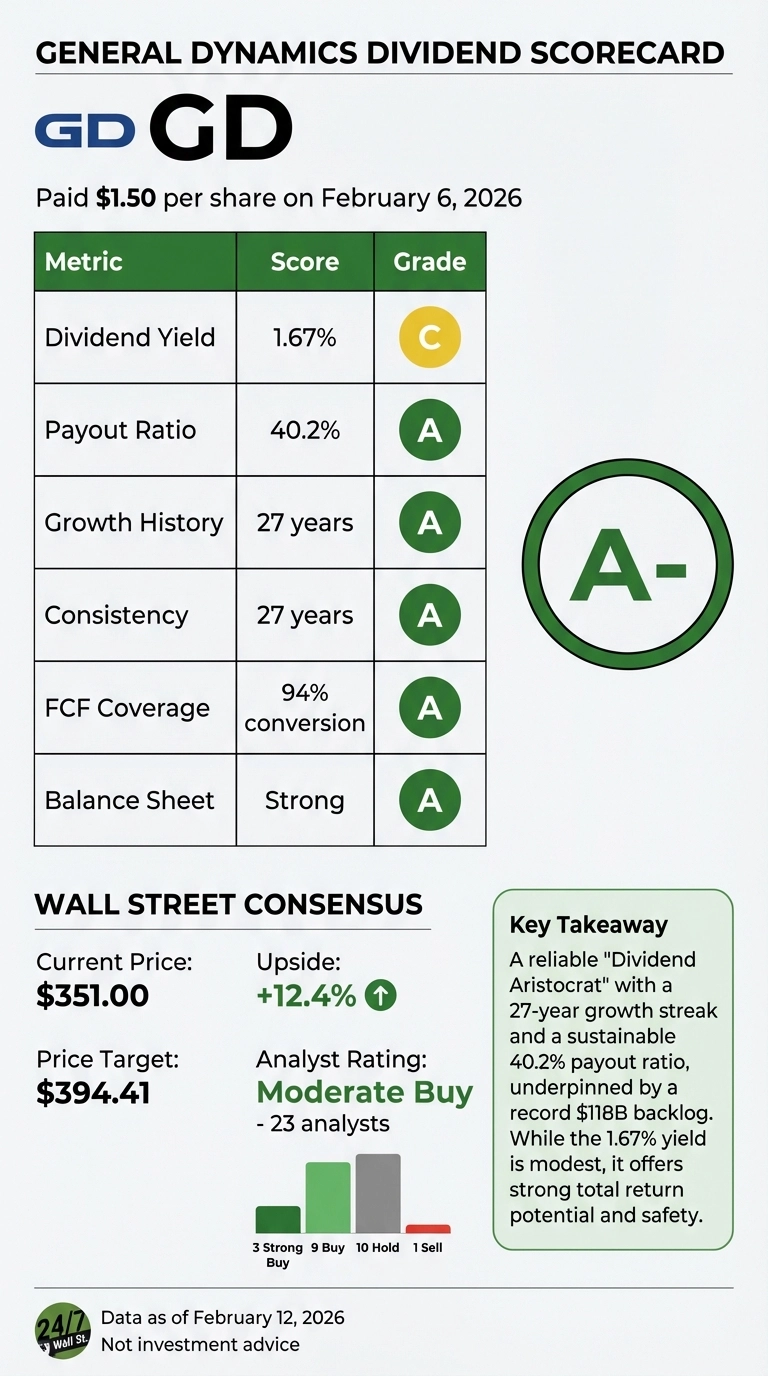
The combination of a 27-year payment history, conservative payout ratio, record backlog, and management’s explicit commitment to the dividend suggests the current $1.50 quarterly payment rests on solid footing. The annual March board review will determine whether 2026 brings another increase to extend the company’s multi-decade growth streak.














 Top Gaining Stocks
 Top Losing Stocks