


While the Dow Jones Industrial Average (NYSEARCA:DIA | DIA Price Prediction) has climbed 3.4% year-to-date entering Thursday’s trading, three blue-chip giants went the opposite direction. Salesforce (NYSE:CRM), Microsoft (NASDAQ:MSFT), and UnitedHealth Group (NYSE:UNH) became the index’s biggest drags, each shedding double-digit percentages while the broader market marched higher. Beating earnings doesn’t guarantee stock gains when investors question the path forward.
| Stock | YTD Return (Feb 18) | vs. Dow Performance |
|---|---|---|
| Salesforce (CRM) | -29.1% | -32.5 percentage points |
| Microsoft (MSFT) | -17.4% | -20.8 percentage points |
| UnitedHealth (UNH) | -12.7% | -16.1 percentage points |
| Dow Jones (DIA) | +3.4% | Benchmark |
The index’s top performers told a different story: Honeywell (NYSE:HON) surged 23% and Chevron (NYSE:CVX) climbed 19%, widening the gap between winners and losers.
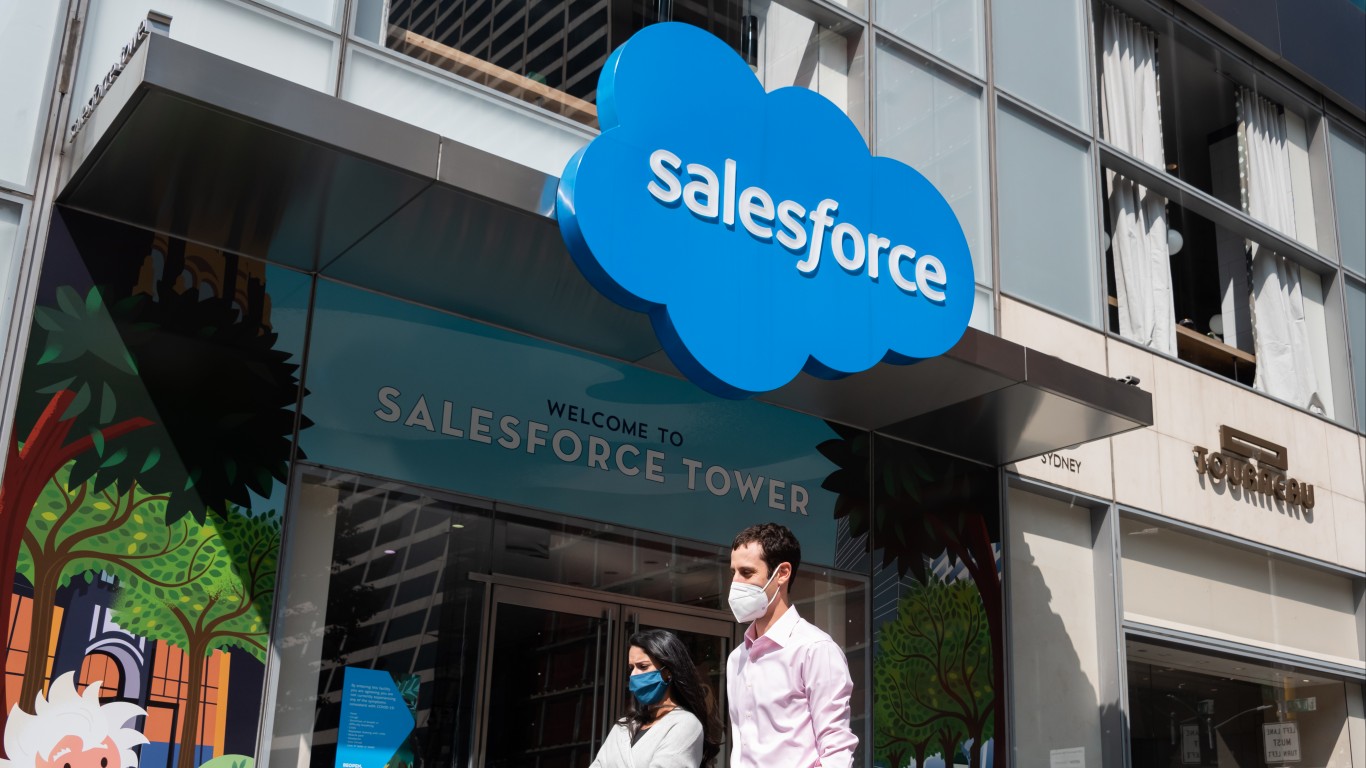
3. Salesforce: The AI Story Wall Street Won’t Buy Yet
Salesforce reported Q3 fiscal 2026 revenue of $10.26 billion, slightly below to in line estimates, and beat on earnings with $3.25 per share versus the $2.86 consensus. Revenue grew 8.6% year-over-year, and the company raised full-year guidance to $41.45 billion to $41.55 billion. Management highlighted Agentforce and Data 360 ARR hitting roughly $1.4 billion, up 114% year-over-year.
None of it mattered. Shares collapsed from $264.91 on December 31, 2025, to $187.79 by February 18, 2026. Loop Capital cut its price target from $250 to $190 on February 19, 2026, maintaining a Hold rating, while Piper Sandler also trimmed its target, citing concerns that AI-driven self-coding tools could compress seat-based revenue models.
Investors questioned whether agentic AI would reduce demand for traditional software licenses. Yet Gartner projected business software spending would grow 14.7% in 2026 to $1.4 trillion. Morningstar awarded Salesforce a 5-star rating in mid-February, signaling significant undervaluation, and Vanguard increased its stake by 0.8% to 89.6 million shares.
The bottom line is that software stocks have been ruthlessly sold off this year as investors’ concerns that AI will limit pricing power in the future grow. It’s hard to know when this sentiment changes, but it’s a brutal environment for companies in the SaaS space. Which brings us to the second-worst stock in the Dow year-to-date…
2. Microsoft: Capex Concerns Trump Azure’s 39% Growth
Microsoft beat estimates in both Q1 and Q2 fiscal 2026. The Q2 report delivered non-GAAP EPS of $4.14 versus the $3.91 consensus and revenue of $81.3 billion, up 17% year-over-year. Azure growth hit 39%, and Microsoft Cloud revenue reached $51.5 billion, up 26%.
The stock sold off anyway. Shares dropped roughly 13% from $519.03 at the Q1 filing in late October to $452.04 by the Q2 filing on January 28, 2026.
The culprit: capital expenditures. Microsoft spent $29.9 billion on capex in Q2 alone, up 89% year-over-year, and free cash flow fell 9.3% despite strong operating cash flow growth. Microsoft’s strategic shift toward internal AI model development and reduced reliance on OpenAI added further uncertainty.
In short, Wall Street is expecting even higher cloud growth than Microsoft is projecting with all this capex, but the company is diverting resources to improve its internal software. It’s a difficult position for Microsoft to be in. If they allocate more of their data centers to Azure, growth will accelerate but the company risks seeing less growth across their software cloud units, which would invite Wall Street to sell the stock off on fears of their software being prone to AI disruption.
Microsoft looks attractively valued in the long-term, but the near-term picture remains murky.
1. UnitedHealth: Operating Income Collapse and Medicare Headwinds
UnitedHealth combined consecutive revenue misses with a catastrophic profitability collapse. Q4 2025 revenue of $113.22 billion missed the $113.73 billion estimate, and operating income plunged 95% to just $380 million versus $7.8 billion in Q4 2024. Net income fell to $10 million, down 99.8% year-over-year, after $2.8 billion in charges related to cyberattack costs, divestitures, and restructuring.
Shares dropped 16% from $379.01 at the Q3 filing in late October to $319.55 by the Q4 filing on January 27, 2026. Mizuho cut its price target from $430 to $350, citing slower-than-expected earnings recovery. The Medicare Advantage business faced structural headwinds: stricter regulations reduced quality-based bonus payments, and higher medical utilization drove Medical Loss Ratios to 88.9%. Multiple sources characterized 2026 as a “reset year” for UnitedHealth.
Optum provided a partial offset — Piper Sandler projected Optum Health operating earnings over $13.2 billion with a 5.1% operating margin, and full-year 2025 Optum revenues hit $270.6 billion, up 7% — but couldn’t overcome the insurance segment’s deterioration. Institutional holders like Zions Bancorporation reduced their stakes by 76% in Q3.
The Dow’s Divergence Problem
These three stocks reflect a broader 2026 market truth: fundamentals alone don’t drive returns when investors reassess structural assumptions. Salesforce beat earnings but couldn’t justify its AI valuation. Microsoft delivered Azure growth but spooked investors with capex intensity and whether it’ll translate to expected growth rates in the back half of 2026.
UnitedHealth’s operating income collapse exposed the fragility of its Medicare Advantage model. The 32-point gap between Salesforce’s decline and the Dow’s gain reflects how differently investors are pricing AI execution risk, healthcare regulatory headwinds, and capex intensity compared to the broader index.











 Top Gaining Stocks
 Top Losing Stocks