



According to the CDC’s latest data, U.S. life expectancy at birth reached 79.0 years of age as of 2024, the highest on record and a full 0.6-year increase from the prior year. More relevant for retirees, life expectancy after turning 65 now sits at 19.7 additional years, meaning the average person retiring today can expect to live to roughly 85, and for women, this number can even stretch past 86.
Most importantly, these are not just abstract statistics, as they are numbers that will reshape the entire financial conversation around retirement. A portfolio built to last 20 years now needs to last 25 or 30 years, and the traditional playbook of shifting heavily into bonds at retirement doesn’t hold up the way it used to when retirements were shorter and less expensive.
The result is a growing disconnect between how long retirees are living and how their portfolios are positioned to support that timeline. Closing that gap is becoming one of the most important financial decisions retirees are facing heading into 2026.
The Old Allocation Rules Were Built for a Shorter Retirement
For decades, the standard advice was to subtract your age from 100 and put that percentage in stocks. A 65-year-old would hold 35% equities and 65% bonds, and this logic made sense when the average retiree might live 15 to 18 years past retirement. A conservative, bond-heavy portfolio could generate enough income and preserve capital over that window.
The math doesn’t work for a 25-to-30 year retirement as a portfolio that is 65% bonds may not generate enough growth to keep pace with inflation, especially in a period where healthcare costs are rising faster than the generational price level. Over a 30-year-horizon, even modest inflation erodes purchasing power significantly.
The reality heading into 2026 is that many retirees need their portfolios to do two things simultaneously: generate reliable income now and continue growing to fund expenses 15 to 20 years from now. This dual mandate requires more equity exposure than earlier generations carried into retirement, and this is likely going to make many retirees uncomfortable.
Why Equities Still Belong in a Retirement Portfolio
The instinct to move entirely into safe, income-producing assets at retirement is understandable, as nobody wants to watch their nest egg drop 20% the year after they stop working. However, the bigger risk for today’s retirees isn’t a bad quarter, it’s running out of money in year 22 of a 30-year retirement because the portfolio didn’t grow enough to keep up.
It should go without saying that equities continue to be the most reliable asset class to provide long-term real returns. Over rolling 20-year periods, the S&P 500 has never delivered a negative return. This history doesn’t eliminate any short-term risk, but it does make the argument for keeping a meaningful allocation to stocks well into retirement, particularly for retirees in their 60s who may have two or three decades of spending ahead of them.
A growing number of financial planners are now recommending equity allocations of 50% to 60% for retirees in their mid-60s, stepping down gradually over time rather than making a sharp shift at the point of retirement. This approach balances near-term income needs with the long-term growth that a longer life demands.
The Role of Income-Producing Assets in a Longer Retirement
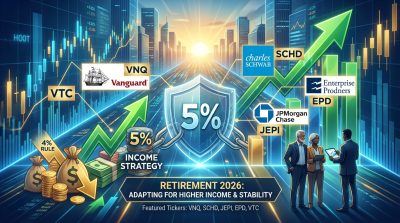
Dividend ETFs, REITs, and bond funds aren’t just yield tools and shouldn’t be considered as such. In a longer retirement, they can serve as the income layer that allows retirees to avoid selling equity positions during downturns. This is where funds like the JPMorgan Equity Premium Income ETF (NYSE:JEPI) with its 7.97% yield and monthly payouts, or Reality Income (NYSE:O | O Price Prediction), which offers over two decades of consecutive income increases, become so structurally important.
The goal isn’t to chase the highest yield available, but more about building a diversified income stream that covers recurring expenses without forcing share sales at the wrong time. When income arrives from dividends, bond interest, and REIT distributions on a predictable schedule, the equity portion of the portfolio can stay invested and compound.
This layered approach also helps manage the psychological side of a longer retirement. Knowing that monthly expenses are covered by income, not liquidation, makes it far easier to hold through volatility without making emotional decisions that damage long-term returns.
What This Means for Portfolio Construction in 2026
Heading into 2026, the combination of longer lifespans, elevated valuations, and anticipated market volatility makes portfolio construction more consequential than it’s been in years. Retirees who are overweighted on bonds may find their purchasing power is declining steadily. Those who are overweight in growth stocks may face sequence-of-returns risk if a correction hits too early in retirement.
The most durable approach is a three-bucket framework starting with cash reserves that can cover one or two years of expenses, an income bucket built around dividend stocks, bond ETFs, and REITs for the next three to seven years, and a growth bucket of diversified equities for the long tail of retirement. This structure gives retirees the flexibility to draw from different sources depending on market conditions.
The core takeaway is simple as living longer is good news, but it requires a portfolio that’s built for endurance, not just safety. The retirees who will be best positioned over the next 20 to 30 years are the ones who resist the urge to play it too safe and instead build an allocation that balances income, growth, and flexibility in a way that matches how long retirement actually lasts.













 Top Gaining Stocks
 Top Losing Stocks