


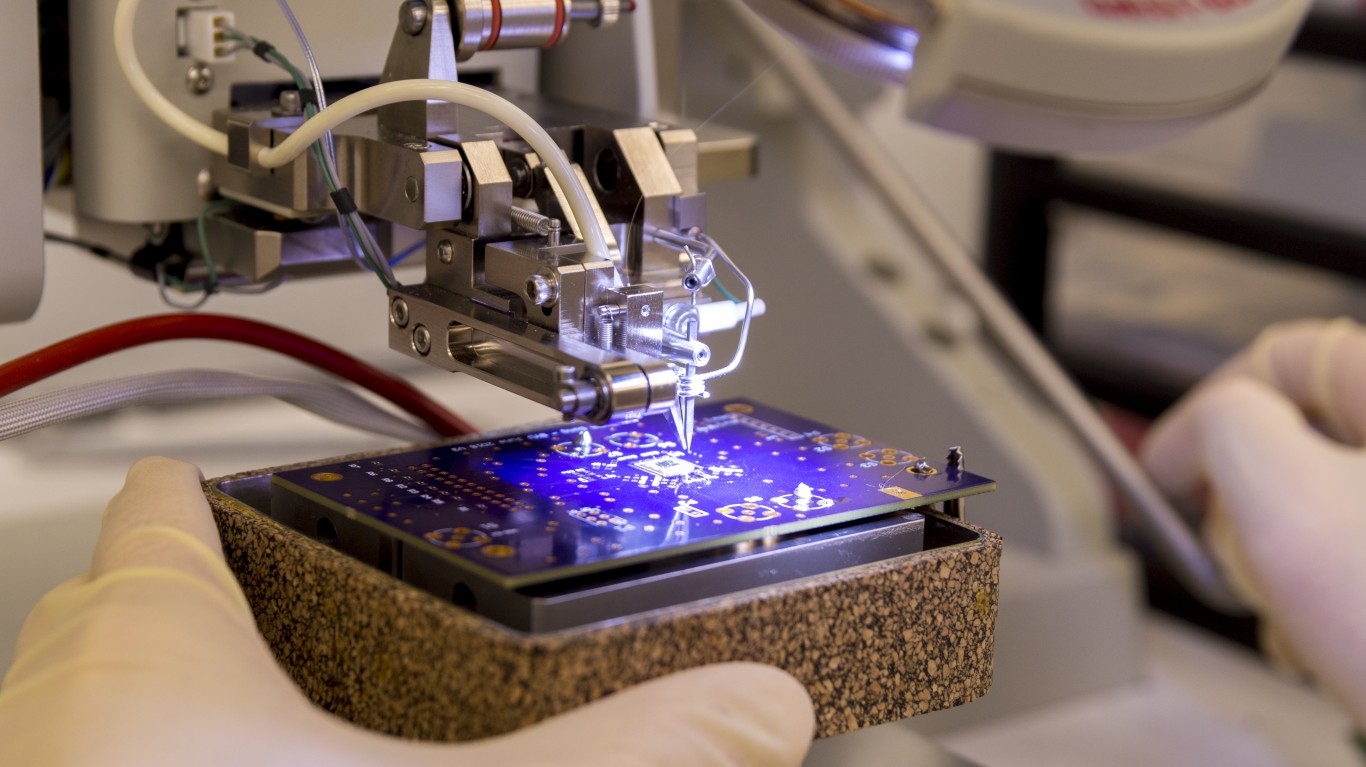
ASML Holding (NASDAQ:ASML | ASML Price Prediction) stands at the forefront of the artificial intelligence (AI) revolution. Its extreme ultraviolet (EUV) lithography technology is what makes possible the development of the critical next-generation semiconductors used to power AI. And it has a virtual monopoly on the technology, created from over 30 years of research and development and thousands of patents that create an insurmountable barrier to entry.
Now it is propelling the technology to the next level, which could reshape production capabilities without requiring massive new investments in factory space or equipment while unleashing a torrent of new chip output over the next few years.
ASML’s Multiplier Effect in EUV Power Scaling
ASML has achieved a major milestone in chip-making technology: their EUV lithography machines can now produce 1,000 watts of usable extreme ultraviolet light using laser-produced plasma.
These machines generate EUV light by hitting tiny molten tin droplets with powerful lasers, creating a hot plasma that emits the short-wavelength light needed to pattern the smallest chip features. Current factory systems deliver around 600 watts. Higher power lets the machine expose silicon wafers faster, increasing throughput, cutting costs, and improving chip yields.
The key advancement is moving from a two-pulse to a three-pulse laser system. The extra pulse optimizes energy transfer to the tin, boosting conversion efficiency by 30% to 50% — so more laser input becomes useful EUV output instead of waste. It also greatly reduces debris — tiny particles that contaminate optics and hurt long-term reliability, which has been a persistent challenge for EUV.
The system requires nanosecond-precise timing and multiple lasers with finely tuned pulse parameters. When tested under realistic customer conditions — such as those at Taiwan Semiconductor Manufacturing (NYSE:TSM), Intel (NASDAQ:INTC), or Samsung — it performs as needed in real production.
This surpasses ASML’s original 2025 plan to double power from 600 watts. The roadmap continuing to 1,500 watts and holds the potential for 2,000 watts in the future. In essence, this makes EUV tools more productive and reliable, speeding up progress toward smaller, more powerful chips for AI, smartphones, and beyond.
Why This Breakthrough Matters
Higher EUV source power directly translates to faster processing speeds in lithography machines. Current systems handle about 220 wafers per hour, but the 1,000-watt upgrade could push this to approximately 330 wafers per hour, a 50% increase. This reduces exposure time per chip, boosting overall throughput without additional tools or floor space. It also means ASML’s customers can keep on using EUV at a much lower cost.
The importance lies in addressing photon scarcity in EUV processes, which has limited broader adoption. With power scaling to 800 to 1,000 watts now feasible, EUV could shift from a constrained resource to one of abundance, enabling more layers in chip fabrication. This is critical as semiconductor nodes shrink below 2 nanometers, where EUV is essential for precision patterning.
For ASML itself, this advancement serves to reinforce its near-monopoly status in EUV lithography, with no direct competitors offering comparable systems. The company expects rapid growth in its EUV business in 2026, driven by demand for upgrades and new installations. Revenue from services and software tied to higher-throughput machines could boost margins as customers extend tool lifecycles.
Key Takeaways
ASML is already a monopoly in one of the most critical areas of AI chip production, supplying the only commercial EUV lithography systems for advanced nodes. If successful in unleashing a 50% explosion in chip output per tool without adding floor space or capital expenditures, it makes ASML’s moat even wider, compounding its irreplaceability in the entire semiconductor supply chain.
Positioning the company to capture more value as demand for next-generation chips escalates, ASML should be at the top of every investor’s list of stocks to buy. Although shares are up 37% year-to-date and the stock trades at seemingly lofty valuations, they are not so stretched considering the primacy of its EUV equipment in an AI boom that shows no real signs of weakening.







 Top Gaining Stocks
 Top Losing Stocks