



Invesco S&P SmallCap High Dividend Low Volatility ETF (NYSEARCA:XSHD) offers a 7.22% dividend yield, making it attractive for income-focused investors. But the ETF’s recent dividend trajectory raises serious sustainability concerns. Understanding how this ETF generates income—and whether that income stream is secure—requires examining both its structure and recent performance.
How XSHD Generates Income
XSHD tracks small-cap U.S. stocks selected for high dividend yields and low volatility. With $74.4 million in net assets, the fund is heavily concentrated in real estate investment trusts—financials alone represent 21.1% of holdings. Mortgage REITs like Global Net Lease (NYSE:GNL), Two Harbors Investment (NYSE:TWO), and Armour Residential REIT (NYSE:ARR) sit among the top positions, meaning the ETF’s income is almost entirely dependent on interest rate spreads and property cash flows rather than diversified business earnings.
The Dividend Cut That Matters
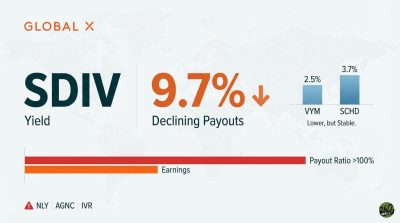
XSHD’s dividend history reveals a troubling pattern. Monthly distributions averaged $0.086 in early 2025 before plunging roughly 28% by mid-year—a sharp and rapid deterioration that signals stress among the ETF’s underlying holdings. This was not a one-time blip; payments have remained depressed ever since, with the most recent January 2026 distribution coming in at $0.06249. Annualized, the current payout is down approximately 40% from 2023 levels, representing a sustained structural reduction rather than a temporary adjustment.
The dividend cut coincides with structural challenges in the mortgage REIT sector. Higher interest rates through 2024 compressed net interest margins for leveraged REITs, forcing many to reduce distributions. While the Federal Reserve has cut rates 75 basis points since October 2025 to 3.75%, the damage to XSHD’s underlying holdings had already occurred.
Total Return Reality
Dividend yield alone tells an incomplete story. XSHD’s price performance shows a 14.06% decline over five years, significantly underperforming the broader small-cap market. The Russell 2000 gained 17.23% over the same period. Even with dividends reinvested, XSHD investors faced negative real returns while taking on concentration risk in volatile mortgage REITs.
Verdict
XSHD’s dividend is currently being paid, but the 28% cut in 2025 signals underlying weakness in portfolio holdings. The heavy REIT concentration exposes the fund to interest rate sensitivity and sector-specific risks. Recent history shows the annualized payout has declined approximately 40% from 2023 levels. The ETF’s income stream remains closely tied to interest rate conditions and the financial health of its mortgage REIT holdings.











 Top Gaining Stocks
 Top Losing Stocks