


HP Inc. (NYSE:HPQ | HPQ Price Prediction) reported after the bell on Feb. 24, and the stock initially dipped to around $16.91 in the hour after filing before recovering. Shares were last trading at $18.20.
AI PCs Lead, Margins Lag
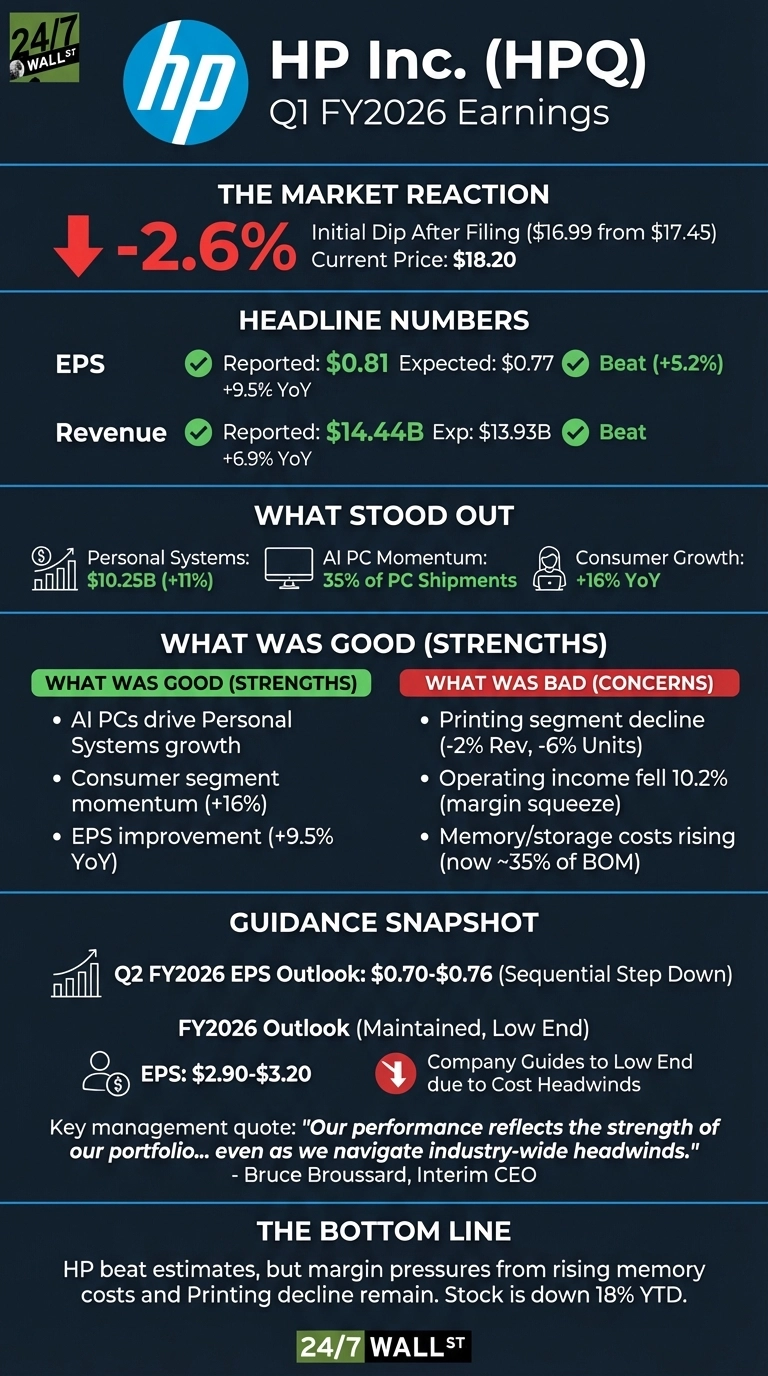
The headline numbers were solid. HP posted non-GAAP EPS of 81 cents versus the 77-cent consensus — a beat of about 5% and up 9.5% from the year-ago period. Revenue of $14.44 billion came in roughly $500 million above estimates, growing 6.9% year over year. Personal Systems was the engine: AI PCs reached 35% of total PC shipments in Q1, up from 30% the prior quarter, pushing segment revenue to $10.25 billion, up 11% year over year. Consumer was the standout within that, up 16%.
Margin pressure showed up as expected. Operating income fell 10.2% year over year to $759 million even as revenue grew. The culprit: DRAM and NAND prices rose roughly 100% sequentially, pushing memory and storage costs from 15-18% to approximately 35% of PC bill of materials. Printing continued its structural slide, with revenue down 2% and hardware units down 6%.
Guidance Holds the Range, But Management Signals the Low End
Interim CEO Bruce Broussard kept the tone measured. “We are pleased to report a strong first quarter, highlighted by robust growth in Personal Systems, including the continued momentum in AI PCs. Our performance reflects the strength of our portfolio and our disciplined execution of our Future of Work strategy, even as we navigate industry-wide headwinds,” Broussard said.
HP maintained its full-year non-GAAP EPS range of $2.90 to $3.20 but explicitly guided toward the low end. Q2 non-GAAP EPS is projected at $0.70 to $0.76, a sequential step down from Q1’s $0.81. Management is pursuing a three-pronged mitigation plan: long-term supplier agreements for memory, expanded lower-cost sourcing, and targeted pricing actions, targeting $1 billion in gross run-rate savings by FY2028.
What to Watch From Here
The beat was real, but the market’s muted initial reaction mirrors November’s earnings, when HP also beat and the stock still declined. With shares already down 18% year to date and trading well below its 200-day moving average of $25.02, the path forward depends on whether memory cost pressures stabilize and AI PC demand holds.
Analyst price targets average $22.96, above the current trading price of $18.20. HP guided toward the low end of its full-year EPS range, citing ongoing memory cost headwinds as a key variable for the remainder of the fiscal year.








 Top Gaining Stocks
 Top Losing Stocks