


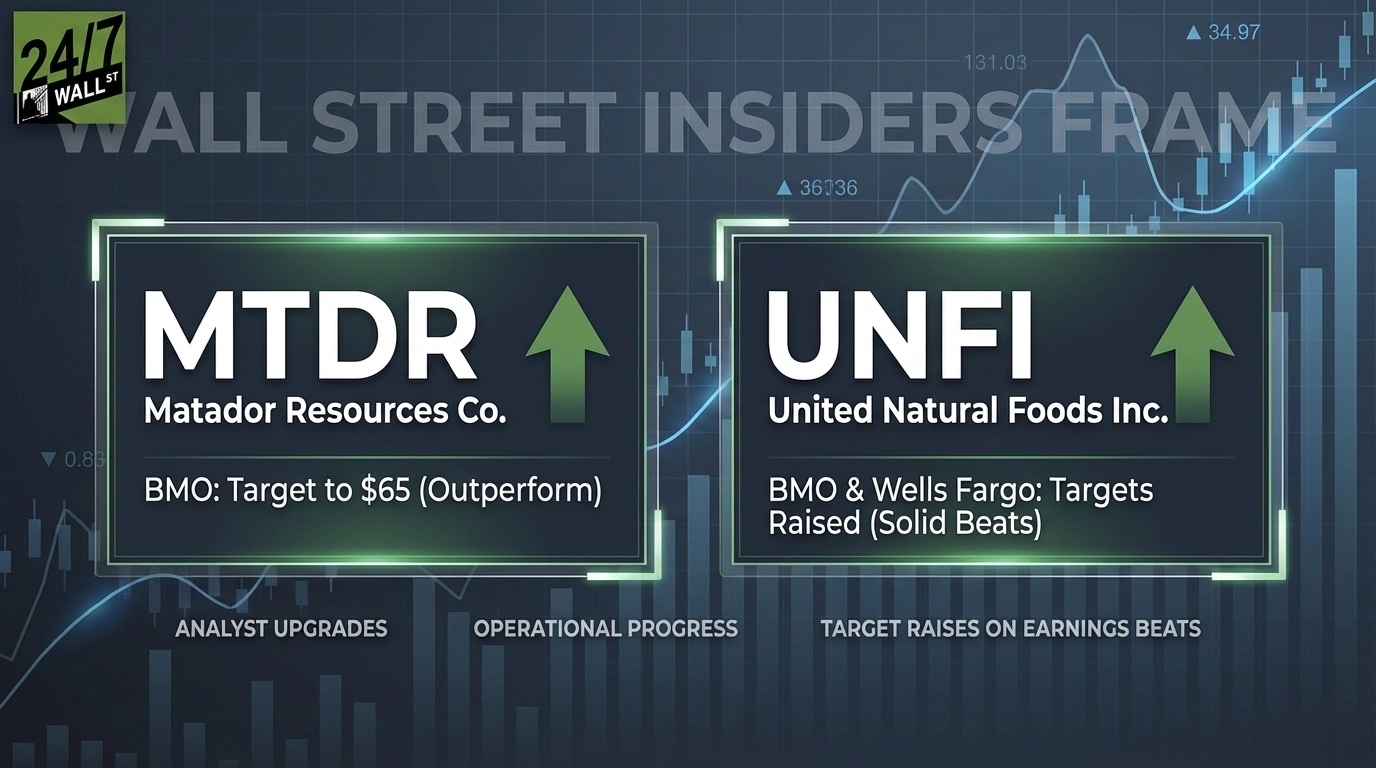
Two analyst target raises landed Wednesday morning after solid quarterly results from an oil and gas producer and a grocery distributor. BMO Capital lifted its price target on Matador Resources (NYSE:MTDR | MTDR Price Prediction) to $65 from $60 following a management meeting, while both BMO Capital and Wells Fargo raised targets on United Natural Foods (NYSE:UNFI) after the company’s Q2 fiscal 2026 earnings beat. Both firms kept their existing ratings intact, signaling conviction in the underlying operational stories rather than a change in overall stance.
| Ticker | Company Name | Firm | Old → New Rating | New Price Target | One-Line Takeaway |
|---|---|---|---|---|---|
| MTDR | Matador Resources Co | BMO Capital | Outperform → Outperform | $65 | Capital efficiency gains and pipeline catalyst underpin the bull case |
| UNFI | United Natural Foods Inc | BMO Capital | Outperform → Outperform | $52 | Network optimization ahead of schedule; EBITDA targets seen as achievable |
| UNFI | United Natural Foods Inc | Wells Fargo | Equal Weight → Equal Weight | $40 | Operational progress is real, but top-line recovery remains the key hurdle |
The Analyst’s Case
BMO Capital’s Matador target increase to $65 from $60 came after a meeting with company management. The firm highlighted Matador’s differentiated position in the Northern Delaware Core Acreage, strong operational execution, and above-average production growth as the primary reasons to stay positive. The Outperform rating was maintained without change.
On United Natural Foods, BMO described the Q2 result as a “solid beat on raise” despite softer top-line numbers, raising its target to $52 from $48 while keeping its Outperform rating. The firm emphasized that the company’s network optimization strategy is running ahead of schedule and that its EBITDA targets remain “very achievable.”
Wells Fargo was more measured, lifting its United Natural Foods target to $40 from $35 while retaining an Equal Weight rating. The firm acknowledged that the focus on efficiency and execution “continues to pay off” and called out the solid bottom-line beat and raised guidance, but flagged that top-line momentum remains a key hurdle for the stock to clear.
Company Snapshot & Recent Performance
Matador Resources is a Dallas-based independent oil and gas exploration and production company focused on the Permian Basin. The stock has had a strong start to 2026, rising 29.31% year-to-date to $54.48 as of March 10. Q4 2025 earnings were a mixed picture: revenue of $847.99 million beat estimates by 11.74%, while EPS of $0.87 missed the $0.9992 consensus as commodity price headwinds weighed on profitability. Realized oil dropped to $58.89 per barrel from $70.66 a year earlier, and Waha hub natural gas realizations collapsed to $0.91 per Mcf from $2.72 in Q4 2024. Production, however, hit a record 211,290 BOE per day, 2% above guidance midpoint.
United Natural Foods is North America’s largest grocery wholesaler, serving more than 30,000 locations. The company reported Q2 fiscal 2026 results on March 10, 2026, posting adjusted EPS of $0.62 against an estimate of $0.5053 against an estimate of $0.5053, a meaningful beat. Net sales of $7.947 billion came in below the $8.108 billion consensus, but management made clear the shortfall was deliberate: the exit of the Allentown, Pennsylvania distribution center weighed nearly 500 basis points on top-line results while driving meaningful margin improvement. The stock is up 11.91% year-to-date and trades at $37.68.
Why the Move Matters Now
For Matador, the investment case centers on a transition from commodity-price sensitivity to capital efficiency and infrastructure value. Management guided for an 11% reduction in total capital expenditures to $1.45-$1.55 billion in 2026, alongside a 6% decline in drilling and completion costs to $785-$805 per lateral foot and well cycle times shortened by roughly 13%. The most watched near-term catalyst is the Hugh Brinson pipeline, expected online in Q3 2026, which would shift gas sales from the discounted Waha hub to Henry Hub pricing. Management has quantified the sensitivity at roughly $90 million in incremental annual revenue per $0.50 per MMBtu improvement — a meaningful number given that Henry Hub closed February 2026 at $3.62 per MMBtu. Approximately 50% of 2026 oil production is hedged with costless collars featuring a floor near $53 per barrel and a ceiling near $66, providing downside protection in a WTI environment that averaged $64.51 per barrel in February 2026. CEO Joseph Foran also purchased shares in the open market at $49.78, a signal worth noting. At the current price, BMO’s $65 target represents a meaningful premium to current trading levels, and the broader analyst consensus sits at $60.42 with 14 Buy ratings and just 3 Holds among covering analysts.
United Natural Foods’ story is fundamentally about whether a margin expansion and deleveraging cycle can overcome persistent top-line pressure. The Q2 results suggest the answer is trending positive. Adjusted EBITDA rose 23.4% year-over-year to $179 million, operating income more than doubled to $57 million, and free cash flow expanded 26.56% to $243 million. Net leverage fell to 2.7x, the lowest since fiscal 2023, with management targeting approximately 2.3x by year-end. The company raised its full-year adjusted EPS guidance to $2.30-$2.70 from a prior range of $1.50-$2.30 and lifted its adjusted EBITDA outlook to $680-$710 million from $630-$700 million. CEO Sandy Douglas summarized the quarter by noting that “disciplined execution of our value creation strategy delivered growth in profitability and free cash flow ahead of our projections, which enabled us to further strengthen our balance sheet and increase our financial flexibility.” The natural segment, which grew 6.7% year-over-year to $4.29 billion, provides a cleaner read on organic demand trends.
Key Metrics to Watch
Both stocks present distinct risk-reward profiles. Matador trades at a trailing P/E of roughly 9x with a dividend yield near 2.3% — inexpensive by energy sector standards, though commodity price exposure is real and the Q4 EPS miss serves as a reminder that realized prices can move faster than production growth can compensate. The insider purchase at $49.78 and the strong Wall Street consensus add credibility to the bull case. Analysts and the company have flagged WTI pricing and the Hugh Brinson commissioning timeline as the key variables for the thesis.
United Natural Foods is a different kind of turnaround story — one where profitability is improving even as revenue shrinks by design. The divergence between BMO’s $52 Outperform target and Wells Fargo’s more cautious $40 Equal Weight target captures the central debate: how much credit to give the margin story before top-line growth resumes. Analysts have identified whether the natural segment’s momentum can eventually offset conventional segment headwinds as a key variable, along with whether the company’s fiscal 2028 targets of $33 billion in net sales and $800 million in adjusted EBITDA remain on track as network optimization winds down.










 Top Gaining Stocks
 Top Losing Stocks