



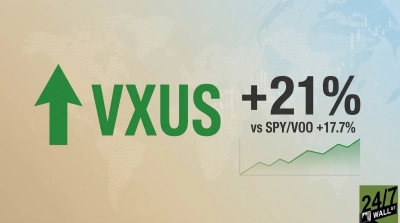
For most of the past decade, owning international stocks felt like a punishment. U.S. markets compounded at rates that made global diversification look like a drag on returns. Then 2025 happened. Vanguard Total International Stock ETF (NYSEARCA:VXUS | VXUS Price Prediction) returned 32% over the past year, while the domestic benchmark Vanguard Total Stock Market ETF (NYSEARCA:VTI) returned 22% over the same period. That gap is worth understanding before assuming the trend continues.
What VXUS Is Actually Built to Do
VXUS tracks the FTSE Global All Cap ex US Index, which means it owns essentially every investable stock outside the United States. Developed markets like Canada, Europe, and Japan sit alongside emerging markets including China and India. The fund holds thousands of positions, and even its largest holding, Royal Bank of Canada at 0.54% of the portfolio, barely registers as a concentration risk. That breadth is the point.
The return engine here is straightforward: you are buying the earnings growth and valuation expansion of non-U.S. businesses. VXUS also pays a 2.86% dividend yield, which adds a meaningful income component. The fund’s 0.05% expense ratio means almost none of that return gets eaten by fees, which matters over a 20-year holding period.
The Recent Outperformance Has Context
VXUS has had a strong run. Year-to-date through March 10, 2026, it is up 5.92% while VTI is essentially flat at 0.04%. Recent coverage has noted that VXUS posted a 38.4% one-year return versus VTI’s 15% attributing the gap to international earnings growth and valuation expansion.
Zoom out and the picture shifts considerably. Over five years, domestic stocks have meaningfully outpaced international ones, and the gap widens further over a decade. The long-run underperformance of VXUS relative to VTI is real and structural. U.S. companies have held durable advantages in earnings growth and capital returns that international markets have not matched over the same period. That is a legitimate position, and investors deserve to sit with it honestly.
The Tradeoffs Worth Understanding
Three risks come with VXUS that are easy to underestimate. First, currency exposure is real and unhedged. When the dollar strengthens, international returns shrink in U.S. dollar terms even if foreign stocks are rising in local currency. Second, the valuation argument for international stocks, while compelling today, has been compelling for most of the past decade without delivering. Lower valuations do not automatically mean higher returns on any particular timeline. Third, the dividend pattern is lumpy. VXUS paid $1.36 in December 2025 but only $0.19 in March 2025. Investors who rely on quarterly income will find the payments inconsistent.
On Reddit’s r/investing, discussions around VXUS have centered on exactly this diversification question, with VXUS frequently recommended as a core international sleeve and receiving strong community endorsement for that role.
Some investors use VXUS as an international sleeve within a broader portfolio, recognizing that a portfolio concentrated entirely in U.S. equities carries its own concentration risk. The historical data, however, shows that international stocks have underperformed domestic stocks over the long run, and there is no guarantee recent outperformance will persist.









 Top Gaining Stocks
 Top Losing Stocks