


GPIQ launched in October 2023 as Goldman Sachs’s answer to one of the most popular income ETFs ever built. With $3.1 billion in assets and a yield that clears 10%, it has earned a serious look from income investors who have long defaulted to QYLD. The two funds share the same underlying index and the same basic strategy, but the differences in how they execute that strategy are what matter.
QYLD: The Original Nasdaq-100 Income Machine
QYLD has been running the covered call playbook on the Nasdaq-100 since December 2013, and with $8.3 billion in assets, it remains the dominant fund in this category. The strategy is straightforward: hold the Nasdaq-100 and sell covered call options against the entire index each month, collecting premium that gets distributed to shareholders as income.
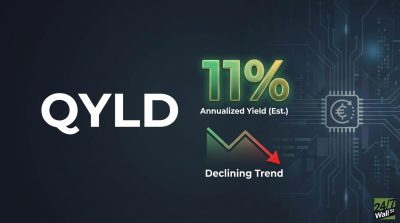
The monthly distributions have been consistent. Over the past year, QYLD paid between $0.1598 and $0.1786 per share monthly, with the most recent distribution of $0.1771 paid in February 2026. On a share price near $17.47, that adds up to a yield well above 10%.
The tradeoff is structural. By selling covered calls against 100% of the portfolio each month, QYLD surrenders virtually all upside participation when the Nasdaq rallies. The fund’s price has risen 13% over the past year, which looks reasonable until you consider that the underlying index delivered far more. The covered call cap means shareholders collect income but give up most of the capital appreciation that Nasdaq-100 investors have historically counted on.
At 0.60%, QYLD’s expense ratio is high relative to newer competitors in the same category. For a fund managing $8.3 billion, that fee gap matters when compounded over years of holding.
GPIQ: Goldman’s Lower-Cost, More Flexible Alternative
GPIQ holds essentially the same portfolio as QYLD. The sector allocations are nearly identical, with information technology at about 50% of the fund, and the top holdings mirror each other almost perfectly. Nvidia, Apple, and Microsoft sit at the top of both funds in the same order, with similar weights.
Where GPIQ diverges is in how it sells options. Rather than writing one large at-the-money call on the full index each month, Goldman uses a laddered approach with multiple shorter-duration contracts at varying strike prices. The fund’s holdings data shows four separate short call positions with different expiration dates and strike prices running simultaneously. This structure lets the fund retain some upside participation when markets move higher, rather than capping gains entirely at the start of each month.
The distributions reflect a meaningfully higher dollar amount per share. GPIQ paid $0.45273 in its most recent March 2026 distribution, and has paid between $0.385 and $0.474 per share monthly over the past year. On a share price near $50.87, the yield clears 10% on an annualized basis.
The price performance over the past year tells an interesting story. GPIQ gained 22% on a price basis over the trailing 12 months, compared to 13% for QYLD. That gap suggests Goldman’s laddered approach captured more upside during Nasdaq rallies than QYLD’s full-notional monthly call writing allowed.
The picture looks different so far in 2026. GPIQ’s price is down about 1% year-to-date while QYLD is up about 1%, a reminder that the laddered structure does not eliminate downside exposure when the Nasdaq sells off — it only improves the upside capture during rallies.
The expense ratio is where Goldman made a deliberate competitive move. At 0.29%, GPIQ costs less than half of what QYLD charges. Over time, that difference compounds in the shareholder’s favor.
Why Elevated Volatility Matters Right Now
The environment for covered call strategies is currently favorable in a specific way. The VIX closed at 29.49 on March 6, 2026, sitting at the 94th percentile of all readings over the past year. Higher volatility means richer option premiums, which translates directly into larger distributions for both funds. The 12-month average VIX was 19.07, so current conditions are producing meaningfully more premium income than the long-run baseline.
This cuts both ways. Elevated volatility often accompanies market stress, and both funds hold the same Nasdaq-100 stocks that have been selling off. The income cushion helps, but it does not fully offset price declines in the underlying portfolio when the index drops sharply.
The Key Differences Side by Side
| Metric | QYLD | GPIQ |
|---|---|---|
| Assets Under Management | $8.3 billion | $3.1 billion |
| Expense Ratio | 0.60% | 0.29% |
| Inception Date | December 2013 | October 2023 |
| Most Recent Monthly Distribution | $0.1771 per share | $0.4527 per share |
| 1-Year Price Return | 13% | 22% |
| Options Strategy | Single monthly at-the-money call on full index | Laddered multi-contract approach |
Which Fund Fits Which Investor
QYLD’s appeal is its track record. Over 12 years it has paid through bull markets, bear markets, and everything in between. For an investor who values a long distribution history and maximum liquidity, QYLD’s $8.3 billion in assets provides deep trading volume and institutional familiarity. The fund has also demonstrated that its share price can recover after downturns, gaining 45% over five years on a price-only basis while paying out substantial income throughout.
GPIQ makes a compelling case on cost and structure. The lower expense ratio means more of the gross premium income reaches shareholders rather than the fund manager. The laddered options approach has shown it can capture more upside in rising markets, as the trailing 12-month price return comparison illustrates. The fund is younger, but Goldman’s infrastructure and the fund’s rapid growth to $3.1 billion in assets suggest it is not going anywhere.
GPIQ’s lower expense ratio and laddered options structure resulted in higher price appreciation over the trailing 12 months. QYLD’s longer track record spanning over 12 years and larger asset base of $8.3 billion provide a longer distribution history and deeper trading liquidity. The two funds differ primarily on cost, options methodology, and tenure — factors investors may weigh differently depending on their own research and priorities.











 Top Gaining Stocks
 Top Losing Stocks