



Monthly income checks from a tech-heavy portfolio sound appealing, but the mechanics behind how QYLD generates that income determine whether it belongs in your portfolio. The answer depends almost entirely on what you need your money to do.
What QYLD Actually Does
Global X NASDAQ 100 Covered Call ETF (NYSEARCA:QYLD) holds the same stocks as the Nasdaq 100 and sells covered call options against those holdings every month. Buyers pay premiums upfront, and those premiums become the income QYLD distributes to shareholders. Think of it like renting out a house: you collect steady rent, but if the property value surges, you’ve already agreed to a ceiling on what you can capture.
The fund’s benchmark is the Cboe Nasdaq-100 BuyWrite V2 Index, which tracks this systematic covered call strategy. With $8.3 billion in net assets and a track record dating to December 2013, QYLD is one of the most established income ETFs in the covered call space, with a dedicated following in communities like r/qyldgang and r/dividends.
The Tech Exposure Underneath
Because QYLD mirrors the Nasdaq 100, the underlying portfolio is heavily concentrated in technology. Information technology alone accounts for nearly 50% of the portfolio, with communication services and consumer discretionary adding another 28% combined. The top seven holdings, including Nvidia, Apple, Microsoft, Amazon, Tesla, Meta, and Alphabet, represent roughly 38% of the fund. This is not a diversified income fund. It is a tech bet with an income overlay.
Does the Income Hold Up?
Monthly distributions have been consistent. Throughout 2025, QYLD paid between $0.16 and $0.19 per share each month, with the most recent payment in February 2026 coming in at about $0.18. That consistency is the fund’s clearest selling point for investors who need predictable cash flow.
But the income has a ceiling problem. Distributions have declined from their 2021 peak, and the premiums QYLD collects shrink when market volatility falls. In calm, rising markets, the options it sells command lower prices, which means less income. The fund cannot grow its payout the way a dividend-growth stock can.
What You Give Up for the Yield
The most important number for evaluating QYLD is not the yield. It is the total return gap versus owning the Nasdaq 100 directly. Over the past five years, QQQ gained 90% while QYLD’s price rose just 44% on an adjusted basis, a gap that reflects how much upside the covered call strategy surrenders in a bull market. That divergence is not a short-term anomaly. It is structural, and it compounds into a significant long-run wealth cost for investors who stay in the fund through extended bull cycles.
Stretch that window to ten years and the divergence becomes even more pronounced. Invesco QQQ Trust (NASDAQ:QQQ | QQQ Price Prediction) gained QQQ gained 454% while QYLD’s price appreciated QYLD’s price appreciated 140%, illustrating that the income premium compounds into a significant long-run wealth cost.
That gap matters because QYLD’s yield is paid out of option premiums and, at times, out of the fund’s own capital. When the market rallies sharply and the calls it sold get exercised, the fund misses those gains. The income is real, but it comes at the cost of long-run wealth accumulation.
The Real Tradeoffs
QYLD’s structure creates a permanent ceiling on gains. Because the fund sells at-the-money calls on the full Nasdaq 100 each month, shareholders largely miss out when the market rallies sharply — the upside belongs to whoever bought those calls. This is not a bug but a deliberate design choice: the fund trades growth potential for immediate income.
The tax treatment amplifies this tradeoff for taxable accounts. Distributions are taxed as ordinary income rather than at the lower qualified dividend rate, which erodes the effective yield for investors in higher brackets. The fund also charges a 0.60% annual expense ratio, making tax-advantaged accounts the natural home for this strategy.
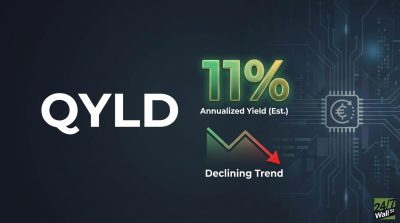
With the 10-year Treasury yielding 4.2%, QYLD’s 11% distribution yield represents a real income premium. But that premium reflects real equity risk, not a free lunch from options.
Who This ETF Is Actually For
QYLD has historically attracted investors who prioritize current income over long-term price appreciation, particularly those in tax-advantaged accounts where ordinary income tax treatment is less of a concern. The historical return data above illustrates the tradeoff between income generation and long-run wealth accumulation.









 Top Gaining Stocks
 Top Losing Stocks