


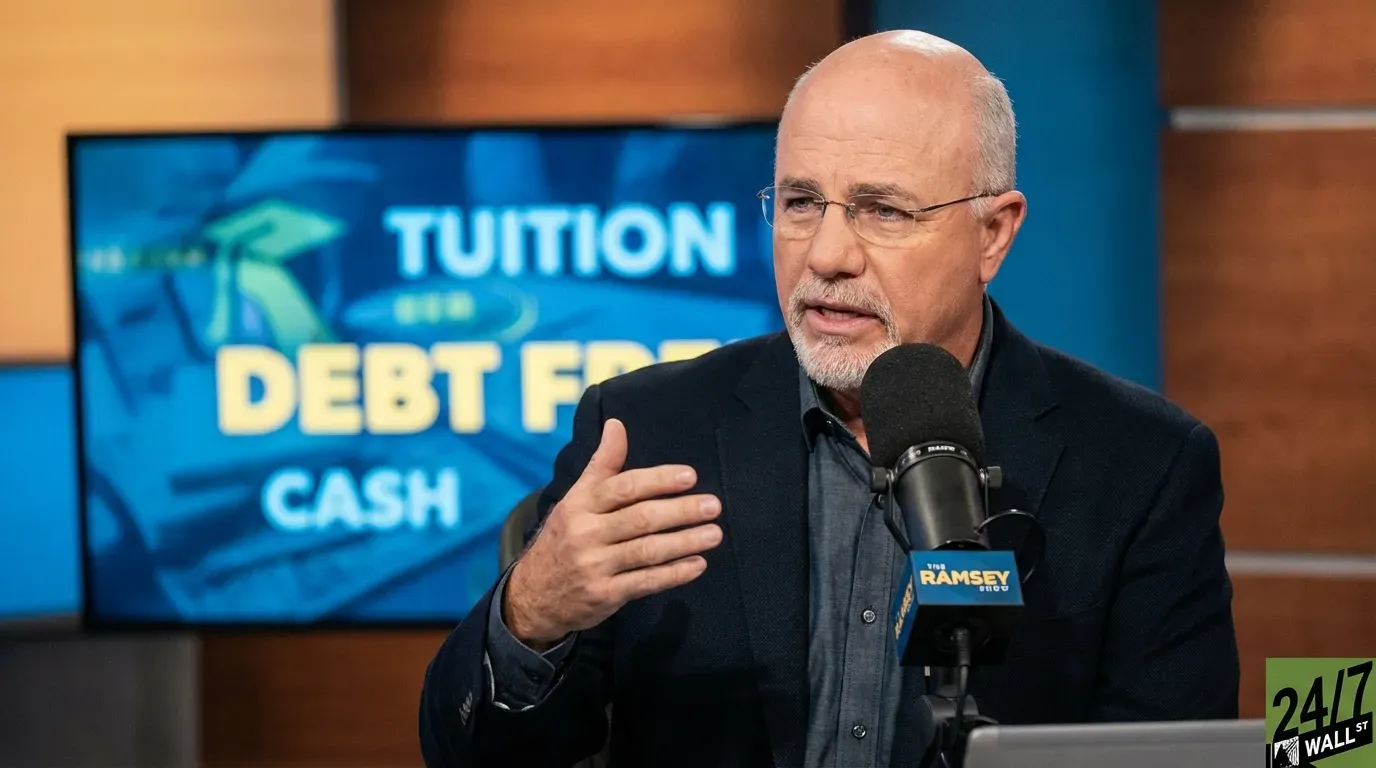
Christian from Fort Worth called The Ramsey Show on April 1 with a problem that sounds complicated but actually isn’t. He has $11,000 saved, $2,400 in credit card debt, and a $15,000 tuition bill due in June for an online biomedical sciences degree. He works two jobs. He wanted to know whether to chip away at the credit card first, take out a student loan for the gap, or just grind toward the full tuition amount in cash.
Dave Ramsey’s answer was immediate: “I would pay for the tuition in cash and not add and not use debt ever again.” His co-host Jade Warshaw added the reasoning: “Debt eats at your ability to build wealth over time. It steals your hard-earned income and causes you not to be able to do things like invest, not to be able to do things like pay cash for emergencies.” “Debt eats at your ability to build wealth over time. It steals your hard-earned income and causes you not to be able to do things like invest, not to be able to do things like pay cash for emergencies.”
Ramsey is right, and the math is specific enough to prove it.
Why Borrowing $4,000 Would Cost Christian More Than He Thinks
Christian’s gap between savings and tuition is $4,000 (he needs $15,000 and has $11,000). The temptation is to borrow that $4,000 in federal student loans, which carry a 6.53% interest rate for undergraduate borrowers in the current academic year. On a standard 10-year repayment plan, a $4,000 loan at that rate produces a modest total interest cost over the life of the loan. That sounds manageable.
But Christian already carries $2,400 in credit card debt. Credit card interest rates currently average above 20% annually. If he diverts $2,000 toward the card as he originally considered and borrows the tuition gap, he is now managing two debt balances simultaneously while completing a demanding one-year degree program. The behavioral cost matters as much as the interest math: every month he carries both balances is a month he cannot direct full income toward building a financial cushion.
Ramsey’s instruction was to “pay minimums on that [credit card], and save up and pay cash for this tuition, and then work on the debt beyond that.” “pay minimums on that [credit card], and save up and pay cash for this tuition, and then work on the debt beyond that.” That sequencing keeps Christian’s focus on a single, achievable goal: accumulate $4,000 more before June. With two jobs, that is realistic. The unemployment rate is 4.4%, and the labor market has stayed in the 4.1% to 4.5% range over the past year, meaning Christian’s ability to keep both jobs and add hours is reasonably well-supported by current conditions.
The Specific Profile Where This Advice Works
Ramsey’s cash-for-tuition strategy fits a narrow but real profile: a student with a short, defined program (one year), a specific and reachable savings gap, demonstrated income from multiple sources, and a degree with a clear vocational payoff. Christian checks every box. He works full-time as a certified medical assistant and bartends on weekends. Biomedical sciences has direct employment pathways. The program costs $15,000 total, not $150,000. The gap is $4,000, not $40,000.
The advice breaks down for a student facing a $40,000 annual tuition gap at a four-year institution with inconsistent income and no clear runway to close the difference through earnings alone. In that scenario, avoiding loans entirely may mean not completing the degree at all, which is a worse financial outcome than carrying manageable debt toward a credential that raises lifetime earnings. Context matters. Christian’s context happens to align almost perfectly with the cash-first framework.
What Christian Should Actually Do
- Stop paying extra on the credit card now. Pay only the minimum on the $2,400 balance until after June. At a $2,400 balance, the minimum payment is typically a small fraction of the balance. Every dollar above that minimum goes into the tuition savings account instead.
- Open a high-yield savings account for the tuition fund. With the CPI sitting at 327.5 and inflation continuing to erode purchasing power, even a 4% to 5% yield on the savings balance helps. On $11,000 held for four months, that is a meaningful offset against inflation over the four-month window.
- After June, attack the $2,400 aggressively. With no tuition payment and two income streams, Christian should be able to eliminate the credit card balance in two to three months. Once it’s gone, the income that was going to minimums becomes the foundation of an emergency fund.
Consumer sentiment has stayed below 60 for months, and the personal savings rate dropped to 4% in Q4 2025 from 6.2% in early 2024, a sign that Americans broadly are borrowing to fill gaps that savings used to cover. Americans broadly are borrowing to fill gaps that savings used to cover. Christian is doing the opposite. Ramsey’s praise at the end of the call was earned: “I would pay for the tuition in cash and not add and not use debt ever again.” the discipline to work two jobs and save $11,000 while in school is the hard part. Avoiding a $4,000 loan to finish the job is just the logical conclusion of what Christian already started.













 Top Gaining Stocks
 Top Losing Stocks