


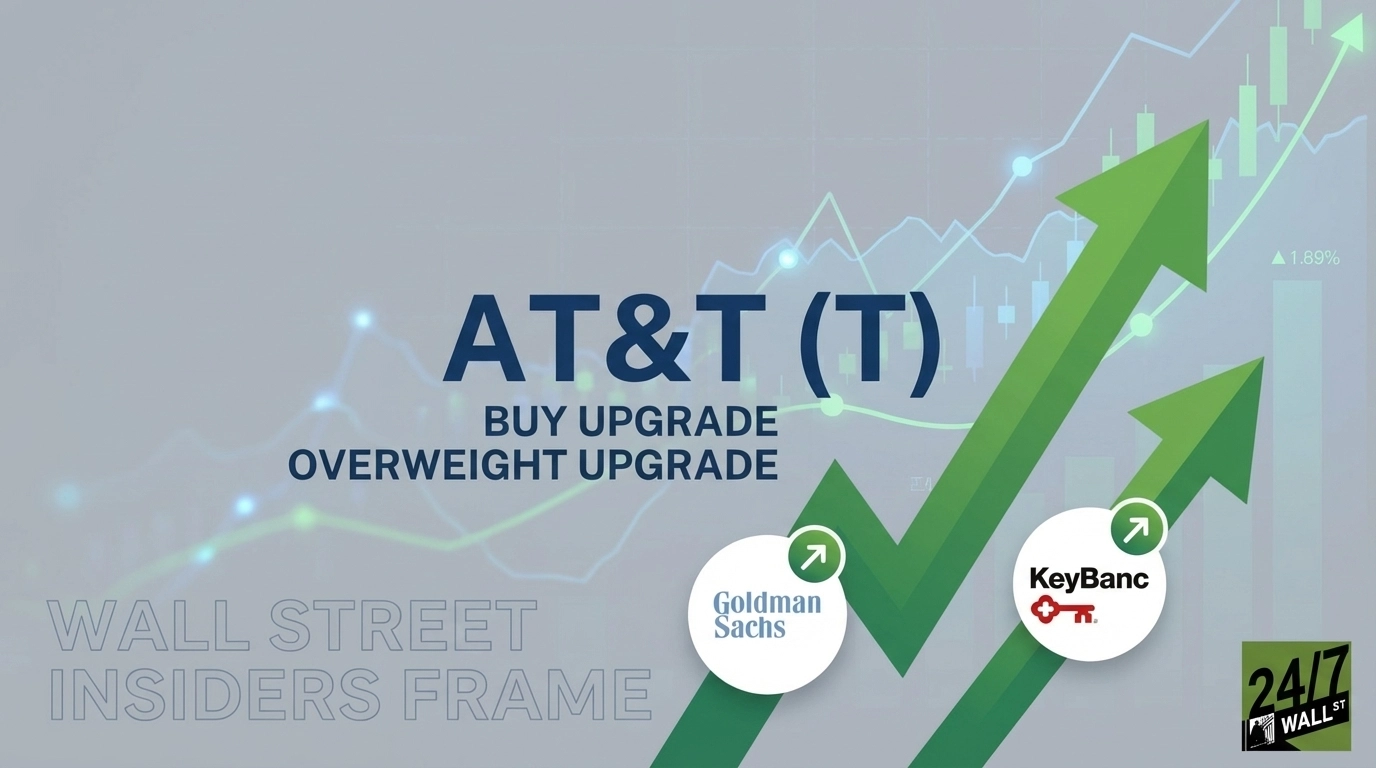
AT&T (NYSE:T | T Price Prediction) received price target increases from two Wall Street firms on Wednesday, with Goldman Sachs and KeyBanc both citing the company’s new segment reporting structure and converged customer momentum as reasons to revise their outlooks higher. The stock is up more than 5% over the past week, bringing its year-to-date gain to more than 17% alongside an attractive dividend that currently yields 3.84%.
| Ticker | Firm | Rating | Old Target | New Target |
|---|---|---|---|---|
| T | Goldman Sachs | Buy | $30 | $33 |
| T | KeyBanc | Overweight | $30 | $36 |
New Segments, Clearer Story
Beginning with Q1 2026 results, AT&T is adopting a three-segment reporting structure: Advanced Connectivity, Legacy, and Latin America. KeyBanc is updating its model to reflect the new segments and its view on 2026 wireless service revenue growth cadence and pricing actions. Goldman Sachs similarly flags the new structure as a catalyst for improved investor transparency. CEO John Stankey framed the rationale directly on the Q4 earnings call: “By separating the performance of our advanced connectivity business from our declining legacy segment, we believe investors will have greater transparency into the returns we’re generating on our growth investments in 5G and fiber.”
CFO Pascal Desroches added important scale context: “In 2025, advanced connectivity drove about 90% of our revenues and over 95% of our adjusted EBITDA on a recast basis.” That concentration makes the Legacy drag more visible but also more manageable. KeyBanc expects Advanced Connectivity EBITDA growth of 6% to 7% to offset Legacy drag beyond 2027, allowing total EBITDA to accelerate from roughly 3% in 2026 to over 5% by 2028, consistent with AT&T’s own guidance range.
Converged Customers as the Core Thesis
Both firms point to converged customer growth as the structural driver behind the upgraded targets. AT&T appears best positioned to drive converged customers to over 12 million by 2030, according to KeyBanc. The current data supports that trajectory: the fiber convergence rate climbed 200 basis points year over year to 42%, the fastest annual increase since AT&T began tracking the metric. Stankey noted the competitive implication directly: “We estimate that our share of postpaid phone subscribers is 10 percentage points higher in areas where we offer fiber than in areas where we don’t.”
AT&T added 283,000 AT&T Fiber net adds in Q4 and 421,000 postpaid phone net adds in the same period, with churn holding at 0.98%. Full-year fiber connections reached 10.4 million, up 11.5% year over year.
What Investors Should Watch
Goldman Sachs flags that postpaid ARPUs face pressure from competitive pricing, back-book cuts, and targeted discounts, even as industry postpaid net addition trends remain stable. That tension between subscriber growth and per-unit pricing will be the key variable to track when AT&T reports under its new segment structure in Q1.
The company’s 2026 adjusted EPS guidance of $2.25 to $2.35 and free cash flow target of $18 billion or more set a clear benchmark against which the new reporting will be measured. With the stock up 17.58% year to date, the bar for continued outperformance is rising alongside the targets.










 Top Gaining Stocks
 Top Losing Stocks