


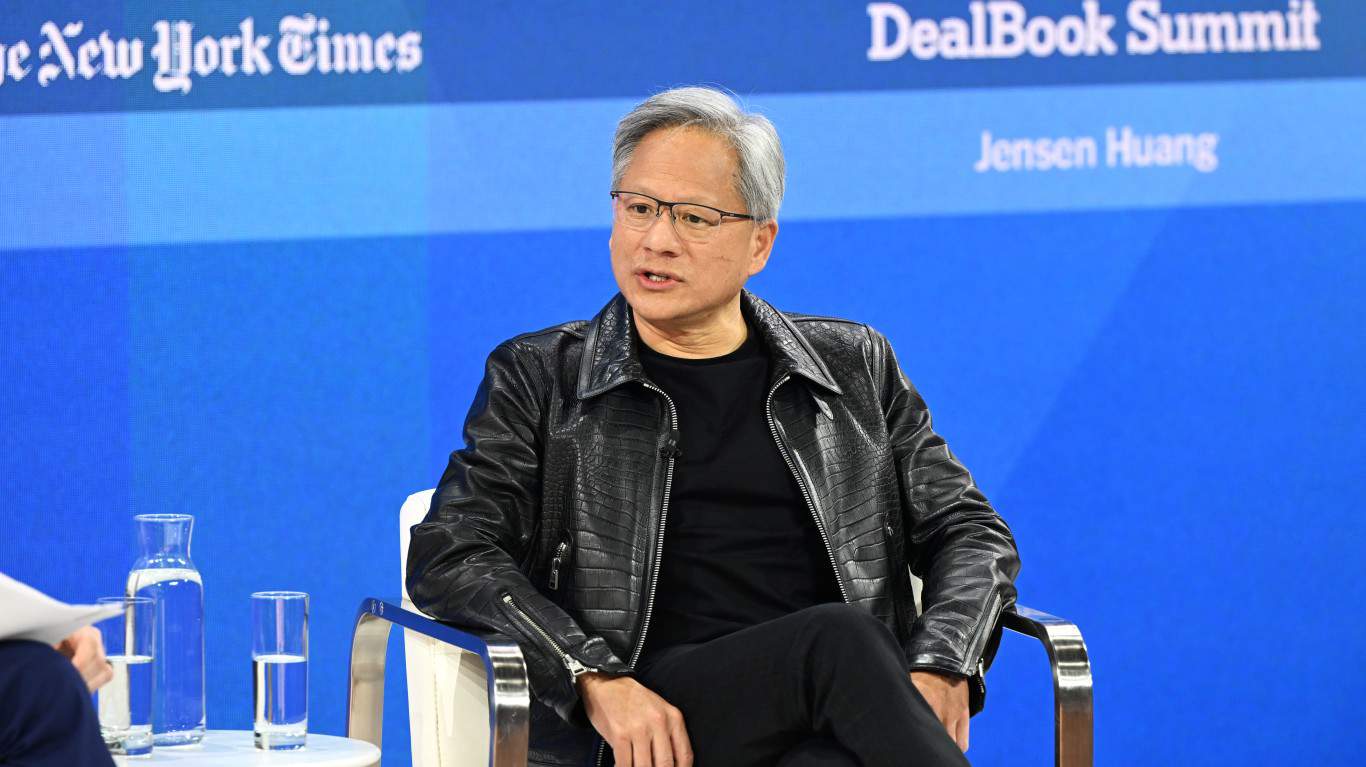
I’ve been holding Nvidia’s stock for years now, and even though I’ve watched about major interview CEO Jensen Huang has done, his recent framing of their business was so incredible that I wanted to share it with you as well.
On the Dwarkesh Podcast, he reduced the entire business to one sentence: “The input is electron, the output is tokens. That is in the middle Nvidia.”
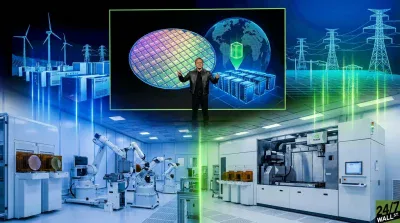
That’s the whole thesis: a factory that converts electricity into intelligence.
What an AI Factory Actually Is
Nvidia (NASDAQ:NVDA | NVDA Price Prediction) has spent years building toward this framing. Jensen has called data centers “AI factories” across multiple earnings calls, but the Dwarkesh appearance sharpened the concept. Every kilowatt of power flowing into a Blackwell rack comes out as tokens, the unit of AI output that every model, agent, and application runs on.
The numbers back the metaphor. Data Center revenue hit $62.3 billion in Q4 FY2026, up 75% year over year. Networking, the connective tissue of those factories, grew 263% year over year to roughly $11 billion, driven by the NVLink fabric ramp. Free cash flow for the quarter was $34.9 billion, up 124% year over year.
For full-year context, Nvidia has nearly $100 billion in supply purchase commitments, with Semi Analysis reporting the figure closer to $250 billion when broader supply chain obligations are included.
Why Commoditization Fears Miss the Point
The bear case on Nvidia usually goes: models get cheaper, token prices fall, demand softens. Jensen’s counter is structural. He argues the number of AI agents and tool users will grow exponentially, so even as the cost per token falls, total token volume accelerates. He specifically called out engineering software, predicting demand for tools like Synopsys Design Compiler will “skyrocket” as engineers get backed by fleets of agents exploring design space at unprecedented scale. His caveat: “The reason why it hasn’t happened yet is because the agents aren’t good enough at using their tools yet.”
The earnings calls support this directionally. Microsoft processed over 100 trillion tokens in Q1 FY2026, a fivefold increase year over year. Reasoning models compound that demand further. As Jensen explained: “The token generation amount, the number of tokens reasoning goes through, is a hundred, a thousand times more than a one-shot chatbot.”
The Supply Chain as Competitive Moat
Jensen’s real moat, as he described it on the podcast, is his ability to align the entire supply chain around his vision. Suppliers invest specifically for Nvidia because they trust he can absorb supply and sell it downstream. His annual GTC keynotes function as “education” to help the supply chain reason about AI’s trajectory. He was candid about the limits: “at some level, the instantaneous demand is greater than the supply upstream and downstream.”
That’s a near-term constraint worth watching. But for a company guiding to ~$78 billion in Q1 FY2027 revenue while holding 57 buy ratings and a $268 analyst consensus target, the market is clearly betting the factory model holds. When electrons keep getting cheaper and tokens keep getting more valuable, the machine in the middle tends to win.








 Top Gaining Stocks
 Top Losing Stocks