


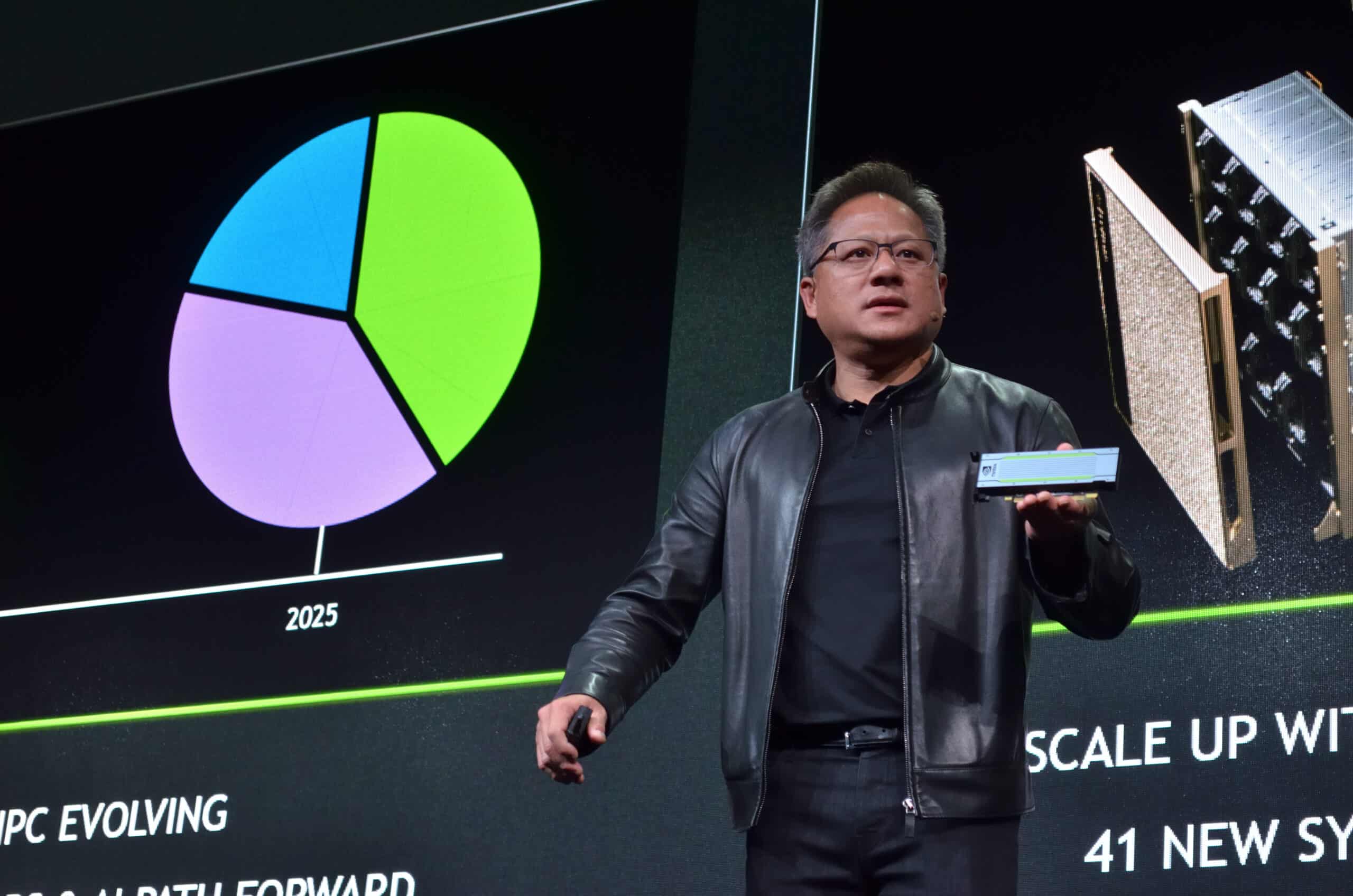
NVIDIA (NASDAQ:NVDA | NVDA Price Prediction) CEO Jensen Huang recently appeared on the Dwarkesh Podcast and said something that stands out in an industry where supply shortages routinely trigger price spikes. “I understand that others in the chip industry change their prices when demand is higher, but we just don’t. We just don’t. That’s just never been a practice of ours.”
That is a striking statement from the CEO of a company sitting on $96.6 billion in annual free cash flow while its chips remain among the most sought-after products in the technology industry.
How the Queue Works
Huang explained that NVIDIA allocates chips based on a queue system tied to data center readiness and purchase order timing. If NVIDIA quoted you a price, that price holds. When demand surges, as it has throughout the current AI infrastructure buildout, the line gets longer. The price tag does not move.
The philosophy behind this is deliberate. Huang framed NVIDIA’s goal as being “the foundation of the industry.” Customers planning billion-dollar data center investments need cost predictability. Dependability, in Huang’s framing, is part of the product itself.
The Tension Investors Should Understand
The podcast host pushed back directly, questioning why NVIDIA would leave money on the table during severe supply shortages. It is a fair challenge. When Blackwell GPUs are sold out and cloud providers are racing to secure capacity, a market-clearing price would almost certainly be higher than NVIDIA’s list price.
Investors can read this two ways. The disciplined view: stable pricing builds deep, long-term enterprise relationships that sustain revenue across cycles. The skeptical view: NVIDIA is forgoing real profit during the moments when its pricing power is at its absolute peak. Both readings are defensible. Q4 FY2026 non-GAAP gross margins reached 75%, so the business is clearly not struggling. But those margins might look different if dynamic pricing had been applied during the tightest supply windows.
The TSMC Connection
The podcast host drew an interesting parallel to NVIDIA’s manufacturing relationship with Taiwan Semiconductor Manufacturing (NYSE:TSM). The same principle of reliability that Huang applies to customers appears to run through NVIDIA’s supply chain partnerships. TSMC reported 41% year-over-year quarterly revenue growth, and the first NVIDIA Blackwell wafer produced on U.S. soil came from TSMC’s Arizona facility, underscoring how deeply the two companies are intertwined.
For investors, the core takeaway from Huang’s comments is that NVIDIA is deliberately trading short-term pricing upside for long-term customer trust. Whether that trade is the right one is a question the 77% one-year price gain has not yet fully answered.












 Top Gaining Stocks
 Top Losing Stocks