



Private credit assets aren’t traded on an open market, so valuations are often based on internal models rather than real-time price discovery. That leads to what looks like smooth, stable returns. But that stability is, to a large extent, an illusion.
Public markets reprice assets every second they’re open. Private credit funds, on the other hand, report net asset values periodically, often quarterly, and those values can lag reality. Add in things like redemption restrictions or outright freezes during stress periods, and investors can find themselves locked in just when they want liquidity most.
Fees are another issue. Between management fees, performance fees, and underlying costs, the total expense burden can be substantial, especially compared to public market alternatives. If the goal is to access high-yield lending strategies without those constraints, there’s a more transparent option: Business development companies, or BDCs.
These are publicly traded, pass-through investment vehicles that lend to middle-market companies, often the same type of borrowers you’d find in private credit portfolios. In many ways, they’re designed to give Main Street investors access to strategies traditionally reserved for institutional capital.
But there’s still a learning curve. Experienced BDC investors tend to focus on metrics like net investment income coverage, non-accrual rates, portfolio yield, leverage ratios, and management track records. For most investors, that level of analysis can be a barrier.
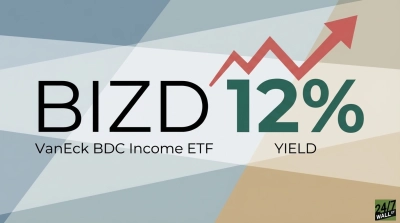
That’s where ETFs come in. One of the most widely used options in this space is the VanEck BDC Income ETF (NYSEMKT: BIZD), which currently manages just under $1.6 billion in assets. Year to date, it’s down 3.47% on a net asset value total return basis as of April 20, 2026. But for income-focused investors, there are still several reasons to take a closer look.
How BIZD Works
BIZD is a passive ETF that tracks the MVIS US Business Development Companies Index. The index is market-cap weighted, which means larger BDCs receive higher allocations. These tend to be more established firms with stronger balance sheets, better access to capital, and longer track records.
While market-cap weighting isn’t perfect, it works reasonably well in this space. If your goal is to prioritize stability, scale, and manager reputation, it’s a practical approach. The ETF currently holds about 35 BDCs, giving you diversified exposure across the industry.
Understanding the Yield
With BIZD, you’ll often see multiple yield figures, and they can look very different:
- The 30-day SEC yield, which is based on recent income after expenses, sits at 8.44%.
- The distribution yield, which annualizes the most recent payout, is much higher at 14.65%.
- Then there’s the trailing 12-month yield at 13.1%, reflecting what investors actually received over the past year.
If you assume recent quarterly payouts will continue, the distribution yield may be more relevant. If you prefer to look at realized income, the trailing yield is useful. If you want a more conservative snapshot, the SEC yield is the cleanest measure. In practice, averaging these gets you to roughly 10% to 11%, which is a reasonable expectation under stable conditions.
With its high yield reinvested, BIZD has delivered a 7.86% annualized returns over the past decade on a net asset value basis. This isn’t a bond substitute, nor is it a pure equity play. It sits somewhere in between. You’re taking on credit risk, equity-like volatility, and reliance on capital markets, all in exchange for higher income.
The Fine Print on Fees
One of the first things investors notice about BIZD is the headline expense ratio of 12.86%. That looks extreme, but it requires context.
Only about 0.40% is the actual management fee paid to VanEck, with another 0.02% in direct expenses. The remaining 12.44% consists of acquired fund fees and expenses. These are the underlying costs of the BDCs themselves, including their management and incentive fees, which are passed through to investors.
In other words, you’re not really paying 12.86% on top of the BDCs. You’re seeing the full cost of owning the underlying vehicles aggregated into one number. It’s largely unavoidable in this space.











 Top Gaining Stocks
 Top Losing Stocks