


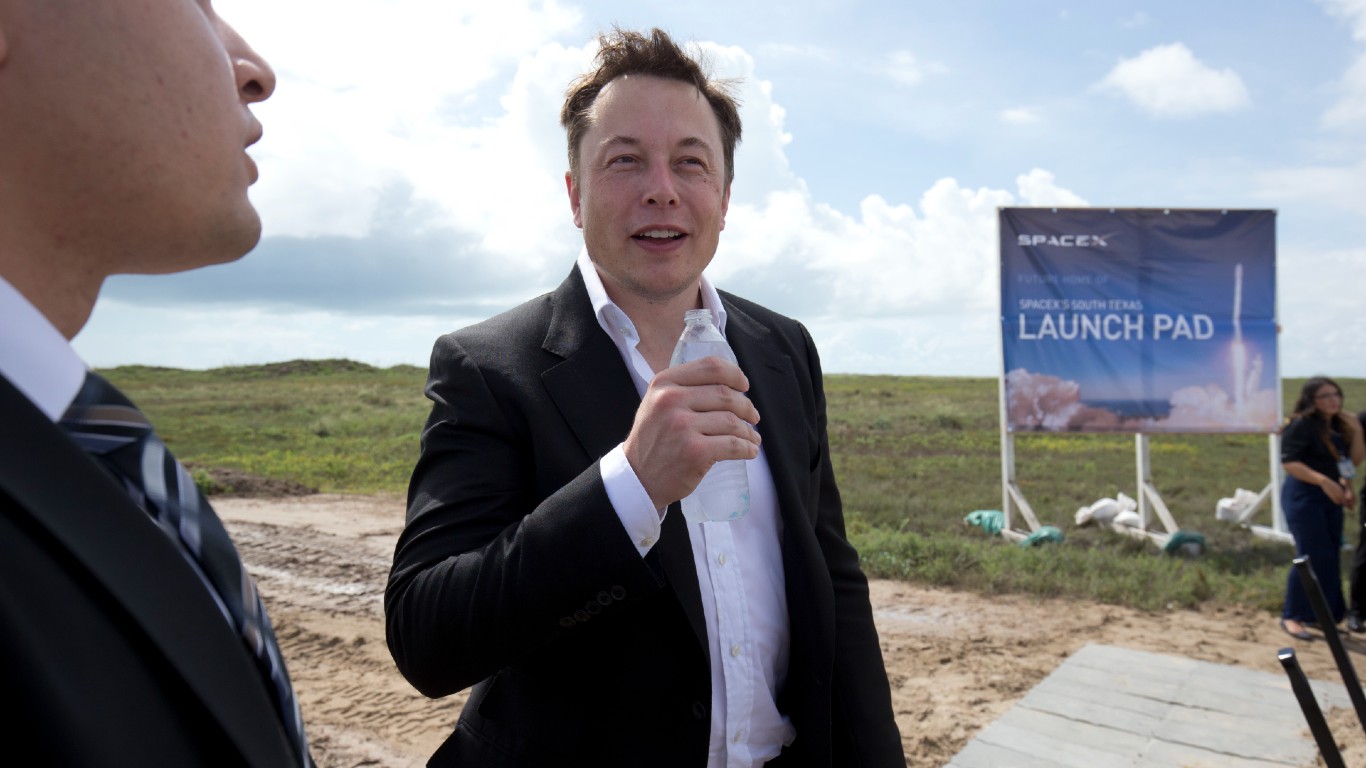
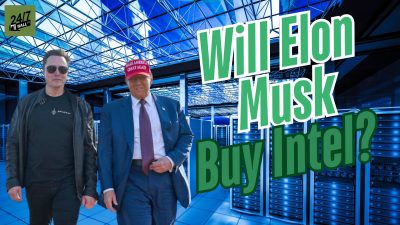
Something rare happened on Intel (NASDAQ:INTC | INTC Price Prediction)’s earnings call. CEO Lip-Bu Tan effectively told investors that Elon Musk will teach Intel more about running a chip business than Intel will teach Musk. For a company that spent decades as the default answer in silicon, that’s a striking shift.
The moment came when Tan was asked about Musk’s TerraFab project. He declined to confirm whether the venture would use Intel’s 14A process, even though Musk name-checked Intel on Tesla’s own call a day earlier.
Tan and CFO Dave Zinser indicated Intel expects to benefit more from working with Musk than the other way around, pointing to Musk’s track record in process optimization and cutting inefficiencies. Musk’s expertise in process optimization and eliminating inefficiencies is something Intel wants to learn from.
Why the hedge matters
Intel’s foundry business remains opaque because the company does not publicly name foundry customers. A confirmed TerraFab win alongside SpaceX, xAI, and Tesla as strategic partners would be the marquee validation the foundry story has lacked. Tan’s refusal to confirm the 14A question signals genuine humility rather than typical IR script.
The numbers give him room to be candid. Intel posted non-GAAP EPS of $0.29 against a $0.01 consensus, on revenue of $13.58 billion, up 7.18% year over year. Data Center and AI revenue climbed 22% and Intel Foundry grew 16%. It was the sixth consecutive quarter of revenue above expectations. The stock, already up roughly 81% year to date and 224% over one year, moved from $67.32 at filing to $80.23 an hour later.
A government-backstopped balance sheet
Intel’s recent recapitalization left the U.S. government as its third-largest shareholder, just ahead of NVIDIA (NASDAQ:NVDA), which completed a $5.0 billion equity purchase. That backstop gives Tan the freedom to sound like a student rather than a monopolist. Intel Xeon 6 was also selected as host CPU for NVIDIA’s DGX Rubin NVL8 systems, adding credibility to the foundry pitch.
The Musk side of the trade
Musk’s leverage is earned. Tesla (NASDAQ:TSLA) just posted Q1 revenue of $22.39B, up 15.8% YoY, with automotive gross margin of 21.1% and a groundbreaking at a SpaceX-partnered semiconductor research fab at Gigafactory Texas. I’ve been following Intel for more than a decade, and the idea of its CEO openly wanting to import Musk’s factory discipline is genuinely new.
The H2 risk investors should not ignore
Intel warned on the PC market for the back half of the year. PC makers spent the first half burning through stockpiled memory chip inventories, and those inventories are running out, creating a bifurcated year where H1 strength reverses. Q2 guidance of $13.8B to $14.8B in revenue and non-GAAP EPS of $0.20 reflects that.
A humbler CEO, a government-anchored balance sheet, and an unconfirmed-but-plausible marquee foundry customer give Intel a different risk/reward shape than it has carried in years. If Tan absorbs what Musk teaches and ships 14A at yield, this is the turnaround. If the H2 PC air pocket collides with foundry slippage, the re-rating reverses fast.






 Top Gaining Stocks
 Top Losing Stocks