


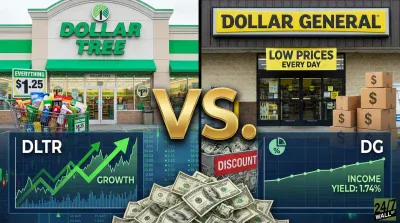
Dollar Tree (NASDAQ: DLTR | DLTR Price Prediction) currently trades near $98, while the average Wall Street price target stands at $124.74, leaving over 27% of implied upside between today’s price and the consensus.
Dollar Tree is the pure-play discount banner that emerged after the Family Dollar divestiture closed in July 2025. Wall Street has been watching the multi-price Dollar Tree 3.0 format, now rolled out to roughly 5,300 stores, drive a streak of comp gains and margin expansion. The gap between price and target matters because the operational story has held up, yet the stock keeps drifting lower.
The setup is a classic dislocation: strong fundamentals, weak tape.
A 6% Monday Slide With No Clean Catalyst
Shares fell from $103.75 on Friday to $97.49 on Monday, a 5.5% one-day decline that pushed the stock to five-month lows. No single news item explains it. Possible drivers include sector-wide weakness, pre-earnings de-risking, and renewed tariff anxiety, but none rises to the level of confirmed catalyst.
Zoom out and the bleed is broader. Dollar Tree is down 8.6% over the past week and 20.3% year-to-date from a starting price of $123.01. That YTD move puts it well behind a roughly flat-to-slightly-positive S&P 500 in the same window. The 52-week range of $78.70 to $142.40 shows just how wide the trading band has been.
Insiders were selling, not buying, into the strength that preceded this drop. CEO Mike Creedon disposed of 10,224 shares at $108.70 on April 1, alongside coordinated sales by the CFO and several other officers. There is no sign of insider dip-buying at current levels.
Why The Sell Side Is Sticking With the Story
The bull case rests on operational consistency. Q4 FY2025 delivered EPS of $2.56, revenue of $5.45 billion (up 9.0% year over year), comps of 5.0%, and a 150-basis-point gross margin expansion to 39.1%. CEO Creedon called it the “20th consecutive year of positive same store sales.” Management’s FY2026 guide calls for net sales of $20.5 billion to $20.7 billion and adjusted EPS of $6.50 to $6.90.
The near-term catalyst is Q1 FY2026 earnings, expected in early June. Barchart’s preview points to adjusted EPS of $1.55, up 23% year over year, fitting inside the company’s own $1.45 to $1.60 guide. Analysts also point to a tailwind from the Strait of Hormuz reopening on April 17, 2026, which pulled oil and freight costs lower.
Coverage skews mixed but constructive:
- Strong Buy: 2
- Buy: 7
- Hold: 12
- Sell: 3
- Strong Sell: 3
The standout is JPMorgan, which carries an Overweight rating and a $160 target raised from $140 in January 2026. Bernstein is more cautious at Hold with a $124 target. Remember: targets are a reference point, not a guarantee.
What the Tape Actually Says
Again, Dollar Tree currently changes hands near $98, against a consensus target of $124.74 spread across roughly 27 covering analysts. Trailing P/E is 16 on TTM EPS of $6.23, with forward P/E of 15.
Shares are down 20.3% year to date, while the S&P 500 has seen a 4.8% gain over the same stretch. The one-year return is still positive at 21.6%, so this remains a pullback inside a longer uptrend.
Capital return remains aggressive: $1.8 billion remains under buyback authorization as of January 31, 2026, after roughly $1.548 billion in FY2025 repurchases.
The Pullback Setup And The Traffic Line
The bull thesis strengthens if Q1 prints near the high end of guidance, traffic stabilizes, and management reiterates the FY2026 EPS bracket. That combination would force the Hold camp to reset and pull the stock back toward JPMorgan’s $160 target as the cleanest path to the consensus.
The bear case calcifies if IndexBox’s 11.8% three-year annual revenue decline, a stagnant store base, the $500 million new term loan, and Corvex Management exiting its entire position in Q4 2025 carry real weight. Q4 traffic fell 1.2%, which is the metric to watch most closely. If ticket growth is masking a customer who comes less often, multiple expansion will not happen.
On balance, the data leans cautiously constructive. The valuation is reasonable, the buyback is meaningful, and the June earnings print is a near-term catalyst that can re-rate the stock. The traffic line is the metric that will confirm or deny the re-rating thesis.








 Top Gaining Stocks
 Top Losing Stocks