


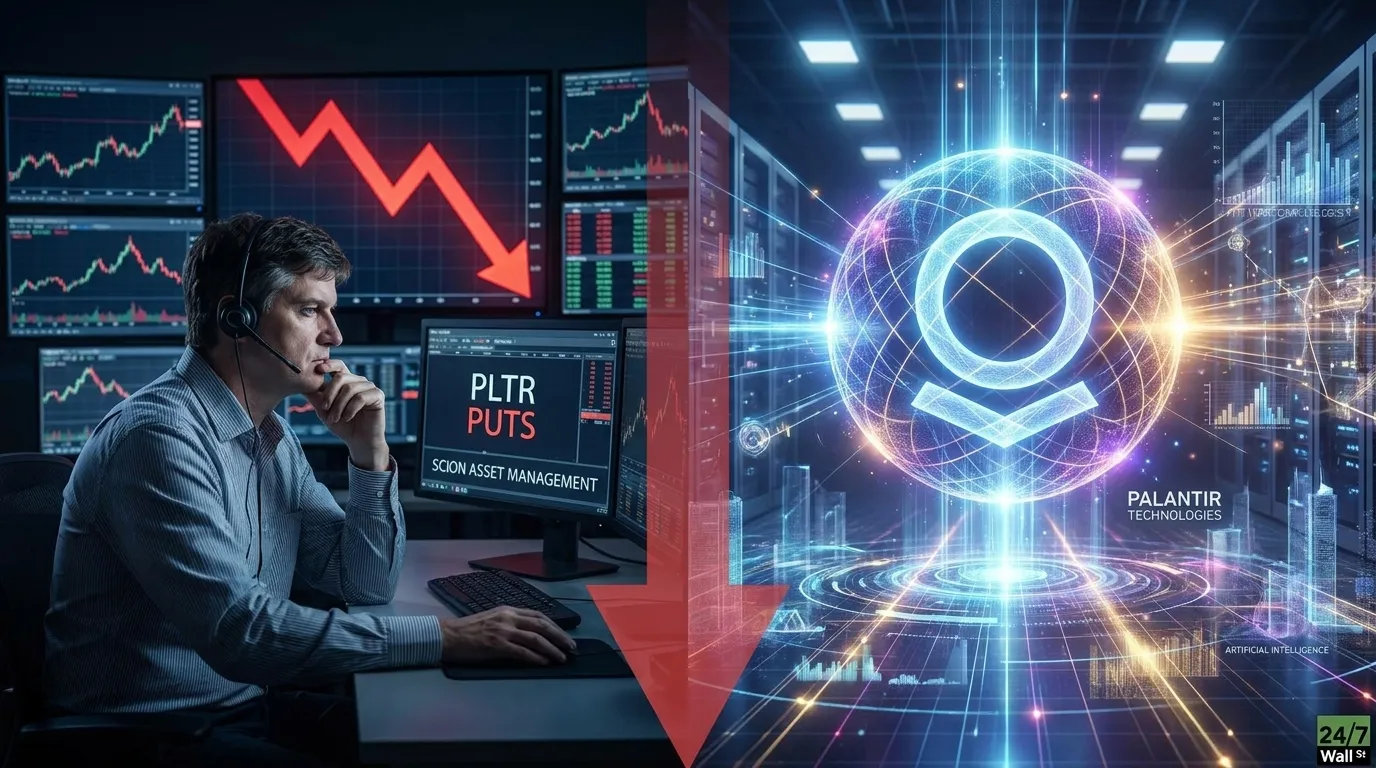
Michael Burry is still short Palantir (NASDAQ:PLTR | PLTR Price Prediction). He has been since the fall of 2025, and as of his Substack post on April 10, 2026, he is not flinching. “I now own the June 17 2027 Strike Price 50 Puts and the December 19, 2026 Strike Price 100 Puts. I am not selling these today,” Burry wrote, after President Trump praised the company on Truth Social and momentarily rescued the stock from a brutal week.
Burry is not backing down
The position itself is famous. Last fall, Scion Asset Management’s 13F showed roughly $912 million in notional bearish put exposure to Palantir, an entry that startled the market because Burry had been quiet for years and because Palantir was the most loved stock in retail’s universe. CEO Alex Karp called the wager “super weird” and “bats— crazy.” Yahoo Finance later reported the trade is up roughly 35% since Burry’s Q3 2025 entry.
Burry’s thesis, laid out at length on his Substack in February, is that a fair price for Palantir might sit around $46 a share, with scenarios ranging from $21 to $146 depending on assumptions. He pointed at heavy stock-based compensation, a long unprofitable history, and what he characterized as deal-driven sales rather than compounding ones. On April 10 he doubled down: “I believe the fundamental value of this company is well under $50/share.”
Then there is what Palantir is actually doing
Q4 2025, reported February 2, was the kind of earnings report Karp uses to taunt his critics: revenue of $1.41 billion (70% YoY), with U.S. commercial up 137% and U.S. government up 66%. Margins and earnings impressed too, with a 41% GAAP operating margin, net income of $608.68 million (up 670% YoY), and a Rule of 40 score of 127%, roughly three times what software investors usually call great. Karp’s commentary in the release was characteristically subtle:
“Palantir’s Rule of 40 score is now an incredible 127%… We are an n of 1, and these numbers prove it. Palantir is alone in choosing to exclusively focus on scaling the operational leverage made possible by the rapid advancements of AI models, a trend that we first called ‘commodity cognition’ well before others started repeating it.”
Management guided 2026 revenue to $7.182-$7.198 billion (61% YoY) with U.S. commercial growth of at least 115%. Free cash flow was $2.27 billion in 2025 and is guided to $3.925-$4.125 billion in 2026. You can read the official numbers on the SEC’s site in the Q4 earnings release 8-K, which also disclosed a record total contract value of $4.262 billion in Q4 alone, up 138% YoY.
Why Burry is still bearish
Burry’s wager is, fundamentally, a valuation call. Palantir carries a trailing P/E of 224, a forward P/E of 111, and a price-to-sales ratio of 76. Insiders have been steady sellers all spring. Peter Thiel disposed of more than 1.9 million shares in early March at prices in the $140-$147 range, the kind of corroborating signal short sellers love to point at even when much of the activity is mechanical compensation churn.
The market has cooled on the name. PLTR is at $138.02 today, down 20.57% YTD and 2.24% on the session. The 200-day moving average sits up at $164.43, well above current levels. Polymarket traders still give roughly 81.5% odds that Palantir beats Q1 earnings, and split 50/50 on whether the company crosses 1,000 customers. The operational story looks intact. The valuation story is where the actual fight happens.
The arithmetic Burry is running, in plain English, looks like this. Even if Palantir hits every guided number for 2026, the stock still trades at something like 80 times adjusted operating income, which only works if you believe 2027 and 2028 deliver another doubling. Karp clearly does. Burry clearly does not, and he is willing to pay theta to wait for the gap to close.
What to watch: Q1 2026 earnings, expected in early May, with Palantir guiding revenue of $1.532-$1.536 billion. A clean beat keeps Karp’s flywheel narrative going. Anything close to in-line, on a stock priced for parabolic growth, is the moment Burry’s rolling puts actually start to matter.











 Top Gaining Stocks
 Top Losing Stocks