


At $384.27, Alphabet (NASDAQ:GOOG | GOOG Price Prediction) looks attractive on a research basis, even after a 30.5% one-month run. The stock cleared $380 last week on a Q1 earnings beat that nearly doubled consensus. The question is whether buying below $400 leaves room for a path to $600.
Alphabet’s search and advertising business is well known, but the chart driver is Google Cloud, which grew 63% to $20.03 billion in Q1 with a $462 billion backlog. That backlog, along with Gemini‘s developer traction and Waymo’s commercial ramp, expanded the multiple from a value-stock 18x to a growth-stock 29x.
Why $384 Could Still Be Early
The bull case rests on segment growth no other hyperscaler matches. Cloud operating margin jumped from 17.8% to 32.9%, cloud operating income tripled YoY, and Sundar Pichai said on the call that “our cloud revenue would have been higher if you were able to meet the demand.” Roughly 50% of the $462 billion backlog is expected to be recognized over the next 24 months.
Q1 EPS of $5.11 against a $2.63 estimate is a 94.1% surprise, the largest in recent history and the fourth straight beat. Revenue grew 21.8% YoY, operating margin expanded to 36.1%, and Gemini now processes 16 billion tokens per minute via direct API.
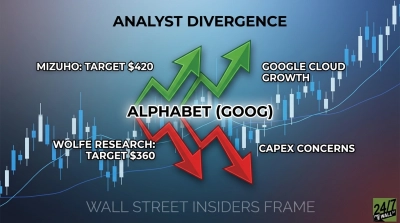
Wall Street is mostly aligned. 61 buy ratings, 6 holds, zero sells. The in-house Fuse model projects $495.35 in 12 months and a bull-case $568.76.
Where the Capex Math Breaks Down
Free cash flow dropped 46.63% YoY to $10.12 billion because capex more than doubled to $35.67 billion. Management raised full-year 2026 capex to $180 billion to $190 billion and warned that “2027 CapEx [will] significantly increase compared to 2026.” That is real money spent before the backlog converts to cash.
Net income’s 81% jump was flattered by $36.91 billion in unrealized equity gains. Strip those out and the operating story remains solid, just less heroic. Google Network revenue declined to $6.97 billion, hedging swung negative, and insiders have logged 158 recent transactions, net selling.
Polymarket assigns only 34% to 37% probability that Alphabet ends 2026 as the world’s largest company by market cap, with essentially no probability mass above $420 in May. The crowd does not see $600 anytime soon.
Why Waiting Two Quarters Has a Real Cost
The hold case lives in that gap. Cloud is genuinely accelerating, but the capex cycle has not produced a clean read on durable returns. Search remains the franchise, but AI Overviews have not been monetized enough to know whether per-query economics improve or decay.
Waiting two more quarters lets the data answer the question. The cost of patience is real if Cloud stays above 60% growth. The cost of buying now is mostly the 1.27 beta and a 29x multiple in a market that has already priced in plenty.
The Numbers in Context
GOOG trades at $384.27, up 22.54% YTD and 132.21% over the past year, against the S&P 500’s the S&P 500’s more modest year-to-date and one-year gains. Consensus analyst target sits at $394.45 across 67 covering analysts, implying modest near-term upside.
The ratings split breaks down as follows.
- Strong Buy, 13 analysts
- Buy, 48 analysts
- Hold, 6 analysts
- Sell, zero analysts
Polymarket prices a 74% probability of GOOG hitting $400 in May and 56.9% for $410.
Why $384 Still Looks Attractive on Research Grounds
At $384.27, Alphabet screens favorably on the research metrics that matter.
The path to $600 is an 18-to-24 month story that hinges on backlog conversion, Gemini monetization, and capex translating into operating leverage. Fuse’s bull case crosses $600 by November 2027; the base case gets there by May 2028.
The risk and reward asymmetry skews positive below $400. If capex pays off, the current 29x multiple holds and earnings do the work. If it does not, the bear case still implies consolidation around $385 to $445 rather than a steep drawdown. That is a rare setup at $4.6 trillion of market cap.
What would invalidate the thesis is cloud growth decelerating below 35% with no margin offset, a regulatory ruling that severs the search-ad linkage, or 2027 capex climbing past $250 billion without matching revenue. Watch Q2 cloud growth, operating margin, and whether Gemini Enterprise sustains 40% paid MAU growth.
You are paying 29x for the only hyperscaler that owns the model, the cloud, the software stack, and silicon competing with NVIDIA (NASDAQ:NVDA), and if you believe in AI, the case for Google as a primary beneficiary is hard to dismiss.









 Top Gaining Stocks
 Top Losing Stocks