



Markets can handle bad news. What they struggle with is uncertainty. That’s why investors have spent much of 2026 reacting just as much to geopolitical headlines as to earnings reports — from Iran tensions to tariff threats to the growing militarization of trade routes.
Now President Donald Trump has opened another front investors may need to price in: direct U.S. military action against Mexican drug cartels. At a White House event honoring military mothers, Trump said, “Drugs coming in by sea are down 97% and now we’ve started the land force, which is much easier… if they’re not gonna do the job, we’re gonna do the job.” The question for investors isn’t political. It’s economic.
Why Wall Street Would Treat This as an Economic Event
Mexico is no longer just a neighboring country in economic terms. It is America’s largest trading partner, according to U.S. Trade Representative data, with total goods trade exceeding $872.8 billion in 2025. That’s more than twice the U.S.-China trade of $414.7 billion
That matters because the modern North American economy is deeply interconnected. Auto parts cross the border multiple times before a finished vehicle reaches consumers. Food, electronics, industrial machinery, and semiconductors all depend on uninterrupted border logistics.
If investors start fearing military escalation near key trade corridors, markets would likely respond immediately.
Here’s what history suggests happens during geopolitical shocks:
| Asset/Sector | Likely Reaction |
| Defense stocks | Rise |
| Oil prices | Rise |
| Gold | Rise |
| Airlines | Fall |
| Retail/importers | Fall |
| Mexican peso | Fall |
| Treasury bonds | Rise |
That shows how investors move toward safety and away from uncertainty. Granted, Trump framed the comments around stopping fentanyl trafficking and border security, not broader military occupation. But markets rarely wait for details before repricing risk.
Defense and Energy Stocks Could Be Early Winners
Let’s start with the sectors that could benefit.
Defense contractors have already outperformed the broader market over the past two years as global conflicts expanded. According to company filings and FactSet data:
- Palantir Technologies (NYSE:PLTR | PLTR Price Prediction) stock has risen more than 25% over the past 12 months as military AI spending accelerated.
- Lockheed Martin (NYSE:LMT) generated $75 billion in 2025 revenue with a backlog exceeding $194 billion.
- RTX (NYSE:RTX) produced almost $89 billion in annual sales while expanding missile and surveillance contracts.
If cartel operations become treated more like counterinsurgency missions, investors could expect higher spending on:
- Drones
- Border surveillance
- AI intelligence systems
- Cybersecurity
- Tactical equipment
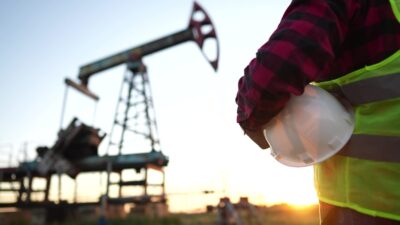
Surprisingly, the energy sector could also benefit even if Mexico is not a major oil battlefield. Oil prices can often rise on perceived supply risk even if there is no actual physical supply disruption.
Higher oil prices would help:
That said, higher energy prices would also raise inflation concerns again — something the Federal Reserve has been trying to cool for nearly three years.
The Bigger Risk Is Supply Chains and Inflation
The real market risk isn’t the military operation itself. It’s whether trade and transportation become disrupted.
Mexico has become central to the “nearshoring” trend as companies shifted manufacturing away from China. According to the U.S. International Trade Commission, imports from Mexico rose 5.8% last year while Chinese imports declined.
That benefits companies, including:
If border crossings slow or violence escalates near industrial hubs, transportation costs could rise quickly. And investors already know what persistent supply-chain stress looks like. Between 2021 and 2023:
- U.S. CPI inflation peaked at 9.1%
- Vehicle prices surged over 20%
- Freight rates tripled on some routes
Wall Street has largely assumed those pressures are behind us. Military tensions along the southern border could challenge that assumption. Markets would probably tolerate a short, targeted operation far better than an open-ended conflict.
Key Takeaway
In short, Trump’s comments introduce a new category of market risk investors can’t ignore. If military operations against Mexican drug cartels remain limited and coordinated with Mexico’s government, markets would likely absorb the shock after an initial wave of volatility.
But if the situation escalates into broader instability affecting trade, supply chains, or energy markets, investors could start pricing in slower economic growth and renewed inflation pressure.
For savvy investors, the clearest takeaway may be sector positioning rather than broad panic. Defense, cybersecurity, and energy stocks could benefit from rising security spending. Industrials, automakers, airlines, and retailers tied to Mexican imports may face more pressure.
When all is said and done, Wall Street cares less about political rhetoric than economic consequences. Investors should, too.










 Top Gaining Stocks
 Top Losing Stocks