



A rental property generating $2,000 a month in net income is a goal millions of Americans chase. Building that income with dividend stocks is more accessible than most realize and requires no landlord license or midnight roof repairs.
The target is $24,000 per year, or $2,000 per month. Four tickers span the yield spectrum: Realty Income Corporation (NYSE:O | O Price Prediction), Main Street Capital Corporation (NYSE:MAIN), Global X SuperDividend U.S. ETF (NYSEARCA:DIV), and Global X SuperDividend ETF (NYSEARCA:SDIV). Each pays monthly and sits at a different point on the risk-return curve. The capital required depends entirely on which tier you choose.
The Conservative Anchor: Realty Income at About 5%
Realty Income has paid 665+ consecutive monthly dividends and raised its payout 113 consecutive quarters. The annualized dividend is $3.24 per share. With shares trading near $63.56, the current yield is about 5.1%.
To generate $24,000 per year at 5%, you need approximately $480,000 in capital.
The tradeoff is favorable. Realty Income’s portfolio occupancy sits at 98.9% across over 15,500 properties in 92 industries. Management guided 2026 AFFO per share of about $4.40, implying roughly 2.8% dividend growth. That growth compounds. Income does not stay flat at $24,000 but creeps higher yearly, while the 10-year Treasury offers about 4% with zero growth.
The Middle Ground: DIV and SDIV at 6% to 7%
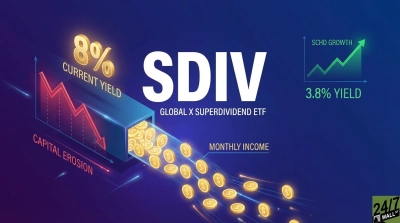
The two Global X ETFs occupy the moderate tier. DIV carries a 6.1% dividend yield with a 0.45% expense ratio and holds 50 equity positions concentrated in energy infrastructure, utilities, and consumer staples. SDIV yields 7.3% with 22.1% of assets in financials, including mortgage REITs and global exposure across North America, Europe, Asia-Pacific, and Latin America.
At 6.1% (DIV), you need approximately $393,000. At 7.3% (SDIV), you need approximately $329,000. That is $87,000 to $151,000 less capital than the conservative tier.
Both funds pay monthly. DIV’s recent payments have run $0.102 to $0.108 per share in early 2026. SDIV has delivered $0.19 per share monthly through most of 2025 and into 2026. The catch: distributions fluctuate with portfolio income rather than growing on schedule. You get higher current yield in exchange for less predictability over time.
The High-Yield Engine: Main Street Capital at About 8%
Main Street Capital is a business development company, not a REIT. The regular monthly dividend is $0.26 per share. Add four quarterly supplemental dividends of $0.30 each, and the total annualized payout is about $4.32 per share. Against a share price near $53, that yields roughly 8.1%.
At 8.1%, you need approximately $296,000. That is $184,000 less than Realty Income.
Main Street’s fundamentals support this yield. Q4 2025 distributable net investment income came in at $1.09 per share, comfortably covering the $1.08 in total dividends paid that quarter. Full-year 2025 return on equity was 17%, and NAV reached a record $33 per share. CEO Dwayne Hyzak noted the company has declared 18 consecutive quarterly supplemental dividends and 11 increases to the regular monthly dividend since Q4 2021. The risk is that BDC income is sensitive to credit conditions and benchmark interest rates. Non-accruals and realized losses are part of the business model in ways they are not for a net lease REIT.
Why the Lowest Yield Often Wins Over Time
A 5% yield that grows 6% annually doubles its income in roughly 12 years. A 7% yield with no growth stays at $24,000 forever. After a decade, the Realty Income investor collects meaningfully more per year than they started with.
Realty Income’s dividend has grown from roughly $0.17 per share monthly in 1999 to about $0.27 today, a meaningful increase over 27 years of compounding small raises. That engine makes the conservative tier competitive over long horizons despite requiring the most upfront capital.
Three Steps Before You Allocate
- Calculate your actual monthly spending. Most people need to replace 70% to 80% of gross salary in retirement. If your real number is $1,600 a month rather than $2,000, capital required at every tier drops 20%.
- Model the tax treatment of each tier. Realty Income dividends are mostly ordinary income. SDIV’s international holdings add foreign tax complexity. Main Street’s return-of-capital components reduce your cost basis over time. Run the after-tax yield comparison in your actual bracket before committing capital.
- Compare 10-year total return, not just current yield. A 5% yield with 6% annual dividend growth can outperform a 7% yield with flat distributions. Look at how each vehicle has performed on a total return basis over a full market cycle before deciding allocation.













 Top Gaining Stocks
 Top Losing Stocks