


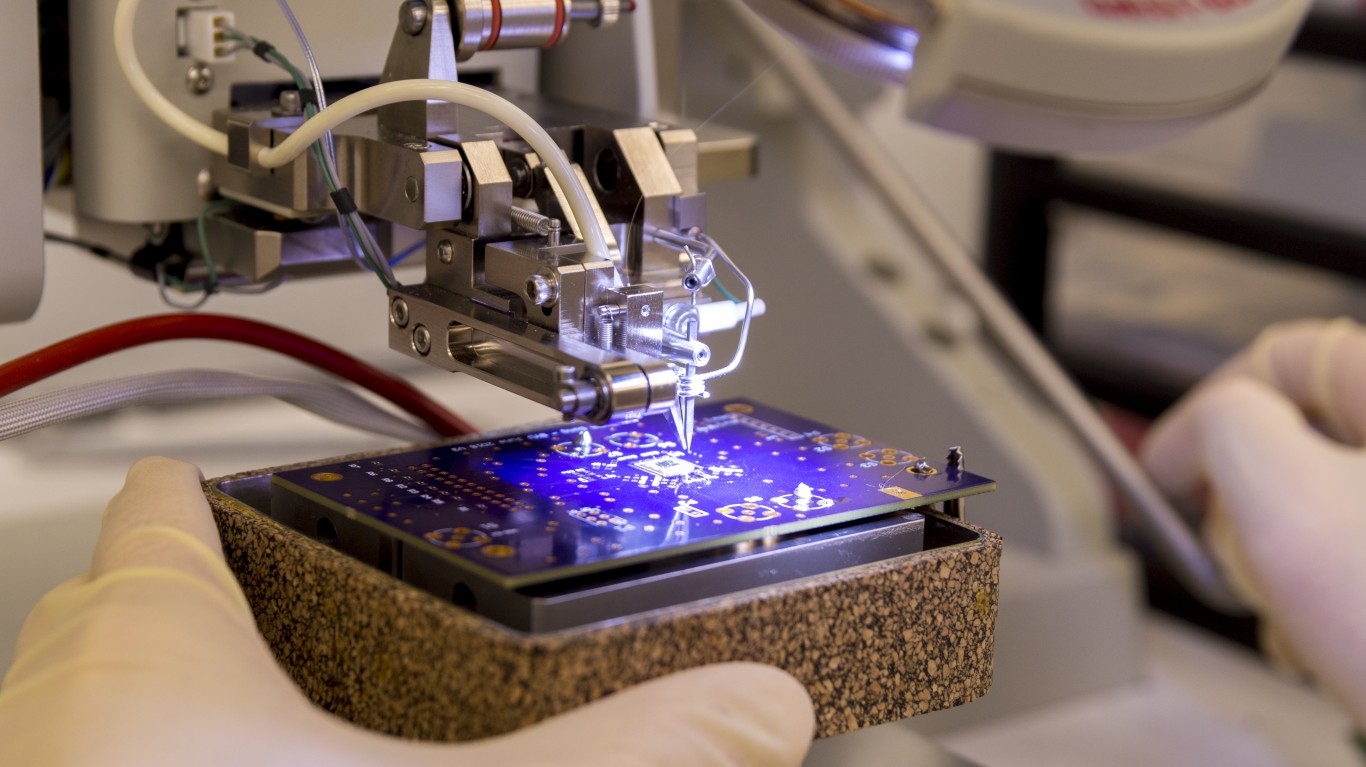
Intel (NASDAQ:INTC | INTC Price Prediction) has long eyed its foundry business as a path to revival. Launched in 2021 as Intel Foundry Services (IFS), the unit aims to manufacture chips for external clients, challenging the dominance of Taiwan Semiconductor Manufacturing (NYSE:TSM).
Intel’s ambitions hinge on advanced nodes like 18A, with high-volume production begun at its Arizona facility, backed by $7.86 billion in U.S. CHIPS Act funding. Yet, IFS has struggled with delays and losses, which reportedly grew to $13 billion in 2024, amid yield issues. A potential deal with Apple (NASDAQ:AAPL), however, could mark a turning point, injecting credibility and revenue into Intel’s push for foundry independence.
A Low-Stakes Bet on 18A
According to TF International Securities analyst Ming-Chi Kuo, Apple could tap Intel’s 18A process for entry-level M-series chips starting in 2027, which would represent a calculated diversification move. These chips, aimed at budget iPads and Macs, will involve volumes of just 15 million to 20 million units annually — a fraction of Apple’s 200 million-plus silicon needs. Unlike the high-performance cores for premium iPhones, which rely on Taiwan Semi’s cutting-edge 2nm and 3nm nodes, this trial focuses on simpler designs where yield risks are lower.
Intel’s 18A, featuring RibbonFET transistors and PowerVia delivery, promises power efficiency gains over prior generations. Apple, burned by supply disruptions during the pandemic, sees value in a U.S.-based alternative.
Arizona’s Fab 62 aligns with Apple’s domestic push, reducing geopolitical exposure to Taiwan amid U.S.-China tensions. Sources indicate Apple tested 18A samples earlier this year, with yields meeting internal benchmarks for low-end applications.
This wouldn’t be a full pivot; Apple remains wedded to Taiwan Semiconductor for 80% of its production. But it signals IFS is maturing. Intel’s foundry has secured deals with smaller players like MediaTek, but Apple’s name carries weight, potentially drawing others wary of Taiwan Semi’s capacity crunch.
From Red Ink to Revenue Reality?
For Intel, this would be more than a win — it would be validation. IFS has bled cash, with 2024 losses exceeding $13 billion as Intel poured resources into process R&D. The Apple order, though modest, could generate $500 million to $1 billion in annual revenue by 2028, according to analyst estimates. That’s a slim number, but it would cover fixed costs on underutilized fabs and build a track record.
Critics point to Intel’s history of execution slips — 18A was delayed from 2024 — but recent progress, including high-volume manufacturing trials, suggests momentum. Former CEO Pat Gelsinger staked Intel’s future on foundry parity with Taiwan Semi by 2027, but CFO David Zinsner recently said that while 18A yields are “adequate,” they “are not where we need them to be.” He does not foresee them hitting peak capacity until “the end of the decade.”
An Apple endorsement offers encouragement, easing investor skepticism after Intel’s shares previously tumbled on it lagging behind on AI. It also positions IFS for defense contracts, leveraging U.S. security clearances.
Supply Chain Shuffle
A deal would also underscore Apple’s supply chain evolution. After 2019, when it ditched Intel CPUs for in-house silicon, Apple rebuilt ties subtly — sourcing some Mac components via IFS. Now, with global chip demand surging 10% yearly, dual-sourcing offsets risks. Others might follow suit, especially after Nvidia (NASDAQ:NVDA) recently announced it would invest $5 billion in Intel in exchange for a stake in the company.
Taiwan Semiconductor Manufacturing would be unfazed, as it is expected to remain Apple’s primary supplier for premium chips through at least the end of the decade. Yet Intel’s edge is its proximity — U.S. fabs cut shipping times versus Taiwan’s 10,000-mile haul, though the industry leader is building out its own U.S.-based facilities.
Key Takeaways
This arrangement would have a negligible impact on Taiwan Semi, as the low-volume order leaves high-end production untouched. For Apple, though, it would secure a second domestic source, enhancing resilience and perhaps offering slight pricing leverage against rising prices.
For Intel, the broader boost is substantial. It could transform IFS from a cost center into a viable operation, potentially flipping to profitability by 2026 with scaled yields. Yet, with the chipmaker having come so far so fast — and its stock is up 8% today on the rumor — Intel still needs to prove it can deliver on its promise. Making big bets on the stock is not warranted yet.









 Top Gaining Stocks
 Top Losing Stocks