



When retail traders pile into a stock on social media, it’s usually dismissed as noise. But what if that collective chatter contains actual signal? The VanEck Social Sentiment ETF (NYSEARCA:BUZZ) bets that it does, using artificial intelligence to track online investor sentiment across millions of posts and convert that data into an investable portfolio of 75 large-cap U.S. stocks.
How the Algorithm Turns Buzz Into Positions
BUZZ tracks the BUZZ NextGen AI US Sentiment Leaders Index, which scans social media platforms, forums, and news sites to identify which stocks are generating the most positive sentiment. The algorithm ranks companies based on volume and tone of discussion, then selects the 75 highest-scoring names and weights them equally. This creates a portfolio that looks like a retail trading forum: Tesla at 3.3%, Palantir at 3.2%, GameStop at 3.0%, and a heavy 39% allocation to technology stocks.
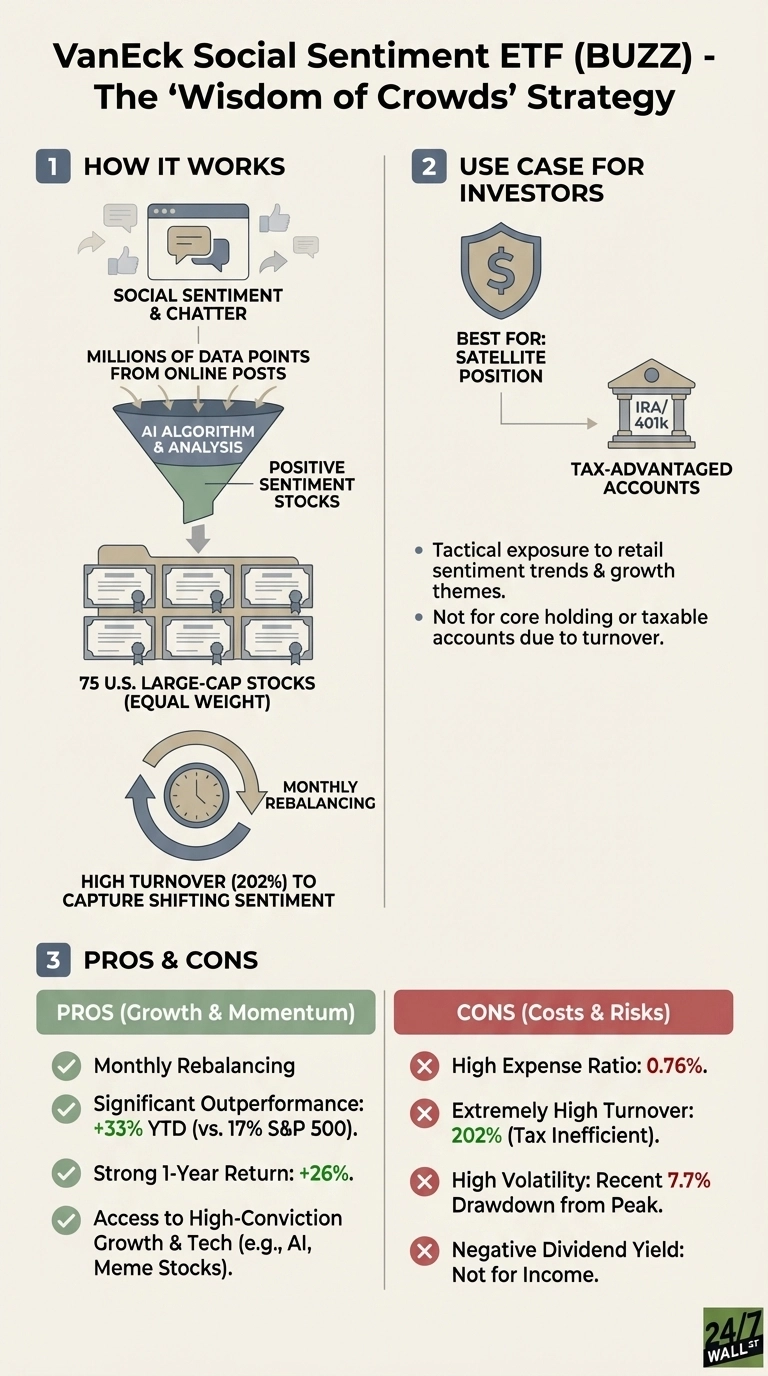
The fund rebalances monthly to capture shifting sentiment, resulting in 202% annual portfolio turnover. That’s not a typo. This constant reshuffling means BUZZ adapts quickly to emerging themes like quantum computing or AI infrastructure, but it also generates substantial trading costs and tax inefficiency.
Strong Recent Performance, But at What Cost
BUZZ delivered on its promise in 2025, gaining 33% compared to 17% for the S&P 500. Over the past year, it returned 26% against the index’s 14%. The strategy captured retail enthusiasm for growth stocks during a favorable market environment. However, the fund hit $35.90 in early November and has since pulled back to around $33, demonstrating the volatility inherent in sentiment-driven investing.
With just $108 million in assets and a 0.76% expense ratio, BUZZ costs significantly more than broad market alternatives. The high turnover also creates taxable events that make it poorly suited for taxable brokerage accounts.
The Tradeoffs You Accept
First, you’re buying momentum, not fundamentals. When retail sentiment shifts, BUZZ follows, which means you’ll own whatever stocks are trending regardless of valuation. Second, the tax burden from 202% turnover will eat into returns in non-retirement accounts. Third, the small asset base raises questions about long-term viability if performance falters and investors withdraw capital.
Who Should Avoid This ETF
Conservative investors seeking stable, predictable returns should stay away. Income-focused investors will find nothing here, as the fund has a negative dividend yield. Anyone investing in a taxable account should also reconsider, given the tax inefficiency of the strategy.
Consider QQQ for Similar Exposure Without the Complexity
The Invesco QQQ Trust (NASDAQ:QQQ | QQQ Price Prediction) offers comparable growth and technology exposure with far lower costs and complexity. QQQ charges just 0.20%, holds 100 of the largest non-financial Nasdaq stocks, and maintains minimal turnover. While it won’t capture the same momentum plays as BUZZ, it provides stable access to large-cap growth without the tax headaches or sentiment-driven volatility.
BUZZ works best as a small satellite position in a tax-advantaged account for investors who want tactical exposure to retail sentiment trends, but the high costs and turnover make it unsuitable as a core holding.














 Top Gaining Stocks
 Top Losing Stocks