


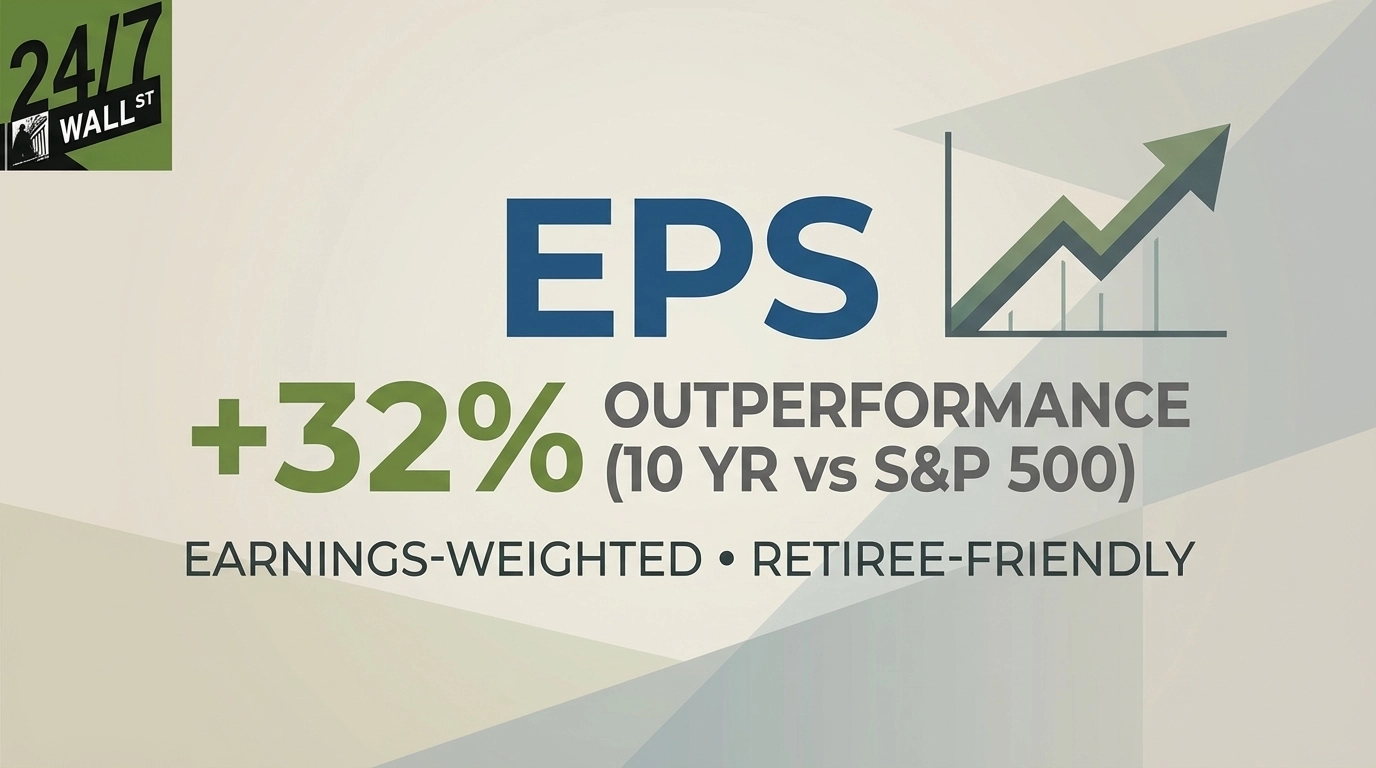
Most retirees want steady growth, reasonable income, and minimal drama. The WisdomTree U.S. LargeCap Fund (NYSEARCA:EPS) delivers through an earnings-weighted approach that outperformed the S&P 500 by 32 percentage points over the past decade.
Earnings-Weighted Simplicity That Works
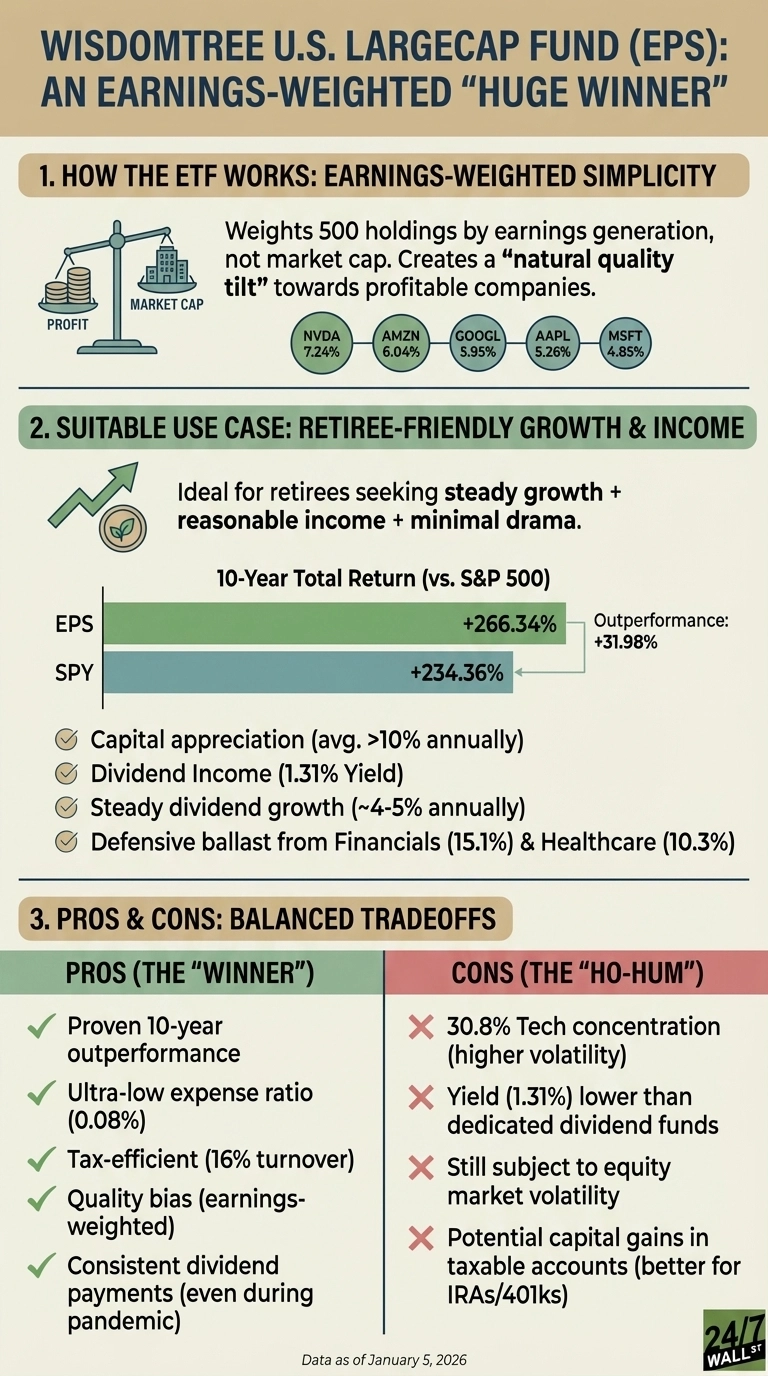
EPS follows the WisdomTree U.S. LargeCap Index, weighting its 500 holdings by earnings generation rather than market cap. Companies producing more profits get larger allocations, creating a natural quality tilt without complex factor screens. NVIDIA (NASDAQ:NVDA | NVDA Price Prediction) holds the top spot at 7.2%, followed by Amazon (NASDAQ:AMZN) at 6% and Alphabet (NASDAQ:GOOGL) at 6%, while Apple (NASDAQ:AAPL) and Microsoft (NASDAQ:MSFT) receive smaller allocations than in market-cap weighted funds.
This methodology created meaningful outperformance. Over the past 10 years, EPS delivered a 266.34% total return compared to 234.36% for the S&P 500. The 0.08% expense ratio means investors keep nearly all excess return, while 16% annual turnover minimizes taxable distributions.
The Retiree-Friendly Balance
Information technology commands 31% of assets, but the 15% financial allocation provides defensive ballast through dividend payers like JPMorgan Chase (NYSE:JPM). The bank’s 1.7% dividend yield and 16% earnings growth exemplify the income-plus-appreciation combination retirees need. Healthcare (13%), consumer discretionary (11%), and industrials (9%) round out the top sector allocations, while the tech overweight captures growth without concentrated single-stock risk.
EPS distributes quarterly dividends with a current 1.3% yield. The yield won’t replace a pension, but combined with capital appreciation averaging over 10% annually, it delivers total returns that preserve purchasing power and fund withdrawals.
The Tradeoffs Worth Understanding
Earnings-weighting naturally underweights unprofitable growth companies and can lag during momentum-driven rallies when investors pile into the largest names regardless of fundamentals. The 31% technology concentration means retirees accept more volatility than balanced funds mixing stocks and bonds.
Tax efficiency is strong but not guaranteed. While 16% turnover beats actively managed funds, sector rebalances can trigger capital gains in taxable accounts. The fund works best in IRAs and 401(k)s where distributions don’t create tax bills.
Who Should Look Elsewhere
Investors seeking high current income should choose dedicated dividend funds with 3% to 4% yields. EPS prioritizes total return over distributions, making it unsuitable for retirees needing maximum cash flow today. Those uncomfortable with equity volatility need bond exposure or target-date funds that automatically reduce stock allocations.
Consider Vanguard S&P 500 ETF Instead
The Vanguard S&P 500 ETF (NYSEARCA:VOO) offers an even simpler alternative with a 0.03% expense ratio and $1.5 trillion in assets. While EPS outperformed over the past decade, VOO’s lower cost and massive liquidity appeal to investors preferring pure market-cap exposure. Accept VOO’s slightly higher concentration in mega-cap tech for rock-bottom fees and perfect S&P 500 tracking, or choose EPS for its quality tilt and historical outperformance.
EPS proves boring strategies can produce exciting results when given time to work. Retirees who bought shares years ago likely appreciate the steady growth and minimal fuss more than chasing the latest market narrative.











 Top Gaining Stocks
 Top Losing Stocks