



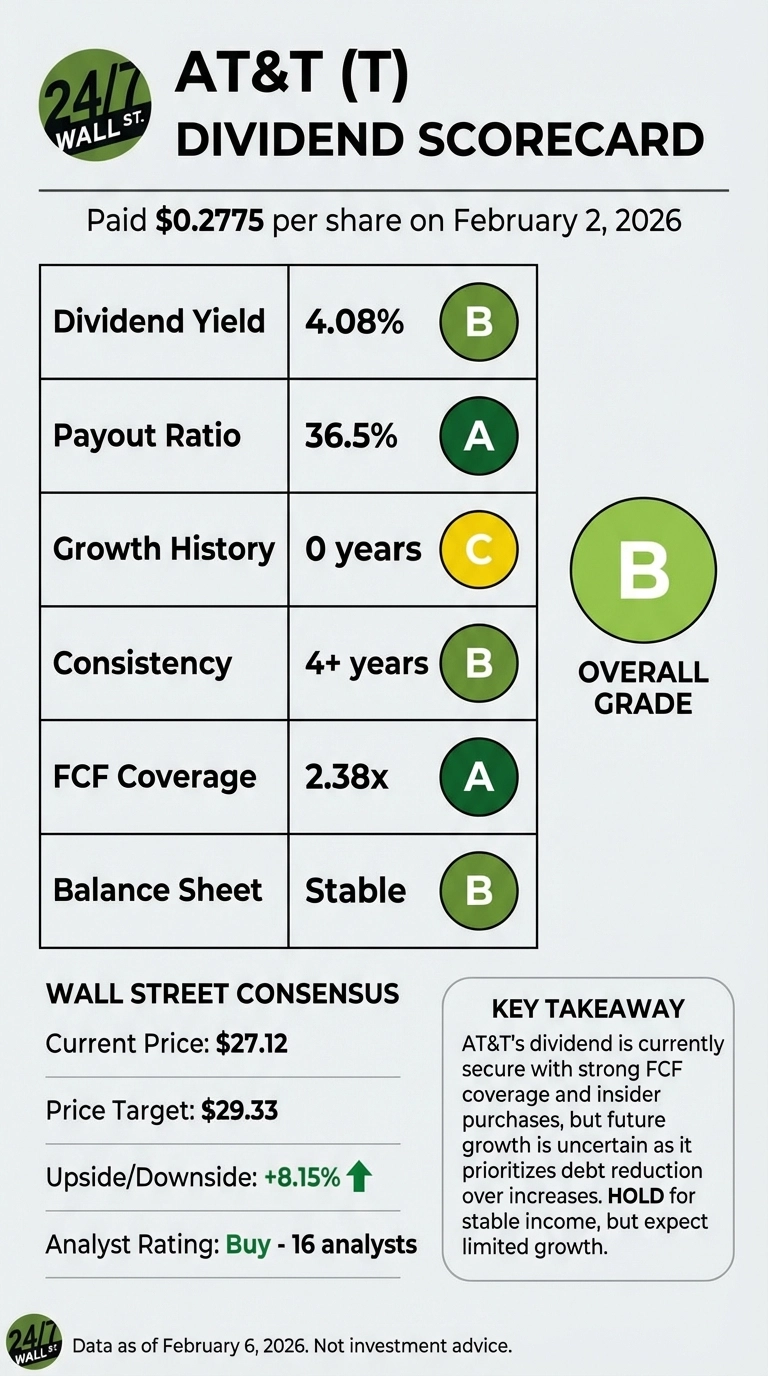
AT&T (NYSE: T) | T Price Prediction just paid its quarterly dividend of 27 cents per share on Feb. 2, 2026, marking another chapter in the telecom giant’s post-2022 dividend reset. With a 4.08% yield and 2.38x free cash flow coverage, the dividend appears secure. But how does it stack up against nine other income-focused stocks that just paid their shareholders?
AT&T’s Dividend Profile: Recovery Mode
AT&T’s current 27-cent quarterly payout represents a dramatic shift from its pre-2022 level of 52 cent per quarter — a 46.6% reduction that reset the dividend to sustainable levels following the WarnerMedia spinoff. The company has held this rate steady since early 2022, prioritizing balance sheet repair over dividend growth.
The dividend’s safety metrics tell a reassuring story. AT&T generated $40.28 billion in operating cash flow in 2025 against $8.18 billion in dividend payments, producing a 2.38x coverage ratio. That’s a meaningful improvement from the 1.26x coverage in 2022 when the company faced negative net income and structural challenges.
Management confidence appears solid. Multiple executives made open market purchases at $24.84 to $26.02 per share in late 2025, including CFO Pascal Desroches and Chief Strategy Officer F. Thaddeus Arroyo. These purchases occurred well after the dividend cut, suggesting leadership believes the current payout is sustainable at these valuation levels.
The Telecom Peer: Verizon’s Higher Yield, Higher Risk
Verizon (NYSE: VZ) presents an interesting contrast. The company just paid a dividend of 69 cents per share on Feb. 2, equating to a significantly higher yield of 5.91%. Verizon has maintained an impressive streak, increasing its dividend for 19 consecutive years with the most recent 1.47% increase from 68 cents to 69 cents.
But Verizon’s operational picture looks shakier. The company faces leadership turmoil with consumer division head Sowmyanarayan Sampath stepping down, and it’s significantly cutting its 2026 capital budget and workforce. The stock has delivered 23.81% total return over the past year, but the 67.4% payout ratio leaves less cushion than AT&T’s 36.5%.
Dividend Kings: Johnson & Johnson and Procter & Gamble
Johnson & Johnson (NYSE: JNJ) will pay $1.30 per share on March 10, (ex-dividend Feb. 24), representing a 4.8% increase from the prior year’s $1.24 quarterly rate. The healthcare giant’s 2.19% yield may seem modest, but the 46.6% payout ratio and 35.6% return on equity underscore exceptional capital efficiency.
JNJ has increased its dividend for over six decades, with the quarterly payment climbing from $0.54 in 2010 to $1.30 in 2026—a 140.7% increase over 15 years. The stock delivered 61.11% total return over the past year, combining dividend income with substantial price appreciation.
Procter & Gamble (NYSE: PG) paid $1.0568 per share on Feb. 17, up 5.0% from the previous year’s $1.0065 rate. The consumer products giant’s 2.66% yield comes with a 61.3% payout ratio, reflecting its mature business model. PG’s dividend has grown from $0.6695 per quarter in 2016 to $1.0568 in 2026, demonstrating steady compounding even in a low-growth category.
Beverage Giants: Coca-Cola and PepsiCo
Coca-Cola (NYSE: KO) most recent paid 51 cents per share on Dec. 15, 2025, continuing its decades-long dividend growth streak. The company increased its quarterly dividend 5.15% in 2025, from 48 cents to 51 cents, delivering a 2.74% current yield. With a 65.8% payout ratio and 27.3% profit margin, Coca-Cola balances income generation with reinvestment capacity.
The stock has delivered 28.43% total return over the past year, benefiting from both dividend payments and price appreciation. Coca-Cola’s dividend has grown from $0.16 per quarter in 1999 to $0.51 in 2025, a testament to the power of brand moats and global distribution.
PepsiCo (NASDAQ: PEP) will pay $1.4225 per share on March 31, reflecting a 4% increase announced in early February 2026. This marks PepsiCo’s 17th consecutive annual dividend increase, with the quarterly rate rising from $1.355 to $1.4225. The stock returned 21.97% over the past year, though it trails Coca-Cola’s recent performance. Its dividend currently yields 3.34%.
Pharma Yields: AbbVie and Bristol Myers
AbbVie (NYSE: ABBV) has a dividend yielding 3.10%, or $1.73 per share, last paid on Feb. 17, following a 5.5% increase from the prior $1.64 per share rate. The Big Pharma mainstay has aggressively grown its dividend, with the quarterly payment climbing from 40 cents in 2013 to $1.73 in 2026 — a 332.5% increase over 13 years.
However, AbbVie’s 524% dividend payout ratio raises questions and is likely unsustainable. The company’s operating cash flow of $18.8 billion in 2024 covered the $11.0 billion dividend at a 1.71x ratio, but that coverage has tightened from 2.48x in 2022. Recent insider stock equivalent unit acquisitions at $228.49 by three directors in late 2025 suggest board-level confidence, but the lack of open market purchases is notable.
Bristol-Myers Squibb (NYSE: BMY) paid 63 cents per share on Feb. 2, marking its 17th consecutive annual increase. The 4.3% yield comes with a somewhat more sustainable 83.5% payout ratio. The stock delivered 13.35% total return over the past year, benefiting from both dividend income and a 16.18% year-to-date price gain.
The Monthly Dividend Outlier: Realty Income
Realty Income (NYSE: O) operates on a different cadence entirely, paying 27 cents per share monthly with the its next monthly payment coming on Feb. 13. The real estate investment trust (REIT) has a yield of 5.13%, which translates to $3.205 per share annually and is distributed across 12 monthly payments.
The company’s operating cash flow of $3.57 billion in 2024 covered $2.70 billion in dividends at a 1.32x ratio. However, all recent insider activity shows selling rather than buying, with CEO Sumit Roy disposing of 34,866 shares at $56.37 in late December 2025 and early January 2026. The concentrated year-end selling by multiple executives warrants monitoring, though the timing suggests routine equity compensation management rather than fundamental concerns.
The Value Play: General Mills
General Mills (NYSE: GIS) paid 61 cents per share on Feb. 2, equating to a 4.99% yield — the highest among the non-REIT stocks in this comparison. The packaged foods company increased its quarterly dividend from 60 cents to 61 cents, good for a modest increase of 1.67%.
The 52.04% payout ratio provides substantial coverage, but the stock has struggled with -15.23% total return over the past year. General Mills faces -45.8% quarterly earnings growth year-over-year and -7.2% revenue decline, reflecting broader pressures in the packaged foods category.
The Verdict: Yield, Growth, and Sustainability
AT&T’s 4.08% yield sits in the middle of this pack, but its dividend story is fundamentally about rebuilding credibility after the 2022 cut. The 2.38x free cash flow coverage provides meaningful cushion, and the company’s strategic partnerships with Amazon Web Services and Amazon Leo satellite network position it for potential revenue growth.
Compared to Verizon’s higher yield but tighter coverage and operational challenges, AT&T appears relatively better positioned despite its lack of recent dividend growth. The Dividend Kings like Johnson & Johnson and Procter & Gamble offer lower yields but unmatched reliability and growth track records. AbbVie and Bristol Myers provide higher yields with pharmaceutical sector exposure, while Realty Income’s monthly payments appeal to income-focused investors seeking regular cash flow.
For investors prioritizing yield stability over growth, AT&T’s reset dividend offers a reasonable middle ground—not the highest yield, but backed by improving cash flow metrics and insider confidence. The real question is whether management will resume dividend increases or continue prioritizing debt reduction and network investment in the 5G era.









 Top Gaining Stocks
 Top Losing Stocks