


When every other asset class is posting double-digit gains, a bond fund delivering 3% feels like dead weight. That’s the frustration many investors felt watching Vanguard Total International Bond ETF (NYSEARCA:BNDX | BNDX Price Prediction) in 2025. While the fund posted a modest gain, it lagged U.S. bonds by roughly 4.5 percentage points and trailed equities by an even wider margin. The question isn’t whether international bonds disappointed, it’s whether they still deserve space in a diversified portfolio.
The Diversification Insurance Policy You Hope Not to Use
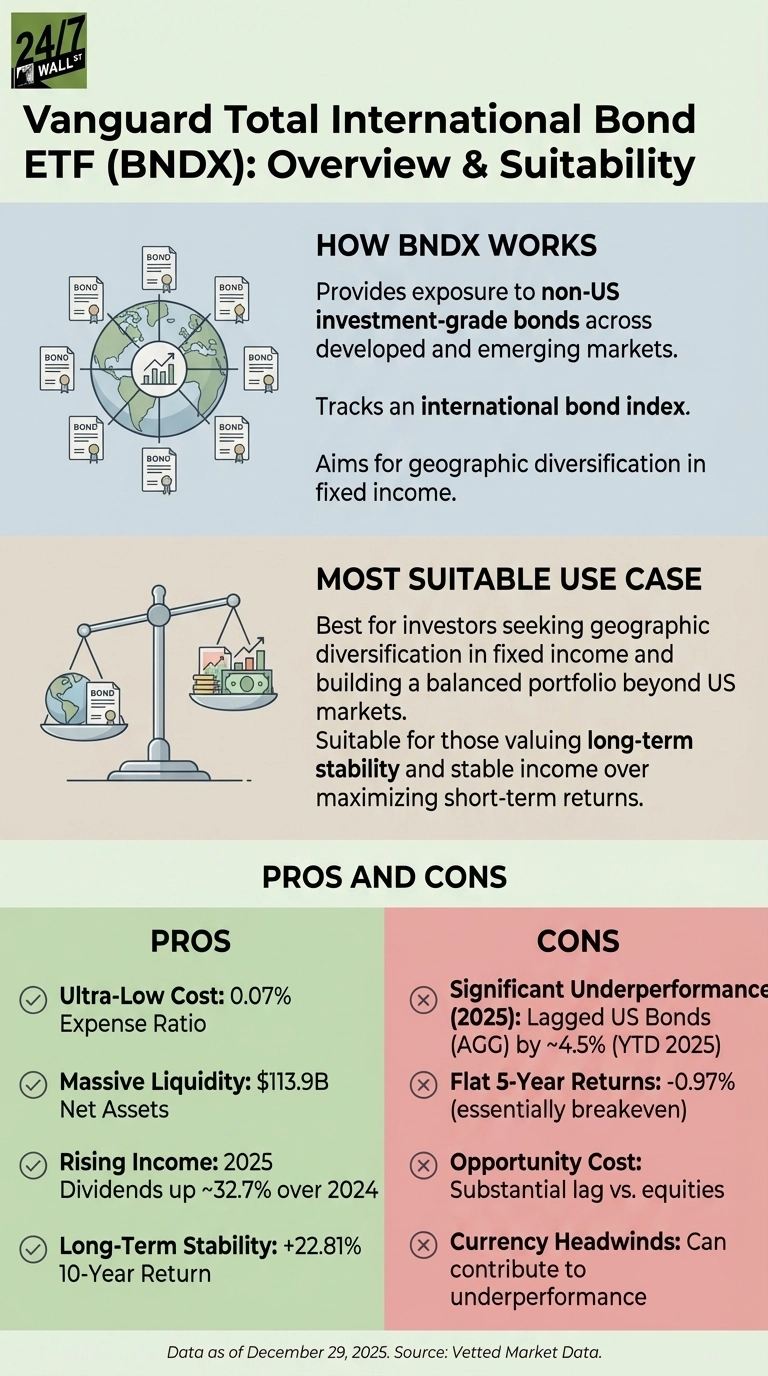
BNDX provides exposure to investment-grade bonds outside the United States, spanning developed and emerging markets. The fund hedges currency risk back to the dollar, meaning returns reflect bond price movements and income rather than forex swings. It’s geographic diversification for the fixed income portion of your portfolio.
The return engine is straightforward: interest payments from thousands of international bonds, combined with price appreciation when rates fall. In 2025, investors collected a 3% yield while the fund’s price gained roughly 3%, producing a total return around 6%. That’s respectable for a bond fund, just not competitive with U.S. alternatives that delivered closer to 10%.
When the Insurance Premium Feels Too High
BNDX fulfilled its mandate in 2025 by providing stable income and preserving capital. The problem is U.S. bonds did the same job better. The fund’s 0.07% expense ratio is ultra-low, and its $113.9 billion in assets ensures ample liquidity. Yet investors who chose international diversification paid an opportunity cost measured in percentage points of underperformance.
Over five years, BNDX has essentially broken even with a -0.97% return, while over 10 years it’s up 22.81%. The long-term record suggests the fund works as designed, but recent years have tested investor patience.
The Tradeoffs Are Getting Harder to Justify
Owning BNDX means accepting that international bonds will periodically underperform U.S. bonds, sometimes for extended stretches. Currency hedging eliminates forex volatility but also removes potential upside when the dollar weakens. The fund’s moderate 26% portfolio turnover keeps trading costs low, but it can’t overcome structural headwinds when U.S. rates and credit conditions are more attractive.
Diversification benefits aren’t always visible. In years when U.S. markets struggle, international bonds may provide ballast. In 2025, that wasn’t the case.
Who Should Skip This Fund
Investors focused purely on maximizing bond returns should look elsewhere. If you’re building a fixed income allocation and don’t specifically need international exposure, U.S. bond funds have delivered better risk-adjusted returns recently. Retirees drawing income from their portfolios may find the incremental diversification benefit doesn’t justify the performance drag.
Consider AGG for Simpler U.S. Exposure
iShares Core U.S. Aggregate Bond ETF (NYSEARCA:AGG) offers broad U.S. investment-grade bond exposure with an even lower 0.03% expense ratio and stronger recent performance. AGG returned roughly 7.5% in 2025 compared to BNDX’s 6%, and over the past year the gap was similar. For investors who want bond market exposure without the complexity of international diversification, AGG provides a more straightforward path with better recent results.
BNDX remains viable for investors committed to global diversification, but only if you can tolerate periodic underperformance as the cost of that geographic spread.











 Top Gaining Stocks
 Top Losing Stocks