


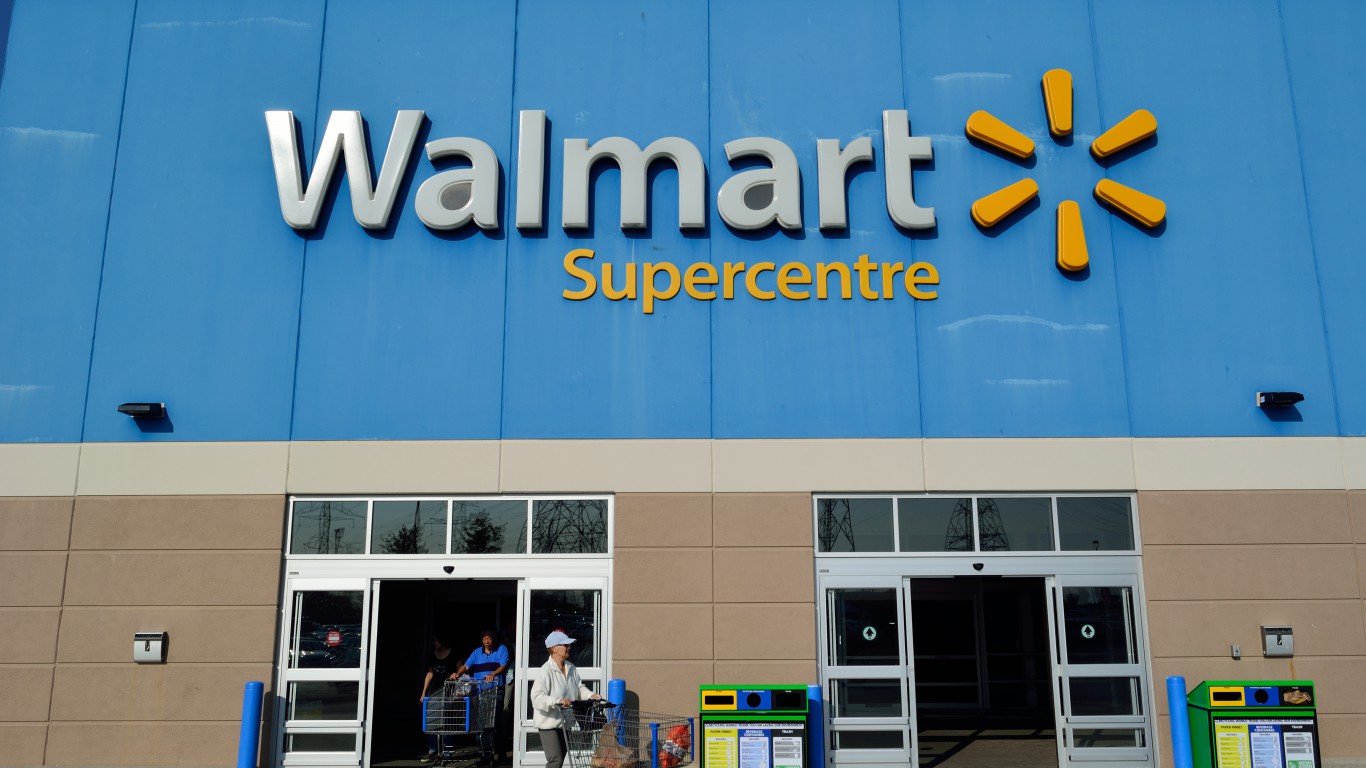
Walmart (NYSE: WMT | WMT Price Prediction) has quietly become one of the more compelling macro stories of 2026. Bank of America recently reinstated coverage with a Buy rating and a $150 price target, arguing the retailer is uniquely built to win in a bifurcated economy where higher earners keep spending and lower earners pull back hard. With shares at $128 today, that target implies over 17% upside. Yet, the more interesting question is whether Walmart is structurally positioned as a hedge, not just a trade.
The K-Shaped Consumer Thesis
University of Michigan consumer sentiment sits at 56.4, deep in pessimistic territory and approaching recessionary levels. Yet retail sales held at $735 billion in December 2025, flat month-over-month but up 2.4% year-over-year. The divergence tells the story: aggregate spending is resilient, but confidence is fragile. Those are classic K-shaped conditions.
Walmart’s Q4 FY26 results reflect exactly this dynamic. Walmart U.S. comparable sales grew 4.6% excluding fuel, driven by transaction growth across all income tiers. Critically, upper-income households led share gains, with wealthier shoppers gravitating toward Walmart’s fast delivery, expanded brand selection (including new names like Fender, Weber, and Stanley added in FY26), and a Google Gemini-powered shopping interface. Meanwhile, the core lower-income base remains anchored by everyday low prices and grocery dominance.
The Numbers Behind the Hedge
The operational picture strengthens the case. Operating income grew 10.8% to $8.71 billion in Q4, outpacing the 5.6% revenue gain — margin expansion in a low-margin business is meaningful. Global e-commerce hit 24% growth and now represents 23% of total net sales, a record. High-margin advertising revenue surged 37% globally, and membership fee revenue rose 15.1% — both diversifying away from thin-margin retail.
Year-to-date, Walmart shares are up 15.1% versus the S&P 500’s essentially flat 0.1% gain. The stock’s beta of 0.67 reflects genuine defensiveness.
What Investors Should Watch
The risks are real. FY27 guidance of 3.5% to 4.5% net sales growth came in below the roughly 5% analysts expected, triggering a post-earnings dip. Tariff exposure remains a material wildcard — a concern that surfaced prominently in Reddit’s r/investing community: “the 150-day tariff clock is ticking… what happens in july??” (79 upvotes, r/investing). Management flagged tariff and trade policy changes as potentially material to results, and with significant sourcing from China and international markets, the exposure is not trivial. Still, Walmart’s scale, omnichannel moat, and diversifying revenue streams are among the factors analysts cite when discussing defensive positioning in the current environment.










 Top Gaining Stocks
 Top Losing Stocks