


The announcement of a robotaxi partnership between Uber (NASDAQ: UBER | UBER Price Prediction) and Rivian (NASDAQ: RIVN) has many holes. The headline of their press release was “Uber and Rivian Partner to Deploy up to 50,000 Fully Autonomous Robotaxis.” Start with the word “up to.”
Further down in the announcement was the sentence “Uber to invest up to $1.25 billion in Rivian through 2031, subject to the achievement of autonomous performance milestones.” That includes the words “up to” and “milestones.”
“Uber, or its fleet partners, expected to purchase 10,000 fully autonomous R2 robotaxis with the option to purchase up to 40,000 more in 2030.” That includes the words “expected” and “option.”
The announcement is really barely an announcement at all. That is why Rivian only traded up 3.8% on the day of the press release, only to drop today. Even with the big news, Rivian’s stock is down 20% this year.
The fact of the matter is that Rivian still has an amazingly weak business model. Its P&L shows how crippled that company is financially. Its sales show it has niche products in a very troubled US EV industry, which has been abandoned by the world’s largest car manufacturers.
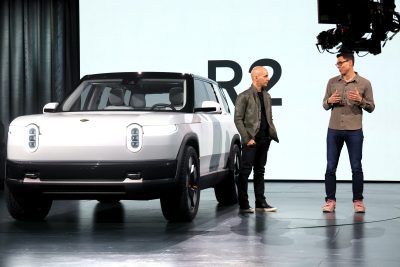
Rivian recently launched its new R2 model. The idea is to offer EV buyers (of EV SUVs only) an affordable, but extremely well-featured product. However, affordability is comparative. Rivian announced, “Deliveries start in Spring 2026, beginning with R2 Performance with Launch Package (starting at $57,990²), followed by additional Premium configurations in late 2026 and Standard configurations in 2027.” The fine print says the figure does not include “all applicable taxes and fees.”. Those probably drive the price closer to $60,000. That takes The R2 out of the “affordable” category.
In 2025, Rivian produced 42,284 vehicles and delivered 42,247 vehicles. The company said it would deliver as few as 62,000 this year.
It is impossible to do the math completely, but it is ugly. In the fourth quarter, Rivian had revenue of $1.28 billion, down from $1.73 billion in the same period a year ago. It had a net loss of $804 million, compared with $743 million in the year-ago period.
The Uber announcement seemed like good news on its face. Apparently, based on the stock price just after the press release, investors did not see it the same way.






 Top Gaining Stocks
 Top Losing Stocks