



The Defiance Daily Target 2X Short SMCI ETF (NASDAQ:SMCZ) exists for one job: deliver negative two times the daily price move of Super Micro Computer. Traders use it to press a short-term bearish view on a single AI-server name without borrowing shares or paying short-rebate fees. It is a tactical instrument, sized for hours and days, and the prospectus language reflects that.
The risk picture flows directly from that design. Two factors dominate everything else: how the fund compounds in volatile tape, and how it behaves around catalysts in a stock that gaps hard.
The Primary Risk: Daily Reset Decay on a Whipsaw Stock
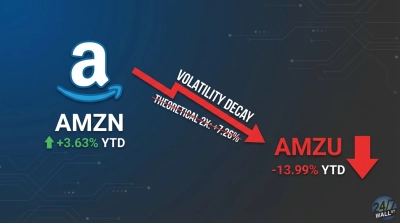
SMCZ resets its inverse exposure every day. That sounds technical, but the consequence is concrete: returns over any holding period longer than a single session are path-dependent. In a choppy tape that ends roughly where it started, a daily-reset 2x inverse fund can lose money even when the underlying stock is flat.
SMCI provides exactly that kind of tape. Over the past month, the stock rose 20% to about $28. Over the past year, it declined 17%. Year-to-date it is down about 5%. Those three numbers tell you the path was not a straight line. Recent earnings reactions confirm the swing pattern: an intraday range of almost 14% on the Q2 2026 beat and about 18% lower on the Q4 2025 report. The fund that holds SMCZ through both of those days does not get a clean -2x of the cumulative SMCI move. It gets the compounded daily product, which in two-way volatility is mathematically worse.
Single-stock concentration makes the decay sharper than it would be in a sector inverse fund. Every dollar of SMCZ exposure rides on one company’s order book, one CEO, and one supply chain. SMCI carries its own history here, including a prior short-seller report and accounting questions that produced abrupt repricings in either direction.
The Secondary Risk: Earnings Gaps and Upside Catalysts
Inverse exposure has unlimited theoretical loss because a stock can rise without a ceiling. SMCI reports Q1 2026 results today, May 5, after the close. Last quarter’s 41% EPS beat, anchored by CEO Charles Liang’s claim of “more than $13B in Blackwell Ultra orders” and full-year guidance of at least $36 billion in revenue, sent SMCI up almost 14% on the report day. A repeat would translate to a roughly twice-as-large single-day loss for SMCZ holders carrying into the report.
The other half of that story matters too. SMCI fell almost 9% the next day and about 5% over the following 30 days despite the beat. Holding SMCZ across that round trip would have produced losses on the gap up and given back gains on the round trip down. That is the volatility-decay trap in one sequence.
What to Watch
- SMCI implied volatility and the VIX. The VIX sits at about 17, down from a March peak near 31. Rising single-stock IV on SMCI, visible on any options chain, is the cleanest tell that decay risk is escalating. Check before any multi-day hold.
- SMCI earnings calendar. Today’s after-close earnings report is the immediate catalyst. The next will sit on Supermicro’s investor relations page. Carrying inverse exposure across an earnings date is the highest-variance decision an SMCZ holder makes.
- Defiance fund page. Expense ratio, AUM, and swap counterparty disclosures live there. Shrinking AUM widens bid/ask spreads and raises execution cost.
- SMCI margins and cash flow. Gross margin compressed 380 basis points year-over-year last quarter and operating cash flow ran negative $917 million. Those are the fundamental swing factors that produce the gaps the fund must absorb.
The Bottom Line
SMCZ does what it advertises for a single trading day. The biggest structural risk is that the instrument is hostile to multi-day holding in a stock that routinely moves double digits on a single earnings report. Anyone holding through tonight’s report is taking concentrated, leveraged, path-dependent exposure to one company’s guidance. That is a defensible trade for some, and an expensive misunderstanding for others.















 Top Gaining Stocks
 Top Losing Stocks