



Managed futures funds spent most of the past decade as a footnote in portfolio construction conversations. They came back into the spotlight in 2022 when stocks and bonds fell together, and the conversation never really faded. The three funds covered here, the Simplify Managed Futures Strategy ETF (NYSEARCA:CTA), the iMGP DBi Managed Futures Strategy ETF (NYSEARCA:DBMF), and the KraneShares Mount Lucas Managed Futures Index Strategy ETF (NYSEARCA:KMLM), each take a different route to the same destination: returns that move on their own schedule rather than tracking the S&P 500.
The distinction showed up again this spring. The VIX pushed close to 31 in late March before sliding back toward 17 by early May, and the 10‑year Treasury yield swung from roughly 4% to about 4.5% over the same stretch. Equities, rates, and currencies all moved with real force, which is exactly the kind of backdrop that trend‑following systems are designed to navigate.
Why these funds, and why now
Managed futures ETFs run systematic strategies across dozens of futures markets, going long or short based on price trends. The strategy can profit when the dollar strengthens, when crude oil collapses, or when the front end of the yield curve reprices. In a year of elevated volatility across equities, bonds, and currencies, trend-following managed futures strategies have delivered consistent, non-correlated returns.
Year-to-date through May 6, CTA is up about 10%, KMLM about 11%, and DBMF about 8%, against SPY at roughly 7%. Managed futures earned most of those returns while equities were under pressure in March, then held up as the S&P rebounded, delivering the non-correlated return profile these funds are designed to provide.
iMGP DBi Managed Futures Strategy ETF (DBMF): the hedge fund replicator
DBMF is the cleanest way to access the managed futures category if the goal is to mimic what the largest commodity trading advisors are actually doing. The Dynamic Beta team uses regression analysis on the SG CTA Index, the benchmark for the largest trend-following hedge funds, then replicates the aggregate positioning using a small basket of liquid futures contracts. Investors are paying for the asset class beta rather than for any single manager’s edge.
The portfolio rotates exposures across equity index futures, government bonds, currencies, and a handful of commodities, with positions reset monthly. Because the strategy holds equity index futures when CTAs collectively are long stocks, DBMF can correlate with equities at times. That is by design. It is the truest representation of how the hedge fund category is positioned, with the diversification benefits that come from that aggregate exposure.
DBMF has led the group over the past year at roughly 20%, helped by long‑bond and currency positions that trended cleanly. The catch is replication risk. When the underlying CTAs shift their books faster than a monthly rebalance can keep up, DBMF falls behind the index it is designed to mirror. For investors who want a single‑ticker stand‑in for the SG CTA Index, it remains the most direct expression.
KraneShares Mount Lucas Managed Futures Index Strategy ETF (KMLM): the equity-free diversifier
KMLM tracks the KFA MLM Index, a rules-based trend system Mount Lucas has run for more than three decades. The fund trades 22 futures contracts split across global currencies, fixed income, and commodities. There are no equity index futures in the portfolio, which is the structural feature that matters most for anyone using KMLM as a hedge.
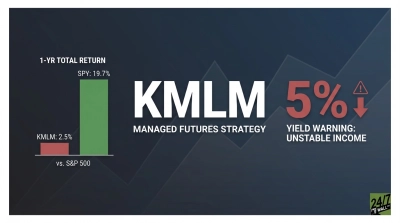
That structure makes KMLM the clearest equity diversifier in the group. When stocks fall, and bonds fall with them, as they did in 2022, a fund with no S&P 500 exposure cannot get caught long the wrong asset. The signals are mechanical, and the weights adjust to volatility, which keeps any single market from overwhelming the portfolio. KMLM is up around 11% year to date and roughly 8% over the past year, with most of the gain coming from currency and rates trades during the March volatility spike.
The tradeoff is the flip side of the same feature. By design, KMLM will not benefit when equities trend higher in a calm tape, and the absence of equity exposure caps participation in long melt-up regimes. That is the price of clean diversification.
Simplify Managed Futures Strategy ETF (CTA): the actively managed wildcard
CTA is the less obvious choice. Simplify runs the fund actively, combining trend signals with carry models and adding an options overlay intended to cushion the worst drawdowns that pure trend systems can suffer when markets whipsaw. The expense ratio sits at about 76 basis points, on the higher end of the category, reflecting active management and the options sleeve.
The track record so far rewards the complexity. CTA leads the group year to date at about 10% and has returned roughly 20% since its March 2022 inception, a period that includes the 60/40 drawdown the category is best known for navigating. The options overlay adds a layer of convexity that index-based competitors lack, and it is the main reason a reader looking past the obvious DBMF and KMLM picks should consider it.
The weak spot is model risk. Active management means the fund can lag the simpler index approaches when the manager’s discretionary calls or carry models miss the mark. The recent pullback shows how quickly that can surface. CTA is down about 5% over the past week as positions unwound. Investors who choose complexity for the sake of diversification need to be comfortable with a manager taking steps a passive index would never take.
Choosing among the three
The choice ultimately depends on what role the fund is meant to play. An investor who wants the most efficient access to the managed‑futures hedge‑fund category and accepts that the position may occasionally correlate with equities will gravitate toward DBMF. An investor specifically trying to hedge equity drawdowns and willing to lag during calm bull markets finds the cleanest fit in KMLM.
CTA suits the investor who wants trend‑following exposure with a manager actively layering in options for tail‑risk protection, and who is comfortable paying 76 basis points for that combination. The three funds can also work together. They rely on different signals, trade different markets, and rebalance on different schedules, so a basket helps dilute any single model’s blind spots while preserving the non‑correlated return profile that becomes valuable when the VIX is pushing toward 30 rather than sitting near 17.













 Top Gaining Stocks
 Top Losing Stocks