


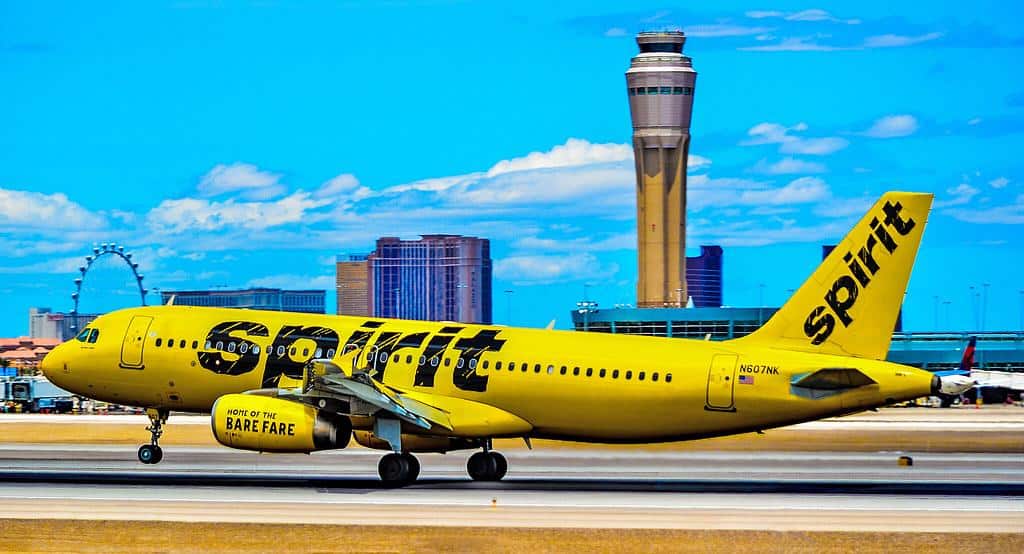
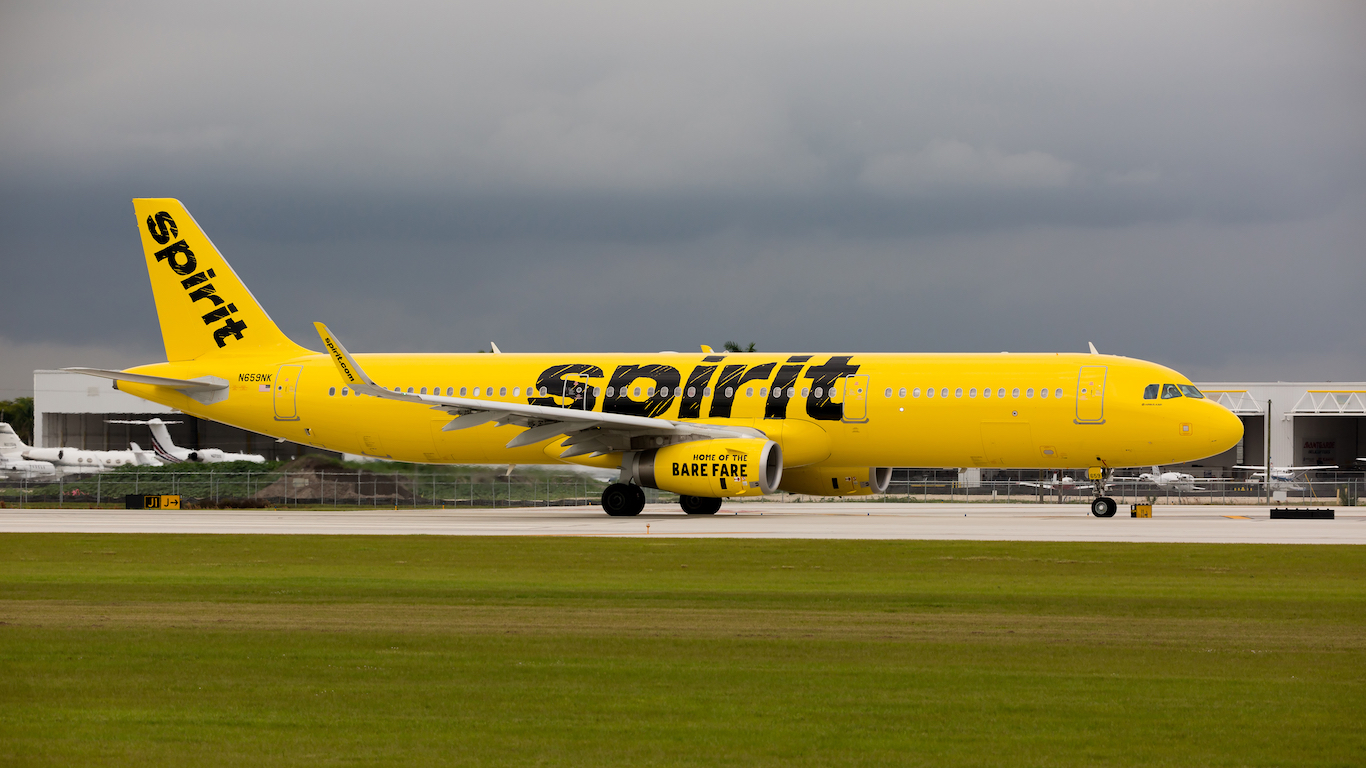
A round-trip ticket from Las Vegas to Dallas-Fort Worth cost $39 on Spirit Airlines the morning of May 1. By the afternoon of May 3, that same itinerary on the next-cheapest carrier was selling for $124. That’s a 217.9% jump, and it happened inside the 48-hour window after Spirit’s 3:00 AM ET shutdown on May 2.
LAS-DFW is not an outlier. It’s the leading edge of a fare reset that’s now visible on every former Spirit corridor, and the data behind it is unusually clean.
The Fare Pairs Your Phone Already Knows About
Spirit ceased operations at 3:00 AM ET on May 2, 2026, yanking 1.8 million seats off the May calendar overnight. Real-time pricing from Cirium, Kayak, and Google Flights shows fare inflation of 15% to 25% on every route where Spirit held double-digit market share. The pattern concentrates where Spirit flew heavy: Cirium’s hub-level capacity data lights up FLL, MCO, and LAS in red.
Here’s the route board before and after. Spirit fares were unbundled; replacement Basic Economy fares include a carry-on. A true apples-to-apples comparison shaves a few points off each jump. It doesn’t erase them.
| Route | Spirit (pre-May 2) | Market (post-May 2) | Increase |
|---|---|---|---|
| LAS-DFW | $39.00 | $124.00 | +217.9% |
| DEN-DTW | $59.00 | $179.00 | +203.4% |
| MCO-ORD | $54.00 | $159.00 | +194.4% |
| FLL-LGA | $49.00 | $139.00 | +183.7% |
| FLL-LAX | $79.00 | $120.00 | +51.9% |
Why this is causal, not coincidence
Two pieces of evidence rule out the obvious “fuel just went up” explanation.
First, the geography. The 15% to 25% surge is concentrated specifically on routes where Spirit had a meaningful share. Corridors with no Spirit presence did not move on the same timeline. If this were a generalized fuel pass-through, you’d see uniform increases across the network. You don’t.
Spirit’s bare fares were the anchor that forced Delta Air Lines (NYSE:DAL | DAL Price Prediction), American Airlines (NASDAQ:AAL), and United Airlines (NASDAQ:UAL) to publish deeply discounted Basic Economy in the same booking class. The Brueckner, Lee, and Singer academic literature labels it the “Spirit Effect”: Spirit’s entry pulled legacy fares down for three decades, and the exit produces the symmetric reverse. Fares spiked on Spirit hubs only, not network-wide.
Frontier Group Holdings (NASDAQ:ULCC) is absorbing some routes with half-off promotions but cannot backfill 60,000 daily passengers. J.P. Morgan analyst Jamie Baker has framed the rebalancing as a permanent reset of the bottom of the fare market. Without Spirit forcing the issue, legacy carriers have no incentive to keep publishing fire-sale Basic Economy.
Enjoying our content? Click the Follow button above to see more from us.
Who Eats the $100 to $300 Summer Premium
Leisure travelers out of Fort Lauderdale, Orlando, or Las Vegas face the steepest jumps because the legacy network never built deep discount inventory in those markets. With University of Michigan consumer sentiment sitting at 53.3 in March 2026, deep in pessimistic territory, a sudden $200 add to a four-ticket summer booking lands hard on households already squeezed at the grocery line.
Denver corridors take secondary damage. Price-sensitive families and budget travelers who built vacations around a $49 Fort Lauderdale fare eat the rest.
Watch the May 14 BLS CPI release for the first clean reading on airfare inflation after the liquidation, and Frontier’s late-May route announcements for any meaningful capacity backfill. The route table above is the one to screenshot before you book your summer flight.











 Top Gaining Stocks
 Top Losing Stocks