



What a difference a year makes. Where the Magnificent Seven stocks were still carrying the market last year after being responsible for between 65% and 75% of the S&P 500‘s gains in 2023.
So far this year, six of the seven stocks are in the red, and the one winner — Meta Platform‘s (NASDAQ:META | META Price Prediction) — is up less than 7% year to date. That’s better than the less than 2% loss by the benchmark index, but no other Mag 7 is beating it. In fact, the two worst performers in 2025 are Nvidia (NASDAQ:NVDA) and Tesla (NASDAQ:TSLA), which are down 16% and 35%, respectively.
Considering both companies still have excellent long-term growth prospects, the current discount the stock of each is exhibiting could be attractive to an investor interested in buying shares at the cheapest valuation they’ve offered in a while.
This was brought to mind because a Redditor on the r/portfolios subreddit was looking for advice on buying either NVDA stock or TSLA stock. Where he was previously a passive investor buying exchange-traded funds, he had $30,000 to put to work and wanted to buy individual stocks now. He saw Nvidia or Tesla as a potential place to put $30,000 he has available, but was opening to other stocks as well.
The case for passive investing
Most investors can (and arguably should) go their whole investing career without buying anything more than an S&P 500 index fund. The Redditor’s previous experience of just owning index ETFs is sufficient.
No less a person than Warren Buffett has said, “The goal of the non-professional (investor) should not be to pick winners — neither he nor his “helpers” can do that — but should rather be to own a cross-section of businesses that in aggregate are bound to do well. A low-cost S&P 500 index fund will achieve this goal.”
In fact, when he dies, Buffett instructed his estate to “put 10% of the cash in short-term government bonds and 90% in a very low-cost S&P 500 index fund. (I suggest Vanguard’s.) I believe the trust’s long-term results from this policy will be superior to those attained by most investors — whether pension funds, institutions or individuals — who employ high-fee managers.”
If passive investing is good enough for the Oracle of Omaha, then it should satisfy everyone else.
But we are stock pickers here at 24/7 Wall St. and, like Buffett, deciding whether Nvidia, Tesla, or some other stock can beat the S&P 500 over the long haul is what we do. Let’s look at the case for each.
The bull case for Nvidia

Nvidia’s dominance in AI is a big tailwind for future growth
The cornerstone of the argument in favor of Nvidia is its unrivaled position in artificial intelligence. Its graphics processing units (GPUs), particularly the leading H100 and its newest Blackwell architecture, power the world’s most advanced AI models, from ChatGPT to autonomous driving systems.
Global AI spending is projected to exceed $500 billion by 2027, Nvidia’s data center revenue, which tripled from the prior year in the fourth quarter, positions it as the backbone of this revolution.
Analysts forecast 30% annual earnings growth rate over the next five years, fueled by insatiable demand from hyperscalers like Amazon (NASDAQ:AMZN) and Alphabet (NASDAQ:GOOG)(NASDAQ:GOOGL).
Beyond AI, Nvidia’s gaming segment remains robust. The GeForce RTX line continues to dominate the $40 billion gaming hardware market, with cloud gaming and virtual reality as untapped growth frontiers. Meanwhile, its automotive division, though smaller, is poised for a breakout as electric and self-driving vehicles proliferate. Nvidia’s DRIVE platform already partners with Tesla and Mercedes-Benz (OTC:MBGYY).
Financially, Nvidia is a juggernaut. Its gross margin exceeds 74%, reflecting pricing power and economies of scale, while free cash flow hit $17.2 billion in 2024. Despite a forward P/E of 20, its valuation based on its long-term earnings growth rate suggests NVDA stock is fairly valued. Share repurchases and a nascent dividend add shareholder value.
There are risks, of course. Competitors like Advanced Micro Devices (NASDAQ:AMD) and supply chain hiccups exist, but Nvidia’s R&D moat — it spent nearly $13 billion last year — and its CUDA ecosystem that tends to lock-in customers, mitigate these risks.
For long-term investors, Nvidia’s leadership in AI, gaming, and automotive, paired with stellar financials, makes it a bet on the future of technology itself.
The bull case for Tesla
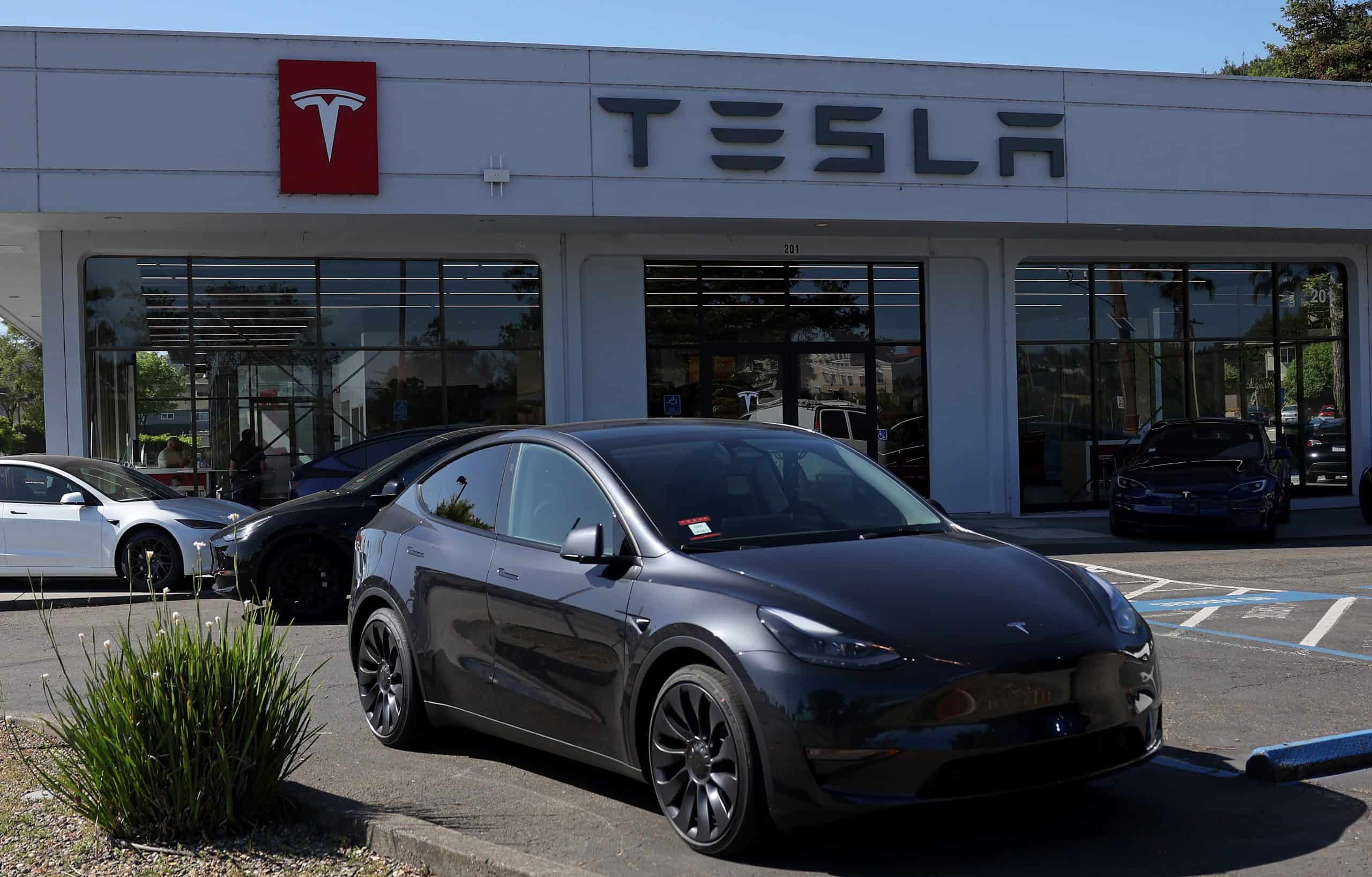
Tesla remains the leader EV car maker, but also has massive growth opportunities in energy storage and more
Tesla’s electric vehicle dominance in the U.S. is unrivaled. In 2024, it delivered 1.8 million vehicles, capturing 19% of the global EV market despite intensified competition. Its Shanghai and Berlin gigafactories, alongside Texas and Nevada, drive production scalability, targeting 20 million annual deliveries by 2030. Price cuts in over the past year or so helped bolster demand, and the Cybertruck’s rollout that had 500,000 preorders added a high-margin wildcard.
With global EV adoption projected to hit 35% of car sales by 2030, Tesla’s first-mover advantage and brand loyalty position it to eventually retake BYD (OTC:BYDDY) as the world’s largest EV manufacturer.
Beyond vehicles, though, Tesla’s energy business is a sleeper hit. Energy storage deployments surged 125% in 2024 to 14.7 GWh, fueled by Megapack demand for grid-scale projects.
Solar and battery revenue could rival automotive by 2030, leveraging a $1 trillion market as renewables accelerate. Tesla’s vertical integration, from owning raw materials to software, has allowed its automotive gross margins to dwarf those of legacy automakers, although it has been slipping in recent periods.
AI and autonomy amplify the case. Tesla’s Full Self-Driving (FSD) tech, powered by its Dojo supercomputer, nears Level 4 autonomy, potentially unlocking a $10 trillion robotaxi market. The Optimus humanoid robot, entering prototype production this year, hints at diversification into labor automation.
Financially, Tesla’s $36.5 billion in cash and $3.6 billion free cash flow in 2024 underpin aggressive R&D ($4.5 billion annually). Trading at a forward P/E of 65, it is pricey. Its PEG below 4.5 exceeds fair value based on 27% earnings growth forecasts. Risks including regulatory hurdles and Elon Musk’s distractions exist, but Tesla’s innovation engine and multi-sector upside make it a long-term powerhouse.
The verdict
While both companies face headwinds, they seem to blow stronger for Tesla. EV demand is already slowing and elimination of tax credits and industry subsidies could have it dry up. Green energy solutions may not be adopted at the rates forecast.
Nvidia, on the other hand, seems to enjoy no slowdown in demand for its GPUs. Data center growth continue apace and the threat posed by DeepSeek’ low-cost AI models may have been overblown.
If it is an either-or situation, Nvidia seems to win the coin-toss and would be the stock to buy.











 Top Gaining Stocks
 Top Losing Stocks