



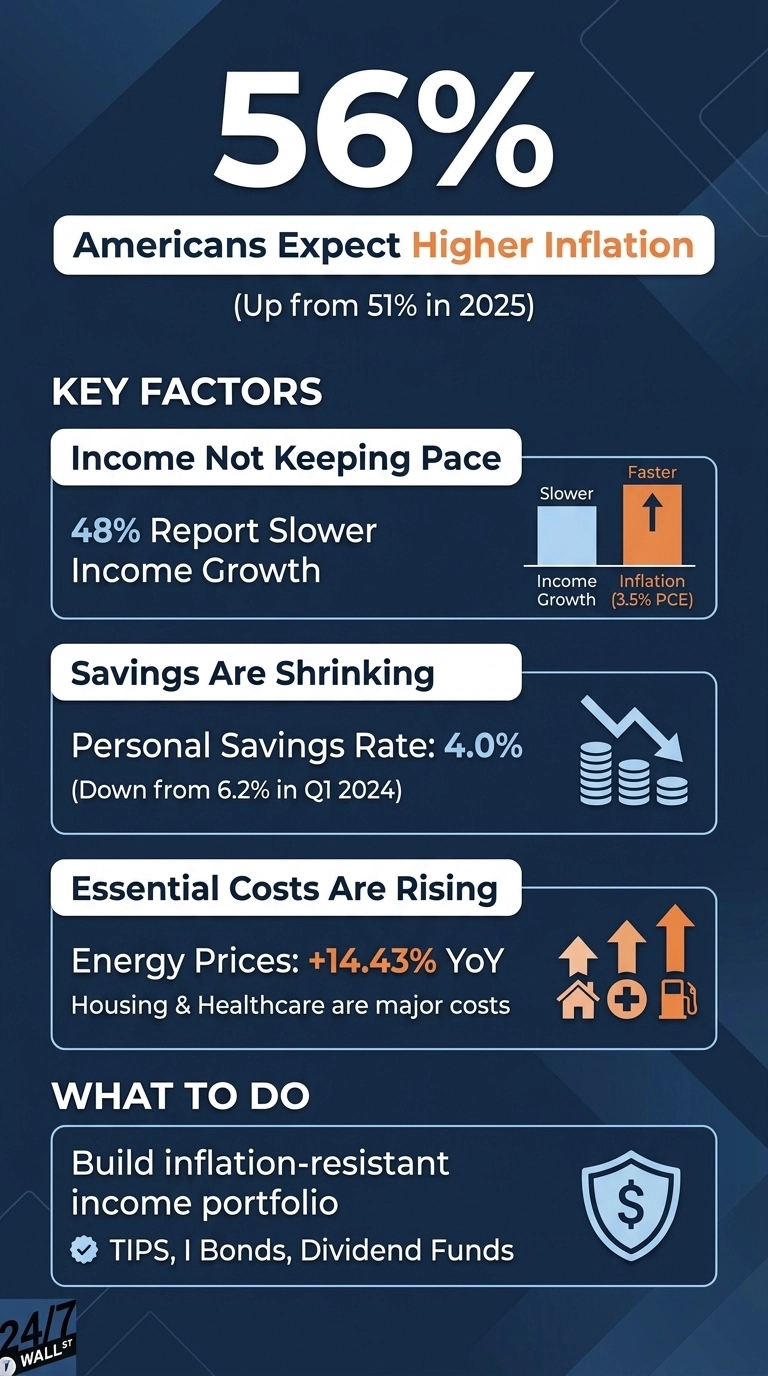
The Northwestern Mutual 2026 Planning & Progress Study lands at a moment when American households are navigating something that feels increasingly personal. Prices are still climbing, savings rates have been drifting lower, and the Federal Reserve has paused after a stretch of cuts that many households were counting on to provide relief. Against that backdrop, it is not surprising that more than half of American adults believe inflation will get worse before it gets better, a share that has grown from the prior year and continues to rise even as some official readings have begun to stabilize.
That anxiety has a clear source as inflation ranks as the single biggest obstacle to financial security in American households, cited by more than four in ten Americans and running well ahead of concerns like lack of savings, personal debt, and healthcare costs, each of which trails by a significant margin. Official price data support the worry.
Both headline and core inflation measures have been running near the top of their recent ranges, and consumer sentiment has followed prices downward into territory typically associated with recessionary psychology. The labor market remains relatively stable, which makes the mood all the more telling. When people feel financially stretched even while employed, the pressure is coming from costs, not paychecks, and that is a harder problem to solve by simply working more.
Why Half of America Is Still Losing the Inflation Race
The income picture adds another layer to the story. The share of Americans reporting their household income is growing more slowly than inflation has improved slightly from the prior year, but nearly half of all households still find themselves on the losing end of that race. The underlying data reflects the same tension. Wages have risen in nominal terms, but the personal savings rate has fallen meaningfully over the past two years, even as disposable income climbed, which means the additional earnings are being absorbed by higher costs rather than building any kind of cushion.
The Categories That Are Hardest to Cut Are the Ones Inflating the Fastest
The squeeze is most visible in the categories where households have the least room to adjust. Housing and healthcare together account for a substantial share of total personal consumption, and both have proven resistant to the kind of relief that lower rates were supposed to deliver. Services inflation has remained sticky across recent months while goods prices have reaccelerated, and energy has added another layer of pressure on top of both. The result is that the categories most difficult to cut from a household budget are the ones inflating the fastest.
Why Safe Investments Are No Longer Playing It Safe
Traditional savings vehicles have not kept pace with that environment. Government bond yields have moved higher following rate cuts, but with headline inflation running where it is, the real return on the safest fixed income available remains thin. That spread, combined with the persistence of service price inflation, helps explain why more than half of Americans admit they are overemphasizing wealth building while underinvesting in protection, a gap that shows up most often among younger adults who feel the pressure of rising costs most acutely.
A Healthy Labor Market That Does Not Feel Like One
The labor market has remained relatively healthy throughout all of this, with unemployment holding within a range that economists generally consider stable and nominal wage growth remaining positive. The disconnect is that neither of those conditions has been enough to produce real gains large enough to offset what shelter, healthcare, and energy costs have taken back. A growing share of household income now flows from indexed government programs rather than from market wages, reflecting how deeply embedded inflationary pressures have become across different income sources.
What an Inflation-Resistant Portfolio Actually Looks Like in 2026
Building a portfolio that can hold its ground against that backdrop typically means pairing growth assets with explicit protection of purchasing power. In the current environment, that conversation tends to include inflation-linked government securities where principal adjusts with price levels, dividend growth equities, and broad income funds that have historically produced cash flow tracking or exceeding inflation, real assets including REITs and commodity exposure that respond directly to the shelter and energy categories driving current readings, and short-duration high-quality credit for yield without meaningful sensitivity to long-rate movements. The composition will vary by household, but the underlying logic is consistent: income that does not keep pace with costs is not doing its job.














 Top Gaining Stocks
 Top Losing Stocks