


Autonomous vehicles (AV) are poised for explosive growth in 2026, with advancements in artificial intelligence (AI) reasoning models and sensor technology enhancing safety and reliability. Regulatory approvals are expanding in major markets, enabling wider commercial deployments. Safety data from existing operations demonstrates lower incident rates compared to human drivers, boosting mainstream acceptance. This transformation will reduce transportation costs, lower emissions, and improve urban mobility.
Uber Technologies (NYSE:UBER | UBER Price Prediction) emerges as the surprising frontrunner. Its ride-hailing platform, serving millions globally, allows seamless integration of autonomous fleets from multiple providers, prioritizing demand aggregation over in-house hardware development.
Alpamayo Accelerates Uber’s AV Ambitions
Uber has shown strong interest in Nvidia‘s (NASDAQ:NVDA) Alpamayo family, unveiled at CES 2026. Alpamayo includes open-source AI models designed for reasoning-based autonomy, tackling long-tail scenarios with chain-of-thought processing.
These tools help self-driving cars think more like humans. Instead of just reacting quickly to common situations (like stopping at a red light), they’re built to handle unusual events — the “long-tail scenarios” — such as a child chasing a ball into the street or construction suddenly blocking a lane. The key is the “chain-of-thought processing,” which means the AI doesn’t just guess what to do, it breaks the problem down step by step, making the car safer in tricky, unpredictable moments.
Sarfraz Maredia, Uber’s global head of autonomous mobility and delivery, stated that handling unpredictable situations remains the crucial challenge, and Alpamayo provides opportunities to advance safe Level 4 deployments. Nvidia lists Uber among mobility leaders supporting Alpamayo for Level 4 autonomy.
Uber also partners with Nvidia on the DRIVE AGX Hyperion 10 platform and DRIVE AV software for Level 4 operations. This includes a joint AI data factory on Nvidia’s Cosmos platform. The collaboration supports Uber’s plan to scale to 100,000 vehicles starting in 2027, with initial vehicles supplied by Stellantis (NYSE:SLTA).
Global Scale and Multi-Partner Ecosystem
Uber operates in over 10,000 cities across 70 countries, with 183 million monthly active users. This vast network generates extensive data for AV routing, pricing, and regulatory compliance. Uber’s strategy is to emphasize partnerships with multiple AV developers.
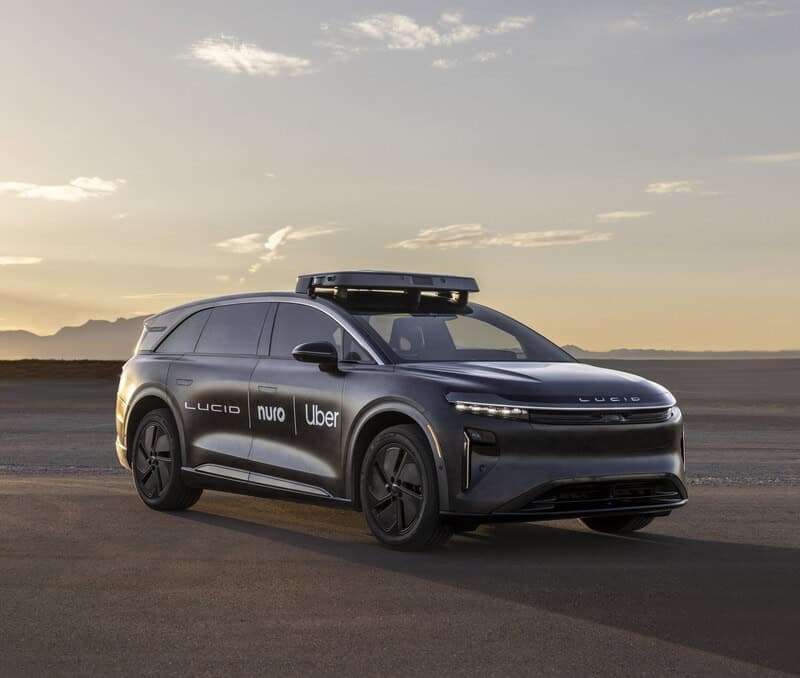
Uber also had its own unveiling at CES. Yesterday, it introduced the vehicles it will be using for its global robotaxi service. In partnership with Lucid Motors (NASDAQ:LCID) and Nuro, the custom vehicle is based on the Lucid Gravity SUV. This vehicle integrates Nuro’s Level 4 system and Nvidia’s DRIVE AGX Thor compute platform. On-road testing began in December, with production starting later this year at Lucid’s Arizona factory and an initial launch planned for the San Francisco Bay Area.
Uber plans to deploy at least 20,000 of these vehicles over several years. It also boasts an extensive lineup of other partners, including Aurora Innovation (NASDAQ:AUR), Motional, Pony AI (NASDAQ:PONY), Wayve, and WeRide (NASDAQ:WRD). This aggregator approach allows Uber to integrate diverse fleets without bearing full ownership costs.
Steep Barriers Create a Competitive Moat
AV development demands massive investments. Industry R&D spending has exceeded $16 billion historically, with ongoing annual costs in the billions for validation and sensors. Per-vehicle sensor suites range from thousands to tens of thousands of dollars. Many OEMs find standalone AV platforms uneconomical due to high customer acquisition costs and low initial utilization. It is just too risky for OEMs to develop their own ecosystem that supports a single brand, particularly when passengers don’t care what car picks them up. Partnering with Uber grants them immediate access to its rider base and operational expertise, improving fleet efficiency and returns.
Key Takeaway
AV technology is advancing rapidly, with reasoning models like Alpamayo enabling safer handling of complex scenarios. The sector, already growing, is set for exponential expansion in 2026 through increased deployments and partnerships.
Uber Technologies’ enormous user base, its collaboration with Nvidia, and a broad partnership roster position it as the one most able to readily and profitably capture this market opportunity.








 Top Gaining Stocks
 Top Losing Stocks