


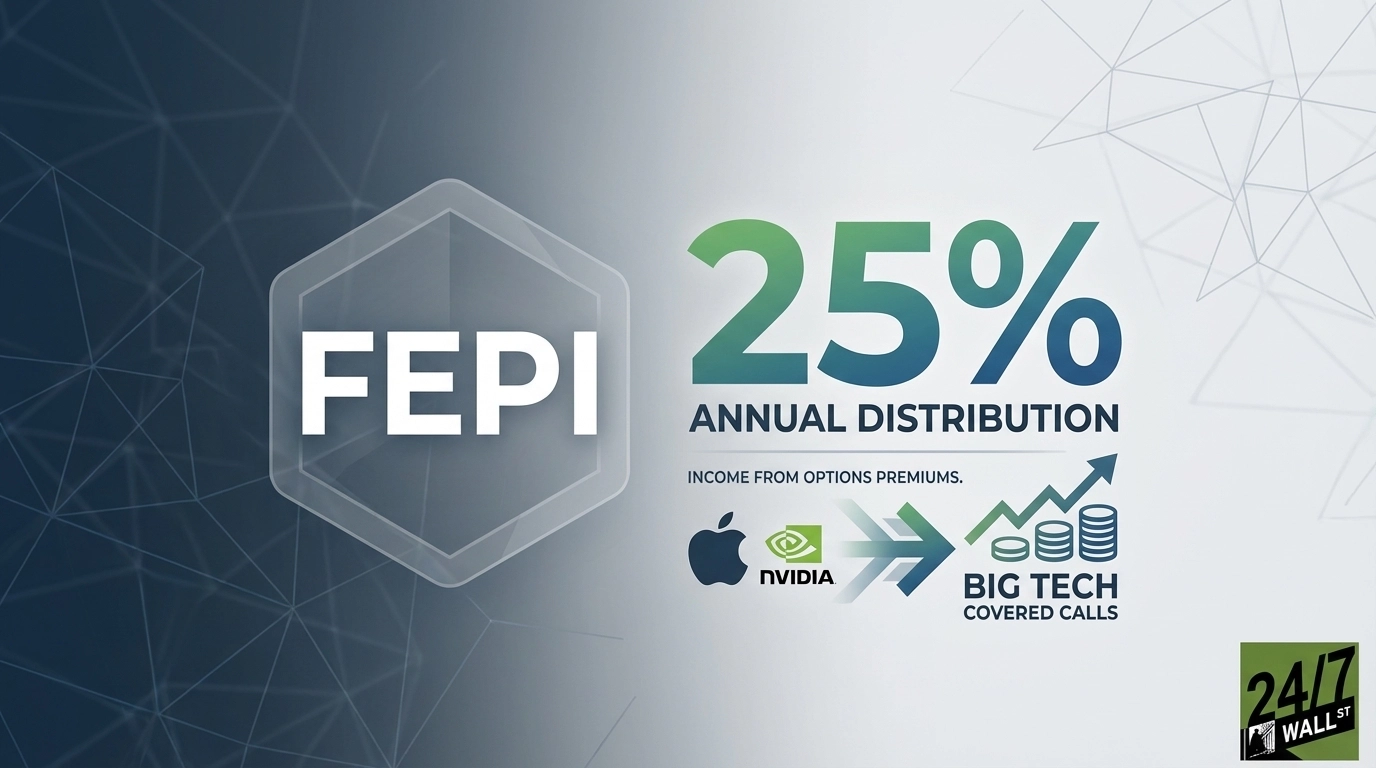
REX FANG & Innovation Equity Premium Income ETF (NYSEARCA:FEPI) delivers a 25% annual distribution from tech stocks that barely pay dividends. The ETF achieves this by selling covered call options on holdings like NVIDIA (NASDAQ:NVDA | NVDA Price Prediction), Apple (NASDAQ:AAPL), and Tesla (NASDAQ:TSLA), collecting premiums distributed to shareholders monthly.
How FEPI Generates Its High Yield
FEPI holds 15 major technology and innovation stocks in roughly equal weight, with positions ranging from 5% to 8% each. Top holdings include Micron Technology (NASDAQ:MU) at 8.2%, Alphabet (NASDAQ:GOOGL) at 7.7%, Amazon (NASDAQ:AMZN) at 7.5%, and Apple at 7%. These companies pay minimal dividends—Apple yields 0.42%, NVIDIA pays 0.03%, and most others pay nothing.
The ETF generates income by writing call options against these holdings. When you sell a covered call, you collect a premium from the buyer in exchange for agreeing to sell your shares at a specific strike price if the stock rises above that level. This strategy transforms low-yielding growth stocks into income generators, but caps upside potential when stocks surge above strike prices.
Distribution Sustainability and Risks
Over the past 12 months, FEPI distributed approximately $11.61 per share through monthly payments ranging from $0.82 to $1.05. These distributions fluctuate based on options market conditions—specifically, how much premium the fund can collect depends on implied volatility and where strike prices are set relative to current stock prices.
The sustainability concern centers on total return. While FEPI delivered 25.7% in distributions over the past year, the ETF’s price gained only 14.9%, bringing total return to roughly 40%. By comparison, the Nasdaq-100 via QQQ (NASDAQ:QQQ) returned 18.35% over the same period. FEPI investors received far more cash income but sacrificed some price appreciation—the cost of selling those call options.
Recent price action shows moderate volatility, with FEPI swinging between $43.01 and $46.89 over the past 30 days. This 9% range reflects the underlying tech stock volatility that makes the covered call strategy viable. Higher volatility means higher option premiums, which supports distribution levels. If tech stocks enter a prolonged low-volatility environment, distribution amounts would likely decline.
The fund’s 66.7% concentration in technology creates sector-specific risk. A sustained tech downturn could pressure both the ETF’s price and its ability to generate attractive premiums. The 0.65% expense ratio is reasonable for an actively managed options strategy.











 Top Gaining Stocks
 Top Losing Stocks